Why Handwritten Grocery Lists Outperform Every App and What That Says About How Memory Actually Works
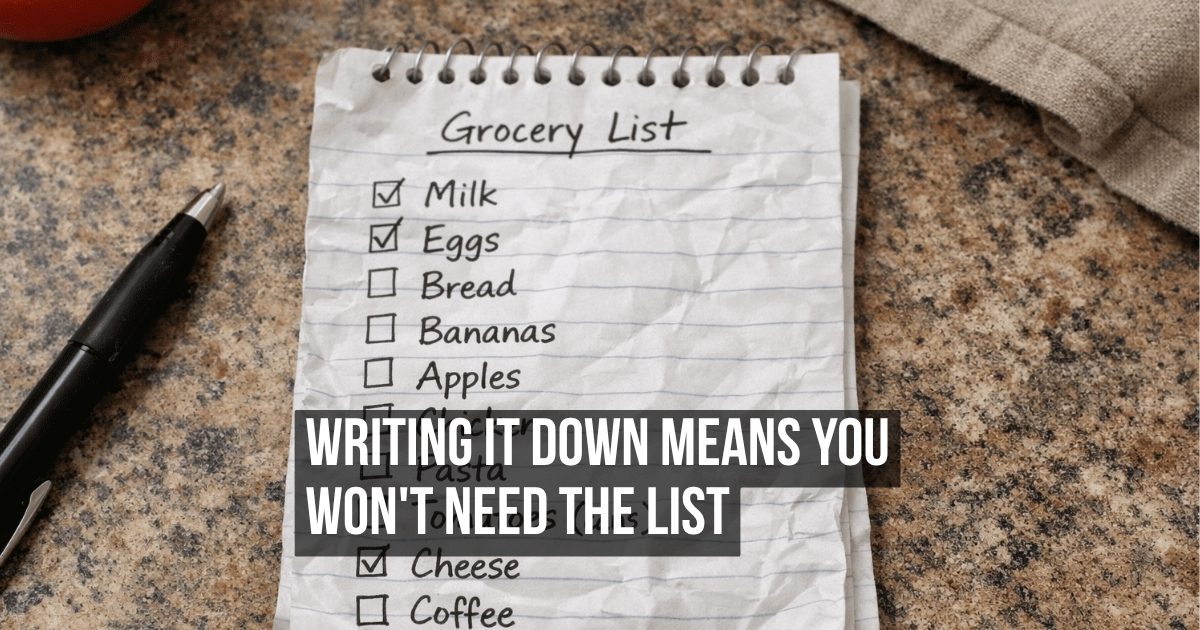
You’re standing in the kitchen, trying to remember whether you need tinned tomatoes. Your phone is in your pocket, loaded with a shopping list app that syncs across devices, sorts by aisle, and checks items off with a satisfying animation. You ignore it. You grab a pen and the back of an envelope and start writing: milk, eggs, tomatoes, pasta, bin bags. The list will be illegible by the time you reach the supermarket. It will crumple in your pocket. You will probably lose it between the car park and the trolley bay. And despite all of that, you will remember more of what was on it than if you had typed the same items into your phone.
The Generation Effect
Cognitive psychologists have documented a phenomenon called the generation effect: information that is actively generated by the learner is remembered significantly better than information passively received. Writing by hand is an act of generation. Each word must be mentally produced, translated into motor commands, and physically inscribed — a process that engages the motor cortex, visual cortex, and language centres simultaneously. Typing on a touchscreen, by contrast, requires only character selection — a recognition task rather than a production task, demanding less cognitive engagement and producing weaker memory encoding.
A 2014 study by researchers Pam Mueller and Daniel Oppenheimer, published in Psychological Science, found that students who took notes by hand retained conceptual information significantly better than those who typed. The handwriting group processed information more deeply because the slower speed of writing forced them to paraphrase and synthesise rather than transcribe verbatim. The same principle applies to grocery lists: writing “tinned tomatoes” by hand involves a micro-act of processing that tapping “tinned tomatoes” on a keyboard does not.
The Encoding Redundancy
Here is the paradox that explains why handwritten lists work even when lost: the act of writing the list is itself the memory aid, not the list itself. The physical process of generating each item — retrieving it from memory, translating it into written form, seeing it appear on paper in your own handwriting — creates an encoding event strong enough that many people can recall most items without consulting the list at all.
Ask anyone who habitually writes shopping lists: how often do you actually look at the list while shopping? Many admit they rarely consult it. The list sits folded in a pocket or at the bottom of the trolley, serving as a safety net rather than an active reference. The writing was the work. The paper is the receipt for work already done.
App-based lists invert this dynamic. Typing into a phone is fast, low-effort, and produces minimal encoding. The list becomes the primary memory store rather than a backup. Without the app, you can’t remember what you needed. The technology that was supposed to support memory has replaced it, creating a dependency that the handwritten list never produced.
Spatial Layout and Visual Distinctiveness
A handwritten list has visual properties that a digital list lacks: the handwriting itself is unique and irregular, each word occupies a distinctive position on the page, and the physical characteristics of the writing (size, pressure, speed) encode contextual information. “Bin bags” written hastily at the bottom of the list in a different pen looks different from “eggs” written neatly at the top. These visual variations create distinctiveness cues that aid recall.
Digital lists present every item in identical font, identical spacing, and identical colour. The uniformity eliminates the visual distinctiveness that would otherwise help you remember individual entries. Research on the von Restorff isolation effect has repeatedly demonstrated that visually distinctive items are recalled more easily than visually uniform ones. Your handwritten list is messy. That mess is a memory feature, not a flaw.
The Ritualistic Dimension
Writing a grocery list is embedded in a domestic ritual: the inventory scan. You open the fridge, check the cupboards, peek into the bathroom cabinet. Each location triggers associated needs. The physical movement through the home environment provides contextual cues that complement the writing process. You remember you need dishwasher tablets because you’re standing at the sink. You remember you need olive oil because you’re looking at the cooking shelf.
Typing a list on your phone while sitting on the sofa lacks this spatial triggering. The phone has no location. It exists in every room and therefore in none. The items you type are retrieved from abstract memory rather than contextual memory, and abstract retrieval is both less reliable and less complete. People who write lists while walking through the kitchen consistently produce longer, more complete lists than those who type from memory while seated elsewhere in the home.
Why the App Wins on Features and Loses on Function
Shopping list apps do things handwritten lists cannot. They share across family members. They organise by store section. They remember frequently purchased items. They never get lost. For household coordination, where multiple people contribute to a shared list across different locations and times, the app is functionally superior. The problem is not what the app does. It is what it prevents: the encoding work that makes the list memorable in the first place.
The app is designed for convenience. Convenience means reducing effort. Reducing effort means reducing cognitive engagement. Reducing cognitive engagement means reducing memory formation. The app solves the wrong problem. The challenge was never “how do I carry a list to the shops?” The challenge was “how do I remember what I need?” Handwriting answers the second question. The app answers only the first, and in doing so, makes the second question harder to answer without the app’s help.
The handwritten grocery list is inefficient, fragile, unshareable, and disorganised. It is also, by every measure cognitive science has devised, a better memory technology than the digital tool designed to replace it. The pen and the envelope won’t sync to the cloud. They don’t need to. The syncing already happened — between your hand and your brain, in the thirty seconds it took to write the list that you’ll probably never look at again.
Something went wrong. Please refresh the page and/or try again.
Help us improve your journey
We use cookies to personalize your experience and understand how you use our site. By clicking 'Yes, I'm in!', you help us show you content you'll actually love. If you prefer to keep things simple, you can stick to the essentials. You can change your mind anytime!
Necessary
Always active
The technical storage or access is strictly necessary for the legitimate purpose of enabling the use of a specific service explicitly requested by the subscriber or user, or for the sole purpose of carrying out the transmission of a communication over an electronic communications network.
Preferences
The technical storage or access is necessary for the legitimate purpose of storing preferences that are not requested by the subscriber or user.
Analytics
The technical storage or access that is used exclusively for statistical purposes.The technical storage or access that is used exclusively for anonymous statistical purposes. Without a subpoena, voluntary compliance on the part of your Internet Service Provider, or additional records from a third party, information stored or retrieved for this purpose alone cannot usually be used to identify you.
Advertising
The technical storage or access is required to create user profiles to send advertising, or to track the user on a website or across several websites for similar marketing purposes.




Leave a Reply