Why Leaving the Dishes Overnight Is Not Laziness and Deserves a Defense
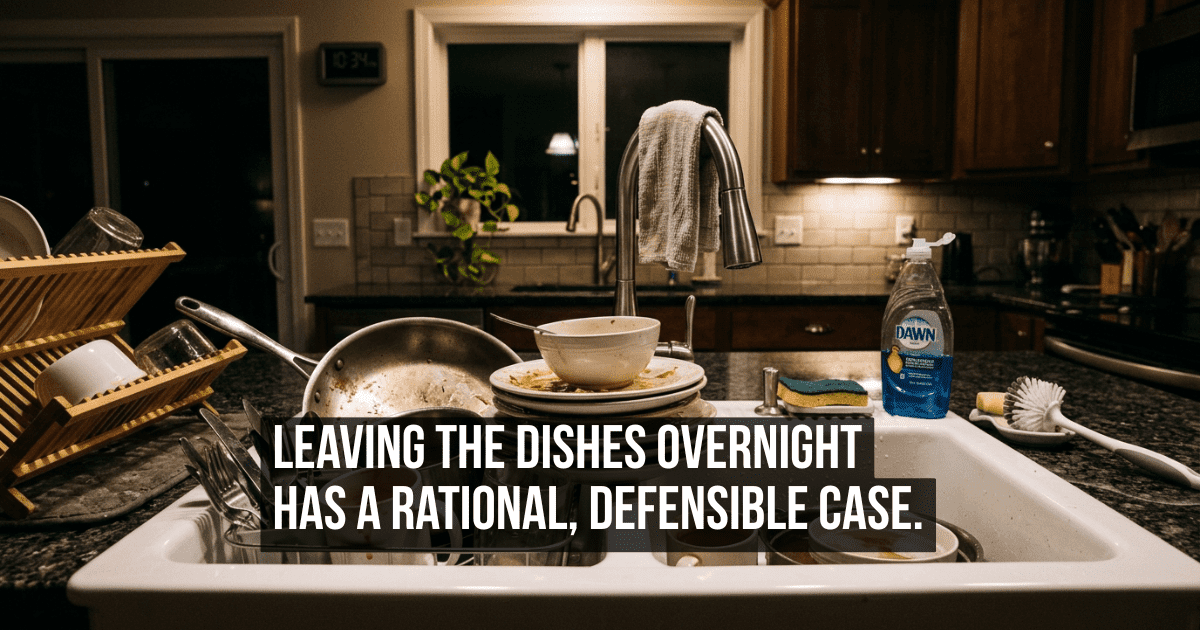
The dinner is finished. The kitchen is warm and the day has been long enough that the idea of washing up now feels disproportionate to whatever benefit it would produce. You look at the dishes. You go to bed. In the morning, the dishes are still there, cold and entirely manageable, and you deal with them in ten minutes before anything else has had a chance to go wrong.
The culture around this is unambiguous. It’s also mostly wrong.
The Moral Weight of a Dirty Plate
Leaving dishes overnight has accumulated a moral gravity entirely disproportionate to its consequences. It’s the kind of domestic decision that sits alongside making the bed and separating recycling in the implicit ledger of what a responsible adult does — not because the evidence for it is compelling, but because the alternative is associated, culturally, with disorder, avoidance, and a general failure of self-management.
None of which follows from the actual behavior. A plate left overnight is a plate that will be washed in the morning. The interval between these events produces, in most cases, no meaningful harm.
The Argument for the Morning
Evening is, for most working adults, the lowest point of the day’s cognitive and physical resources. Decision fatigue is at its daily peak. Energy is at its daily low. The task of washing up, objectively minor, arrives at the worst possible moment for executive function and motivation to align.
Morning arrives with those resources partially restored. The same dishes, under morning conditions, represent a different transaction: a task completed early, a kitchen reset before the day has had a chance to accumulate its own demands. Research on mental restoration during sleep consistently finds that willpower, executive function, and tolerance for effortful tasks all recover during rest. The person who wakes up and deals with the dishes is a better-equipped version of the person who would have dealt with them the night before.
The Shared Kitchen Complication
The defense of overnight dishes weakens in one specific context: shared living. When the kitchen belongs to more than one person, the dish left overnight belongs to the whole household until it’s dealt with. The resource management logic, which works well for a solo kitchen, stops working when the person who encounters the dish in the morning isn’t the person who left it.
The dish isn’t just a dish in that context. It’s a conversation about whose responsibility the kitchen is, deferred until morning. The case for overnight dishes holds when the person doing the deferral is the same person doing the morning. When those are different people, a different negotiation is needed.
The Line Worth Drawing
The defense of leaving dishes overnight is not a defense of leaving dishes for four days, or of a kitchen that has accumulated beyond the point where the morning option remains plausible. The argument is specific: that in the decision between washing up now, when you are depleted, and washing up tomorrow, when you are not, the second option has real merit.
The guilt is cultural. The dishes are manageable. Go to bed.
Something went wrong. Please refresh the page and/or try again.
Help us improve your journey
We use cookies to personalize your experience and understand how you use our site. By clicking 'Yes, I'm in!', you help us show you content you'll actually love. If you prefer to keep things simple, you can stick to the essentials. You can change your mind anytime!
Necessary
Always active
The technical storage or access is strictly necessary for the legitimate purpose of enabling the use of a specific service explicitly requested by the subscriber or user, or for the sole purpose of carrying out the transmission of a communication over an electronic communications network.
Preferences
The technical storage or access is necessary for the legitimate purpose of storing preferences that are not requested by the subscriber or user.
Analytics
The technical storage or access that is used exclusively for statistical purposes.The technical storage or access that is used exclusively for anonymous statistical purposes. Without a subpoena, voluntary compliance on the part of your Internet Service Provider, or additional records from a third party, information stored or retrieved for this purpose alone cannot usually be used to identify you.
Advertising
The technical storage or access is required to create user profiles to send advertising, or to track the user on a website or across several websites for similar marketing purposes.




Leave a Reply