Museums Became Instagram Content Farms and Art Died in the Process of Becoming a Photo Opportunity
We’re not experiencing art anymore—we’re photographing proof we were near it.
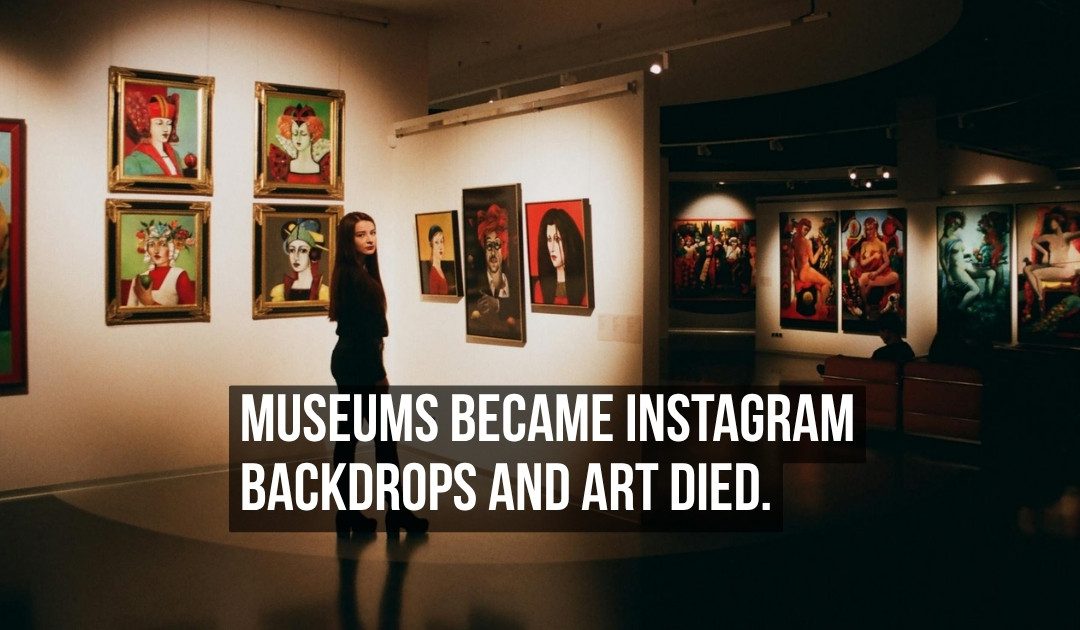
Walk through any major museum and watch the visitors. They’re not looking at art—they’re photographing it. Not studying, not contemplating, not experiencing. Just capturing images they’ll scroll past later, accumulating proof of cultural engagement without any actual engagement. The museum has transformed from space for encountering art into content generation facility for social media.
This shift isn’t superficial. When primary relationship with art is photographic documentation for social validation, the art itself becomes irrelevant. What matters is the selfie proving you were there, the shot that signals you’re cultured, the backdrop for personal branding. Art has become prop in performance of sophistication. This dynamic is part of why AI art exposes how little society values artists—when art is treated primarily as visual content, what it communicates about artists’ actual value becomes clear.
The Experience Replacement
Museums accommodate this by designing installations optimized for photography rather than contemplation. Infinity mirror rooms, immersive color fields, interactive exhibits—all engineered to be photogenic rather than meaningful. The goal is creating shareable moments, not artistic experiences.
This fundamentally changes what art in museums can be. Challenging work that requires sustained attention doesn’t photograph well and doesn’t generate shares. Contemplative pieces that reveal themselves slowly are skipped for visually immediate spectacles. The Instagrammable becomes curating criterion, shaping what gets exhibited and how.
The accommodation also changes visitor behavior. Museums encourage photography, provide perfect lighting for it, design spaces with photo opportunities. The institution validates using art as backdrop rather than subject of attention. The photograph becomes the point; the art is just scenery.
The Status Performance
The museum photograph serves specific social function: it demonstrates you’re person who visits museums, who engages with culture, who has refined tastes. The content of what you’re photographing matters less than the fact of being photographed in culturally validated space.
This transforms museum attendance from cultural engagement into status ritual. You’re not there for art—you’re there for social proof of being there. The visit becomes another item in lifestyle curation, documented and shared like restaurant meals and travel destinations.
The performance pressure also affects what people photograph. You don’t document art that interests you—you document art that will impress others. The famous pieces everyone recognizes. The installations everyone else is photographing. Your museum experience is determined by what will perform best on your feed.
The Attention Collapse
The photographic relationship with art also destroys possibility of actual engagement. You can’t contemplate art while simultaneously documenting it. The mental mode required for photography—composition, lighting, capturing—precludes the receptive attention art demands.
Studies show people remember art they’ve photographed less well than art they’ve simply viewed. The act of photographing substitutes for memory formation. You’ve captured external record, so internal processing doesn’t occur. The experience is outsourced to device and never actually happens for you.
This creates paradox: people photograph art to remember the experience, but photographing prevents having the experience worth remembering. They leave with documentation of event that didn’t happen for them psychologically.
The Art Market Corruption
The Instagrammability imperative also corrupts art market. Artists must create work that photographs well to gain gallery attention. Curators select exhibitions based partially on social media potential. The entire ecosystem shifts toward producing content for Instagram rather than art for human experience. The downstream consequences of this for artistic training are traced in art schools produce graphic designers—when the market rewards visual content over artistic depth, education follows.
This affects what kind of art succeeds. Large-scale, visually immediate, brightly colored, geometrically interesting—these properties make good photographs. Subtle, complex, requiring sustained viewing, challenging—these don’t generate shares, so they’re selected against by market forces.
Young artists especially feel pressure to create Instagrammable work. Their success depends on social media presence, which depends on work that photographs well. The career incentives push toward creating backdrops for selfies rather than artwork for contemplation.
The Demographic Divide
The museum-as-backdrop phenomenon also skews younger and wealthier. Young adults with social media presence treat museums as content opportunities. Wealthy tourists photograph famous art to document their travel. Meanwhile, those who might engage with art seriously find spaces increasingly dominated by photography performance.
This changes who feels museums are for. If you’re there to actually look at art, you’re increasingly minority surrounded by people treating space as photo studio. The social pressure either converts you to photographer or makes you leave. For parallel effects on how physical spaces have been homogenized by the same aesthetic forces, see every new building looks the same.
The Lost Possibility
What’s disappeared is the transformative potential of art encounter. The experience of standing before something that changes how you see, that requires you to slow down, that can’t be consumed quickly or photographed adequately. This kind of encounter requires presence that photography demolishes.
Museums could resist this—prohibiting photography, designing exhibitions that defeat cameras, prioritizing work that requires sustained attention. Some do. But market pressures favor accommodating Instagram culture because it drives attendance and revenue.
The alternative is acknowledging that photographing art isn’t engaging with it, that museum visits spent documenting rather than experiencing are fundamentally empty, that social media validation isn’t substitute for genuine aesthetic experience.
Art became backdrop when we decided proving we saw it mattered more than actually seeing it. And museums became complicit by prioritizing shareable spectacle over meaningful encounter. What we’re losing isn’t just art—it’s the capacity to be present with anything that can’t be immediately documented and shared.
Something went wrong. Please refresh the page and/or try again.
Help us improve your journey
We use cookies to personalize your experience and understand how you use our site. By clicking 'Yes, I'm in!', you help us show you content you'll actually love. If you prefer to keep things simple, you can stick to the essentials. You can change your mind anytime!
Necessary
Always active
The technical storage or access is strictly necessary for the legitimate purpose of enabling the use of a specific service explicitly requested by the subscriber or user, or for the sole purpose of carrying out the transmission of a communication over an electronic communications network.
Preferences
The technical storage or access is necessary for the legitimate purpose of storing preferences that are not requested by the subscriber or user.
Analytics
The technical storage or access that is used exclusively for statistical purposes.The technical storage or access that is used exclusively for anonymous statistical purposes. Without a subpoena, voluntary compliance on the part of your Internet Service Provider, or additional records from a third party, information stored or retrieved for this purpose alone cannot usually be used to identify you.
Advertising
The technical storage or access is required to create user profiles to send advertising, or to track the user on a website or across several websites for similar marketing purposes.




Leave a Reply