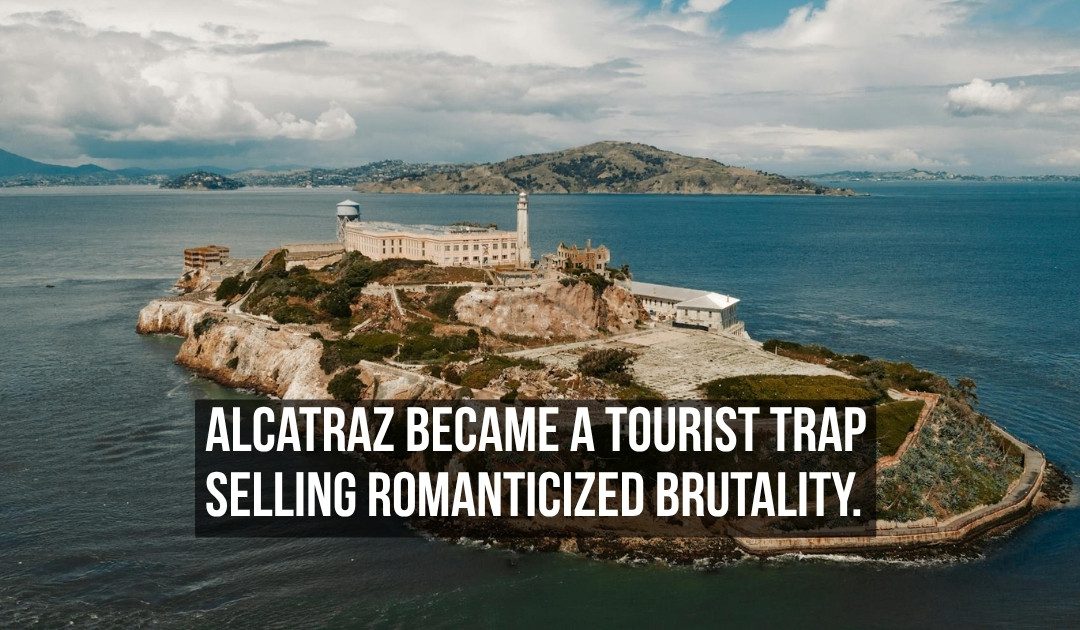
Alcatraz Became a Tourist Trap That Sells Romanticized Brutality to Visitors Who Leave Without Questioning Any of It
We turned a monument to human cruelty into family entertainment, and nobody finds that strange.
Over a million people annually pay to visit Alcatraz, wandering through cells where men spent decades in isolation, listening to audio tours that dramatize escape attempts, posing for photos in spaces designed to break human spirits. The former maximum-security prison has been rebranded as must-see San Francisco attraction, complete with gift shops selling novelty items themed around incarceration.
What’s remarkable isn’t that the prison exists as historical site—it’s how thoroughly we’ve sanitized its brutality into entertainment. Alcatraz tours don’t confront visitors with the horror of the carceral state. They offer thrilling narratives about notorious criminals and daring escapes, transforming systematic dehumanization into adventure story you can experience for $41.
The Sanitized Horror
The Alcatraz experience is carefully curated to emphasize intrigue over suffering. You hear about Al Capone and the Birdman, famous escape attempts, the prison’s reputation as inescapable fortress. What you don’t meaningfully confront is what it meant to spend years in a six-by-nine cell, subjected to arbitrary punishment, denied basic human contact, systematically stripped of dignity.
This selective storytelling serves obvious function—horror doesn’t sell family tickets. So the tour focuses on elements that thrill rather than disturb. The isolation cells become interesting historical details rather than torture chambers. The whole experience gets framed as glimpse into fascinating past, not confrontation with ongoing reality of mass incarceration.
The audio tour even uses dramatic reenactments with sound effects, turning prisoner experiences into immersive theater. You’re not learning about human suffering—you’re consuming entertainment product that happens to be set in former site of that suffering. This is the same dynamic described in museums became Instagram content farms—when visitor engagement becomes the primary metric, historical meaning gets curated away.
The Criminal Fascination
The emphasis on famous inmates reveals another troubling aspect: we’re not interested in incarceration as system but in criminals as characters. Al Capone, Machine Gun Kelly, Robert Stroud—these names sell tickets because they’ve been mythologized into larger-than-life figures whose imprisonment becomes part of their legend rather than examination of justice.
This celebrity framing obscures that most Alcatraz inmates weren’t notorious gangsters but regular prisoners transferred for disciplinary reasons. Their stories don’t make compelling tourist content, so they’re largely erased. What remains is curated selection of “interesting” criminals whose presence justifies visiting without requiring thought about what imprisonment actually means.
The fascination also reflects cultural obsession with true crime that treats real violence and suffering as entertainment genre. We consume prisoner stories the same way we consume murder podcasts—as thrilling narratives divorced from actual human cost.
The Escape Mythology
The obsessive focus on escape attempts—particularly the famous 1962 attempt—further romanticizes the experience. Visitors learn detailed information about how inmates dug through concrete, created dummy heads, built makeshift rafts. The ingenuity gets celebrated as if it were heist movie rather than desperate attempt to flee inhumane conditions.
This framing makes heroes of escapees while avoiding why they were so desperate to escape. The conditions that made men willing to risk death in freezing bay water get treated as background detail rather than central horror. The escape becomes puzzle to admire rather than indictment of the system they were fleeing.
The Contemporary Disconnect
Perhaps most troubling is how Alcatraz tourism exists in complete disconnection from current mass incarceration crisis. Visitors tour a closed prison as historical curiosity while the United States currently incarcerates more people than any country in history, often in conditions as brutal as Alcatraz ever was.
The historical framing allows treating incarceration as past problem we’ve evolved beyond, when actually we’ve just expanded and modernized it. Alcatraz closed not because we decided isolation and punishment were inhumane but because the facility became too expensive to maintain. The practices just moved elsewhere, out of tourist view. This aesthetic displacement of reality mirrors what every new building looks the same describes—the flattening of history into surface, where the appearance of engagement with something substitutes for actual engagement.
This disconnect serves ideological function. If Alcatraz is safely in the past, you can tour it without confronting that the same brutality continues in facilities across the country. The prison becomes museum piece rather than reminder of ongoing systemic violence.
The Moral Contradiction
There’s fundamental contradiction in paying for entertainment access to site of human suffering. We wouldn’t tour active prisons as casual sightseeing—the visible cruelty would be too uncomfortable. But add historical distance and suddenly it becomes acceptable family activity.
This reveals that our objection isn’t to the cruelty itself but to witnessing it actively. Once suffering is safely historical, it becomes consumable. The time gap provides moral permission to treat serious site as entertainment venue.
The gift shop crystallizes this contradiction. You can buy Alcatraz t-shirts, mugs, postcards—merchandise commemorating systematic human degradation as if it were just another San Francisco landmark equivalent to the Golden Gate Bridge.
The Missing Reckoning
What Alcatraz tourism most thoroughly avoids is using the site to prompt serious examination of incarceration. Instead of confronting visitors with questions about justice, punishment, rehabilitation, and human dignity, it offers sanitized historical narrative that demands nothing.
A meaningful Alcatraz experience would connect historical brutality to present systems, would force examination of why we imprison people and what imprisonment does to them, would challenge visitors to reckon with their complicity in ongoing carceral violence. Instead, it offers entertaining afternoon out that requires no uncomfortable reflection.
We turned Alcatraz into tourist attraction because we can profit from sanitized brutality while avoiding confrontation with its continuation. The prison became entertainment the moment we decided its history was more valuable than its lessons.
Something went wrong. Please refresh the page and/or try again.
Help us improve your journey
We use cookies to personalize your experience and understand how you use our site. By clicking 'Yes, I'm in!', you help us show you content you'll actually love. If you prefer to keep things simple, you can stick to the essentials. You can change your mind anytime!
Necessary
Always active
The technical storage or access is strictly necessary for the legitimate purpose of enabling the use of a specific service explicitly requested by the subscriber or user, or for the sole purpose of carrying out the transmission of a communication over an electronic communications network.
Preferences
The technical storage or access is necessary for the legitimate purpose of storing preferences that are not requested by the subscriber or user.
Analytics
The technical storage or access that is used exclusively for statistical purposes.The technical storage or access that is used exclusively for anonymous statistical purposes. Without a subpoena, voluntary compliance on the part of your Internet Service Provider, or additional records from a third party, information stored or retrieved for this purpose alone cannot usually be used to identify you.
Advertising
The technical storage or access is required to create user profiles to send advertising, or to track the user on a website or across several websites for similar marketing purposes.




Leave a Reply