The Obsession With Organizing Everything Is Control Anxiety Dressed Up as Productivity and It Never Actually Helps
Organizing your environment doesn’t organize your life.
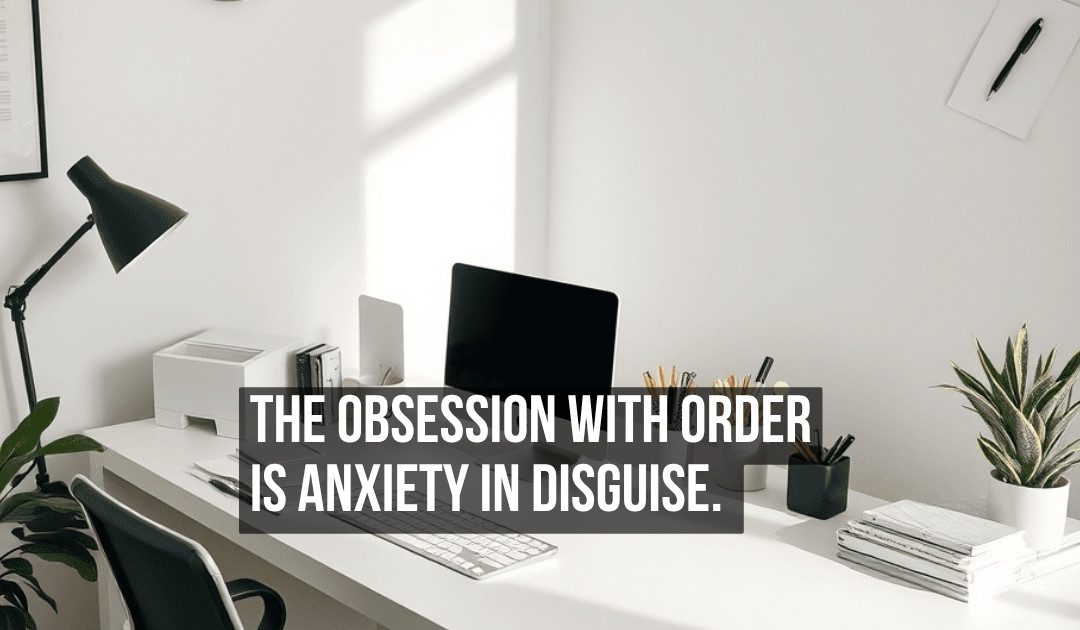
The contemporary fixation on order—minimalist spaces, elaborate organizational systems, everything in its designated place—presents itself as practical efficiency. What it more often represents is attempt to create sense of control in lives that feel fundamentally chaotic. The orderly environment provides visible evidence that you have things under control, even when you don’t.
This matters because the pursuit of order can become displacement activity. Instead of addressing the actual sources of chaos—overwhelming work demands, fractured attention, existential uncertainty—you reorganize your closet. The activity feels productive while avoiding the real problems, which can’t be fixed through better storage solutions.
The Aesthetic Trap
Order has also become aesthetic performance, particularly visible in social media culture. The perfectly organized pantry, the color-coordinated closet, the minimalist desk—all photographed and shared as lifestyle content. The order exists primarily to be documented, suggesting its function is signaling rather than utility.
This performative dimension creates pressure to maintain visible order regardless of whether it actually improves function. You’re not organizing for efficiency; you’re organizing for the appearance of having your life together. The aesthetic of control becomes more important than actual control.
What’s particularly exhausting about performative order is that it requires constant maintenance. The perfect organization photographed today will be disrupted by tomorrow’s normal use. Maintaining the aesthetic requires perpetual reorganization, creating work that serves no purpose beyond maintaining appearances.
The Displacement Function
Order-seeking also functions as productive procrastination. When faced with difficult tasks or unclear problems, organizing something concrete provides sense of achievement without addressing underlying issues. You can’t control your career trajectory, but you can control your desk arrangement. This is the same neurological loop explored in Overthinking and Inaction Are the Same Loop — the mind substitutes manageable activity for the harder, less certain work.
This creates a trap where order-seeking becomes refuge from harder work. The organized environment makes you feel productive while keeping you from the messy, difficult tasks that actually matter. You’ve created perfect conditions for work while avoiding doing the work.
The orderliness can also substitute for other forms of control. If your work life is chaotic, you might obsessively order your home. If relationships are messy, you might focus on organizing possessions. The external order compensates for internal disorder, but doesn’t actually resolve it.
The Anxiety Indicator
Compulsive ordering often correlates with anxiety. When life feels overwhelming, creating small ordered spaces provides brief relief. The activity itself is calming—sorting, arranging, systematizing. The result is tangible evidence of control in otherwise uncontrollable circumstances.
But this relief is temporary and doesn’t address the sources of anxiety. You feel better briefly after organizing, then the underlying anxiety returns because the actual problems remain. This creates cycles where you repeatedly reorganize as anxiety management, never addressing what’s causing the anxiety. Anxiety about the future operates by a similar logic: future anxiety is often procrastination in disguise, a way of feeling active while staying still.
The pursuit of order can also mask recognition of the anxiety itself. You’re not anxious; you just prefer orderly spaces. You’re not avoiding difficult emotions; you’re being productive through organization. The framing allows avoidance of psychological work under guise of practical activity.
The Diminishing Returns
Like most optimization, order-seeking faces diminishing returns. Initial organization provides real benefit—finding things becomes easier, space feels calmer, efficiency improves. But each additional level of systematization yields less practical benefit while requiring more maintenance effort.
Eventually you reach a point where maintaining order requires more effort than the disorder cost in the first place. The elaborate organizational system needs constant management. The perfect arrangement is disrupted by normal use and must be restored. You’re working harder to maintain order than the order actually saves. Productivity and procrastination are neurologically identical — which means the harder you push to maintain the system, the more resistance builds underneath it.
The Mess Permission
What’s often needed isn’t better organization but permission for appropriate disorder. Some mess is productive. Some chaos is creativity in process. Some disorganization is normal life being lived rather than constantly performed.
The perfectly ordered space often indicates a space not being fully used. Real work creates mess. Actual life generates disorder. The pristine organization suggests either constant maintenance labor or lack of actual activity—neither particularly desirable.
This means accepting that functional spaces contain some disorder, that not everything needs a perfect system, that some areas can remain messy without catastrophe. The alternative to constant ordering isn’t chaos—it’s accepting reasonable disorder as normal.
The Control Illusion
Order provides powerful illusion of control precisely because it’s one area where you can actually control outcomes. You can make your space orderly even when you can’t make your life orderly. But the illusion is dangerous if it substitutes for addressing real lack of control over meaningful areas.
The perfectly organized closet doesn’t fix your overwhelming job. The immaculate desk doesn’t resolve your relationship problems. The color-coded bookshelf doesn’t address your existential uncertainty. The order is real, but its significance is overestimated.
What remains important is recognizing when order-seeking serves function and when it serves avoidance. Sometimes organizing genuinely improves life. Sometimes it’s anxiety management disguised as productivity. And sometimes it’s just displacement activity that keeps you from doing harder, messier work that actually matters.
Something went wrong. Please refresh the page and/or try again.
Help us improve your journey
We use cookies to personalize your experience and understand how you use our site. By clicking 'Yes, I'm in!', you help us show you content you'll actually love. If you prefer to keep things simple, you can stick to the essentials. You can change your mind anytime!
Necessary
Always active
The technical storage or access is strictly necessary for the legitimate purpose of enabling the use of a specific service explicitly requested by the subscriber or user, or for the sole purpose of carrying out the transmission of a communication over an electronic communications network.
Preferences
The technical storage or access is necessary for the legitimate purpose of storing preferences that are not requested by the subscriber or user.
Analytics
The technical storage or access that is used exclusively for statistical purposes.The technical storage or access that is used exclusively for anonymous statistical purposes. Without a subpoena, voluntary compliance on the part of your Internet Service Provider, or additional records from a third party, information stored or retrieved for this purpose alone cannot usually be used to identify you.
Advertising
The technical storage or access is required to create user profiles to send advertising, or to track the user on a website or across several websites for similar marketing purposes.




Leave a Reply