The Wrong People Are Panicking About AI While the Right People Are Already Being Replaced Without Anyone Noticing
White-collar workers panic about automation while the actually automatable jobs face no such anxiety—revealing who really controls the narrative.
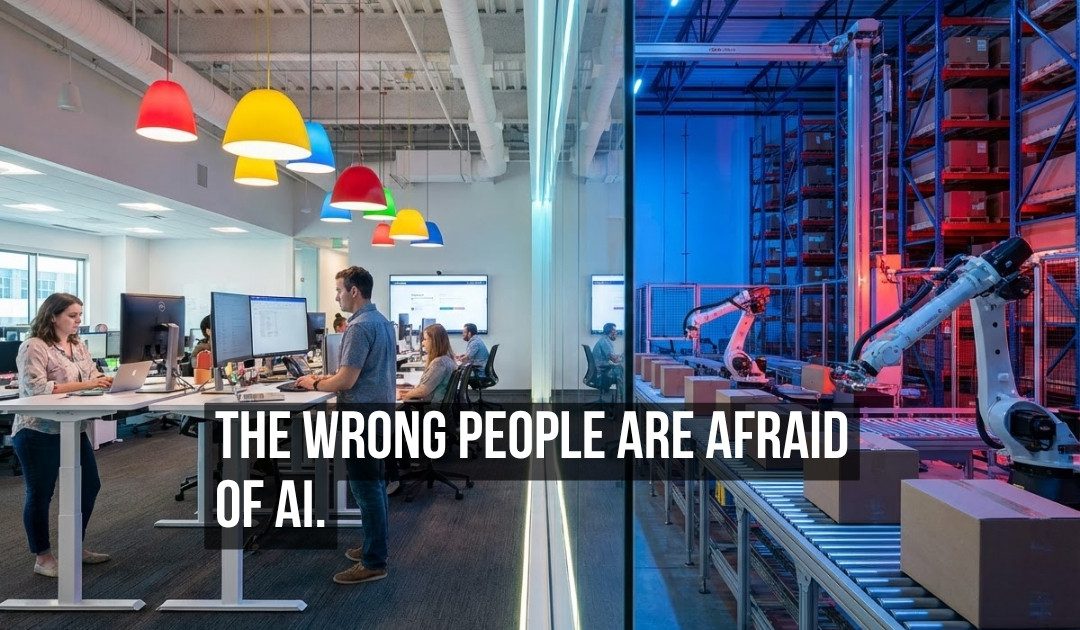
The AI panic is almost exclusively happening in professions least threatened by automation. Journalists, writers, designers, consultants, academics—these knowledge workers are flooding discourse with existential dread about AI replacing them. Meanwhile, the workers whose jobs are actually being automated right now—warehouse workers, call center employees, truck drivers, retail clerks—aren’t leading the conversation about job displacement. They’re just being displaced.
This reveals something strange: AI anxiety correlates inversely with actual automation risk. The jobs hardest to automate are panicking. The jobs being automated are silent. The paradox exposes that the AI debate isn’t really about job loss—it’s about status anxiety in professions unaccustomed to feeling economically vulnerable. This connects directly to what working harder won’t stop AI replacement argues—the response most people are primed for (work harder, skill up) is exactly wrong for what’s actually happening.
The Automation Reality
Look at which jobs are actually being eliminated by automation. Amazon warehouses run with minimal human workers. Self-checkout replaces cashiers. Automated customer service handles most calls. Trucking is rapidly automating. Manufacturing has been automated for decades. These are real job losses happening now, affecting millions of workers.
Yet these workers aren’t dominating AI discourse. They’re not writing think pieces about automation anxiety, not podcasting about their fears, not organizing conferences about AI’s labor implications. The conversation is almost entirely driven by educated professionals whose jobs are actually quite difficult to automate.
This creates bizarre situation where the people talking loudest about AI job displacement are those least affected by it, while those most affected are largely absent from the conversation. The discourse is shaped by professional class anxieties rather than actual automation impacts. This is the argument of AI art exposes how little society values artists—the concern isn’t really about economic justice, it’s about the specific identity threat to people who built careers on being irreplaceable.
The Replaceability Paradox
What AI can currently do well—repetitive tasks, pattern recognition, data processing, physical manipulation in structured environments—describes precisely the work already being automated. What AI struggles with—complex reasoning, ambiguous problem-solving, creative synthesis, context-dependent judgment—describes the work of the professionals panicking about replacement.
The writer afraid AI will replace them is engaging in exactly the kind of complex, context-dependent creative work AI can’t do well. The warehouse worker being replaced by robots was doing exactly the kind of structured, repetitive physical work AI excels at. Yet the writer is terrified while the warehouse worker was given no time to be terrified before being displaced.
The paradox suggests the fear isn’t proportional to actual risk. It’s proportional to whether you’re accustomed to economic vulnerability. The professional class is experiencing for the first time what working class has experienced for decades—the threat of technological unemployment. The novelty makes it feel catastrophic even when the actual risk is lower.
The Voice Asymmetry
The discourse asymmetry also reflects who has platforms. Journalists can write about their AI fears in major publications. Academics can publish papers about automation anxiety. Writers can tweet their concerns to large audiences. The professionally adjacent have media access to vocalize their worries.
Warehouse workers don’t have op-ed columns. Retail clerks aren’t invited on podcasts to discuss automation. Truck drivers aren’t publishing essays about their displacement fears. Their experiences of actual automation happen without shaping public discourse because they lack institutional platforms.
This creates feedback loop where AI anxiety literature is written by, for, and about the professional class, making their specific concerns seem universal while actual automation victims remain invisible in the conversation they should be centering. For the deeper structural argument, see AI anxiety is a smokescreen.
The Status Threat
What the professional class is really afraid of isn’t unemployment—it’s status loss. These are people whose identity and social position depend on their knowledge work being valuable and difficult to replicate. AI threatens not their income (most have resources to weather job transitions) but their sense of being irreplaceably skilled.
The warehouse worker never had occupational status to lose. Their work was always seen as replaceable, always compensated accordingly, always treated as temporary until better opportunities appeared. Automation confirms what was already true about how their labor is valued.
But the journalist who built identity around irreplaceable expertise in synthesis and communication faces existential threat if AI can do similar work. Even if AI is worse at it, even if humans remain necessary, the mere possibility of replacement destabilizes an identity built on being uniquely valuable.
The Preparation Gap
The professional class also has resources to prepare for AI disruption that displaced workers never had. They can retrain, they have savings, they have networks, they have credentials signaling general competence. Their AI anxiety is existential but not immediately economic.
The workers already being automated had none of these buffers. They couldn’t afford retraining, had no savings cushion, lacked networks opening alternative employment, possessed skills specific to jobs being eliminated. Their displacement is immediate economic catastrophe, not theoretical future concern.
Yet the conversation treats professional AI anxiety as the serious version while actual current displacement is barely mentioned. The ability to articulate fear and be heard itself reflects the privilege that makes the fear less materially consequential.
The Political Misdirection
The focus on professional class AI concerns also misdirects policy attention. We debate whether AI should be allowed to write articles when we should be addressing that automation is eliminating millions of working-class jobs without adequate social support systems.
The misdirection serves professional class interests. If AI policy focuses on protecting knowledge work, working-class automation continues unregulated. The workers being displaced now get no protection while policies form around hypothetical future displacement of professionals.
This is particularly visible in proposed AI regulations that emphasize things like copyright protection for creative workers while ignoring need for displaced worker support, retraining programs, or automation taxes funding social safety nets. The regulation protects professional class concerns while working class faces automation without protection.
The Narrative Control
What the paradox most clearly reveals is who controls narrative about technological change. The story of AI is being told by people it hasn’t significantly affected, shaping policy debates around their specific anxieties while actual automation victims remain outside the conversation.
This isn’t new—it’s how technological change has always been discussed. The people with platforms narrate their concerns as universal while others experience the changes without voice. The novelty is that this time the narrators are experiencing even mild version of what they previously reported on others experiencing without much concern.
The professional class afraid of AI is experiencing fraction of economic anxiety that working class has lived with for decades, and discovering it’s terrifying. But rather than recognizing this anxiety as long-standing reality for others, they’re treating it as unprecedented crisis requiring immediate attention—to their specific concerns, naturally.
The Missing Solidarity
The real story is that AI threatens nearly everyone’s economic security to varying degrees at different timeframes. The workers being automated now and the professionals worried about future automation have common interest in social systems that protect everyone from technological displacement.
But the discourse doesn’t build that solidarity. Instead, it positions professional concerns as more serious because they can articulate them better, while treating current working-class displacement as inevitable economic adjustment. The separation prevents collective response to shared vulnerability.
The people most afraid of AI taking their jobs are the ones AI can’t replace. The people AI is replacing weren’t given time to be afraid—they’re just gone. And the people still talking about AI mostly belong to the first group, ensuring the conversation never addresses the reality the second group is living.
Something went wrong. Please refresh the page and/or try again.
Help us improve your journey
We use cookies to personalize your experience and understand how you use our site. By clicking 'Yes, I'm in!', you help us show you content you'll actually love. If you prefer to keep things simple, you can stick to the essentials. You can change your mind anytime!
Necessary
Always active
The technical storage or access is strictly necessary for the legitimate purpose of enabling the use of a specific service explicitly requested by the subscriber or user, or for the sole purpose of carrying out the transmission of a communication over an electronic communications network.
Preferences
The technical storage or access is necessary for the legitimate purpose of storing preferences that are not requested by the subscriber or user.
Analytics
The technical storage or access that is used exclusively for statistical purposes.The technical storage or access that is used exclusively for anonymous statistical purposes. Without a subpoena, voluntary compliance on the part of your Internet Service Provider, or additional records from a third party, information stored or retrieved for this purpose alone cannot usually be used to identify you.
Advertising
The technical storage or access is required to create user profiles to send advertising, or to track the user on a website or across several websites for similar marketing purposes.




Leave a Reply