How Sunglasses Became a Tool for Social Invisibility as Much as Protection From the Sun
Sunglasses block light. That is their stated function, their commercial category, and the reason for their original invention — Sam Foster sold the first mass-market sunglasses at Woolworth’s on Atlantic City boardwalk in 1929, specifically to protect eyes from the sun’s glare. Optically, they are a straightforward product. Socially, they became something considerably more complex within a few decades of their mass adoption, and the social function has now so thoroughly overtaken the optical one that sunglasses worn indoors, at night, in climates without significant solar glare, attract neither comment nor confusion.
What sunglasses do socially has to do with eyes, and what eyes do socially is one of the most studied topics in the psychology of human communication.
The Window That Looks Both Ways
Eye contact is among the most powerful social signals available to humans. Research across cultures and contexts consistently identifies mutual gaze as a regulator of dominance, intimacy, and engagement: who looks at whom, for how long, and who looks away first, communicates hierarchy, attraction, and relative social comfort in real time. The person who can sustain eye contact with composure signals confidence; the person who cannot signals discomfort, deference, or anxiety.
The eyes also reveal involuntary physiological responses that are difficult to control: pupil dilation indicating arousal or interest, rapid blinking indicating stress, gaze aversion indicating discomfort with what is being seen or said. These signals operate below the level of deliberate social management, which is precisely what makes covering them socially significant.
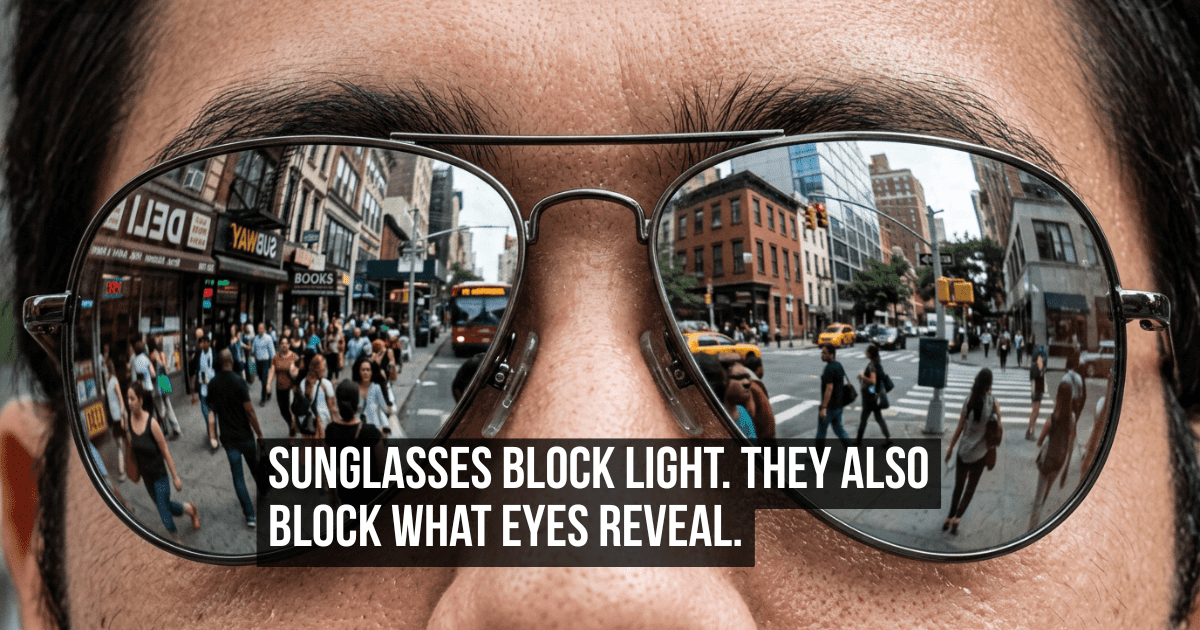
Sunglasses block this channel almost completely. The person wearing them can see; they cannot be seen. They can observe the social environment, track faces, monitor gaze patterns, without providing any reciprocal information about their own attention or emotional state. This asymmetry is not a side effect of the protective function. For many uses, it is the function.
The Celebrity Infrastructure
The association between sunglasses and celebrity is so entrenched it has become a visual code: oversized frames, dark lenses, the rapid movement through public space with eyes invisible to passersby. The sunglasses serve several purposes simultaneously. They provide genuine visual privacy in contexts where recognition is otherwise constant. They communicate a status claim: this face is sufficiently known that its concealment is a recognizable gesture. And they signal the kind of cool that, in the mid-twentieth century, was produced by James Dean and Audrey Hepburn and has been copied in varying forms ever since.
Cool, as a social phenomenon, has been described by theorists as a form of controlled emotional distance — the appearance of not being fully engaged in the social interactions through which others are visibly invested. Sunglasses produce this appearance mechanically, regardless of what the wearer is actually experiencing. They are a cool machine: a technology for generating the visual codes of detachment without requiring the emotional state they imply.
The Emotional Shield in Plain Sight
Outside the celebrity context, sunglasses function as what psychologists call a safety behaviour — a technique for managing social anxiety by reducing the perceived exposure to social evaluation. Wearing sunglasses in a social situation reduces the bidirectional information exchange that eye contact involves. The wearer cannot be fully evaluated, which reduces the anxiety of evaluation. They also cannot be fully met, which reduces the intimacy of the interaction.
People who have recently cried, who are navigating a social situation they find difficult, or who want to move through a public space without signalling their emotional availability frequently reach for sunglasses as a first option. The function is understood by both parties without being acknowledged: the sunglasses signal a kind of managed unavailability that most people read and respect without requiring explanation.
The Instrument of Observation
The final dimension is perhaps the most revealing: sunglasses permit observation without acknowledgment. The person wearing dark lenses can watch, assess, and attend to the social environment while appearing to stare neutrally into the middle distance. The observer and the observed occupy fundamentally different positions. The sunglasses transform the wearer from participant in a mutual social field into observer of it — present but asymmetrically situated, attending without being attended to. Whether this is a protection or a power depends entirely on why the person put them on.



Leave a Reply