The Hidden Structure of Every Supermarket That Explains Why You Always Overspend
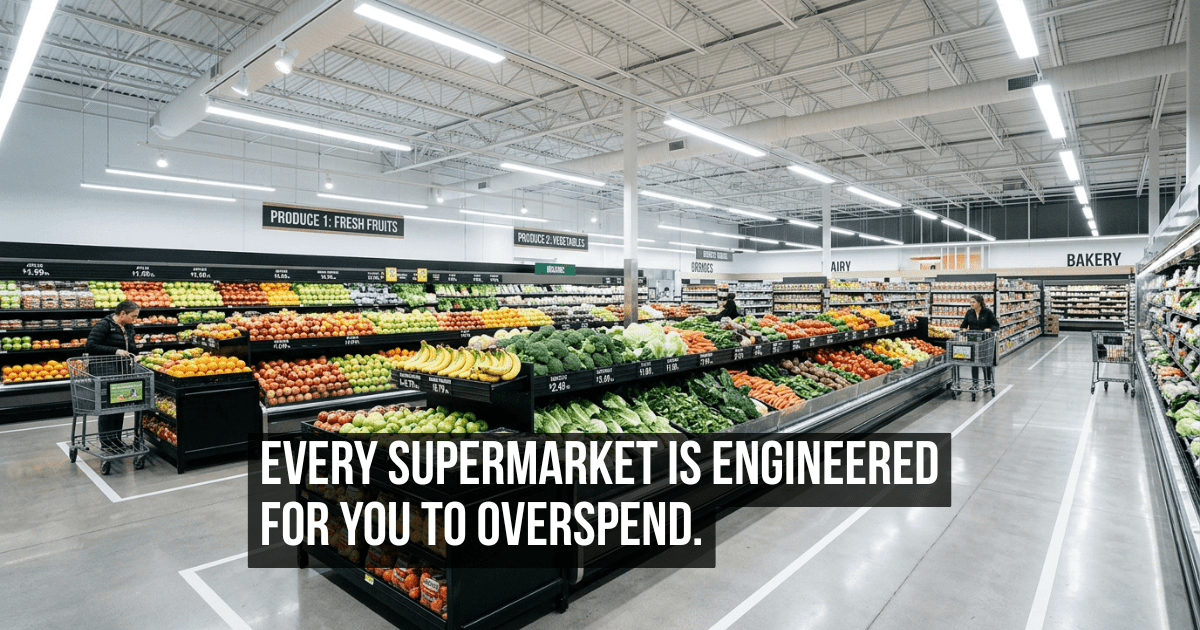
You went in knowing what you needed. You came out having spent more than you planned, purchased things you didn’t intend to purchase, and somehow missed an item that was clearly on the list. The shop is designed to produce exactly this result. It does so with a precision that most people never examine.
The supermarket is not a neutral space.
The Architecture of Spending
The layout of a modern supermarket is the product of decades of retail science: the study of how people move through space, where their attention lands, what conditions lower or raise the threshold between consideration and purchase. Almost nothing about the experience is accidental.
Fresh produce is typically placed at the entrance not because it’s convenient but because opening a shopping trip with fresh, colorful food activates a sense of virtuous behavior that increases willingness to spend on indulgent items later. Essential items, milk, bread, eggs, are positioned toward the back, requiring maximum floor traversal. Every aisle you walk through on the way to necessities is an aisle of exposure to non-necessities. The route is the product.
The Sensory Management You Don’t Notice
Supermarket environments are controlled along dimensions that most shoppers never consciously register. Research on retail atmospherics has documented significant effects from music tempo, lighting color and intensity, and ambient scent.
A widely cited 1982 study by Ronald Milliman found that slower background music increased sales by approximately 38 percent compared to faster music, by reducing movement speed through the store. Shoppers who moved more slowly encountered more products and purchased more of them. The music you hear while shopping was chosen for you. It’s working.
The Cart and the Fatigue
Two physical aspects of the supermarket visit receive less attention than layout and music: cart size and shopping duration. Larger carts produce larger purchases, not because shoppers consciously decide to fill them, but because a half-empty cart generates a low-grade sense of incompleteness. Research from the Journal of Marketing found that doubling cart size increased purchase volume by roughly 40 percent.
Physical fatigue also plays a role. Studies on shopping behavior find that judgment becomes more impulsive as time in the store extends. This is why checkouts are the final gauntlet: small items positioned at the point where cognitive resistance is at its daily minimum. By the time you reach the checkout, you have been inside a decision-producing environment long enough that your defenses are genuinely lower than when you entered.
The Illusion of the Choice
The supermarket presents itself as a space of consumer freedom: thousands of products, unlimited selection, your decision entirely. The reality is that the decision-making environment has been engineered to weight choices in specific directions before you make them. Products at eye level outsell those above and below it. End-of-aisle displays create a perception of value that isn’t always reflected in the actual price.
You are making choices. The choices are not made in neutral conditions. The gap between what you intended to spend and what you spent is not a failure of planning. It’s the intended outcome of a system built, carefully and at considerable expense, to produce it.
Something went wrong. Please refresh the page and/or try again.
Help us improve your journey
We use cookies to personalize your experience and understand how you use our site. By clicking 'Yes, I'm in!', you help us show you content you'll actually love. If you prefer to keep things simple, you can stick to the essentials. You can change your mind anytime!
Necessary
Always active
The technical storage or access is strictly necessary for the legitimate purpose of enabling the use of a specific service explicitly requested by the subscriber or user, or for the sole purpose of carrying out the transmission of a communication over an electronic communications network.
Preferences
The technical storage or access is necessary for the legitimate purpose of storing preferences that are not requested by the subscriber or user.
Analytics
The technical storage or access that is used exclusively for statistical purposes.The technical storage or access that is used exclusively for anonymous statistical purposes. Without a subpoena, voluntary compliance on the part of your Internet Service Provider, or additional records from a third party, information stored or retrieved for this purpose alone cannot usually be used to identify you.
Advertising
The technical storage or access is required to create user profiles to send advertising, or to track the user on a website or across several websites for similar marketing purposes.




Leave a Reply