The shelves empty of toilet paper before anything else. Your brain has a reason.
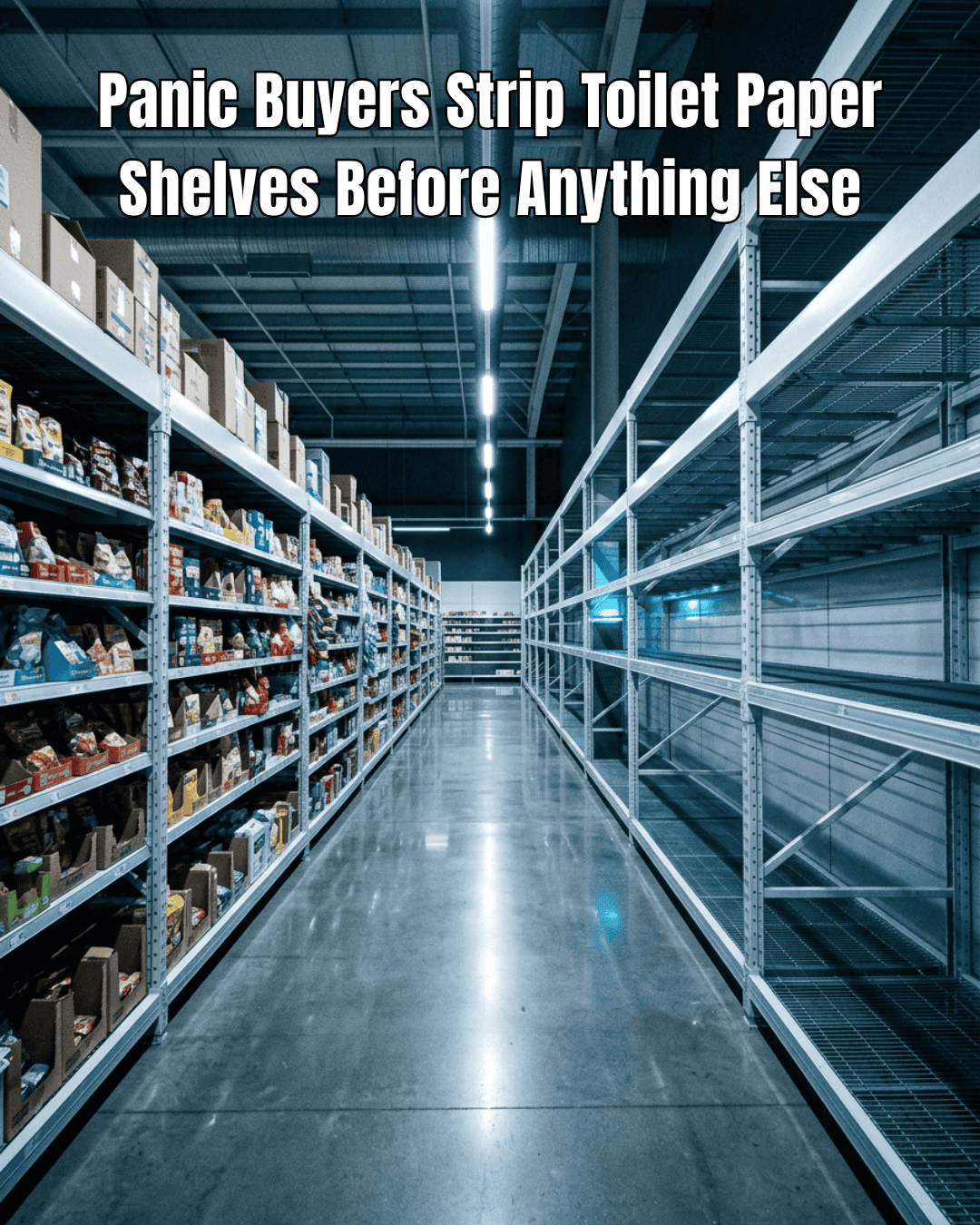
Everything else is still on the shelf. The pasta, the canned tomatoes, the shampoo, the biscuits. In the middle of aisle six there is a long clean gap where the toilet paper used to be.
In March 2020 that gap appeared in supermarkets from Sydney to Seattle within days of each other, and nobody could say why a respiratory virus would make people so worried about their bathrooms.
Nobody hoards toilet paper because they are afraid of the virus. They hoard it because they are afraid of the aisle.
Someone is photographing the empty shelf for their group chat. That photo will do more to empty the next shop than any rumor. A picture of absence is the most contagious kind of news.
The perfect panic item
Consider the product. It is cheap, so buying ten packs feels affordable. It is bulky, so a stack at home feels like safety you can see. It never goes off, so there is no risk of waste. And everyone needs it, so being without it would be a humiliation shared by nobody in particular.
Cheap items are the easiest to hoard because the downside is tiny. If you are wrong, you own a lot of toilet paper. If you are right, you are the person who prepared. It is the cheapest insurance policy on the market.
Compare it with the other panic purchases. Pasta, tinned tomatoes and flour went too, but toilet paper went first and stayed gone longest. Pasta can be eaten within a week. Toilet paper is a quantity you can easily imagine running out of at the worst moment.
It is also a low-stakes way to act. In a frightening moment you cannot control a virus, but you can control a shopping trolley. Buying something practical turns a vague dread into a task with a finish line.
Some of it is plain domestic arithmetic. A household of four gets through a pack faster than anyone expects, and nobody wants to be the one explaining to the others why the cupboard is bare. The fear is small, specific and embarrassing, which is exactly why it spreads so well.
Picture the cart rolling out of the shop: two enormous packs on top, a handful of tomatoes underneath. The shopper looks slightly guilty and slightly proud, which is the exact expression of someone who has done something sensible and feels watched for it.
A shortage that feeds itself
The deeper mechanism is a loop. You see an empty shelf. The empty shelf suggests that others know something you do not. You buy extra, just in case, which empties the shelf for the next person, who now sees the same thing. Each shopper’s caution becomes the next shopper’s alarm.
Each shopper behaves sensibly, and that is the catch. If you believe others will stock up, the rational move is to stock up first, and everyone who thinks that way proves everyone else right. The sociologist Robert Merton named this a self-fulfilling prophecy in 1948, and the supermarket is its stage.
Supply chains make it worse. Retailers order based on recent sales, so a spike looks like a new normal and orders overshoot, which ripples back through the chain. Economists call the amplification the bullwhip effect: a small change at the shop end becomes a violent swing at the factory end.
There was also a real mismatch in 2020. When offices and restaurants closed, more toilet paper was used at home, and the commercial rolls made for offices could not simply be redirected to household shelves. The product existed. It was just in the wrong place.
Stores responded by limiting purchases to a couple of packs per customer. The limit had its own effect. A sign saying “two per person” tells you that someone, somewhere, expects people to take ten.
It has happened before
In December 1973 the American television host Johnny Carson joked on air that there was a shortage of toilet paper. There was not one. Viewers rushed to the shops anyway, and for a few weeks shelves in several states really did run empty.
A joke, a rumor, a photo: it takes very little, because what is being bought is not only paper. It is the feeling of being the person who prepared.
The quiet lesson is about trust. A shelf is a promise that tomorrow’s delivery exists, and panic is what happens when that promise looks shaky for even a day.
There is an honest note to add. Some of the stockpiling was reasonable. A household told to stay at home for weeks has a good reason to want a few extra rolls, and not every purchase was panic. Panic is the label we give other people’s baskets.
Then it passed. The rolls in the cupboard turned into a long, slightly embarrassing supply, and the jokes about them outlasted the stock. Plenty of people still keep a spare pack tucked away, as if the memory of the gap had been filed under habit.
A shortage starts the moment enough people believe in it.
Something went wrong. Please refresh the page and/or try again.
Help us improve your journey
We use cookies to personalize your experience and understand how you use our site. By clicking 'Yes, I'm in!', you help us show you content you'll actually love. If you prefer to keep things simple, you can stick to the essentials. You can change your mind anytime!
Necessary
Always active
The technical storage or access is strictly necessary for the legitimate purpose of enabling the use of a specific service explicitly requested by the subscriber or user, or for the sole purpose of carrying out the transmission of a communication over an electronic communications network.
Preferences
The technical storage or access is necessary for the legitimate purpose of storing preferences that are not requested by the subscriber or user.
Analytics
The technical storage or access that is used exclusively for statistical purposes.The technical storage or access that is used exclusively for anonymous statistical purposes. Without a subpoena, voluntary compliance on the part of your Internet Service Provider, or additional records from a third party, information stored or retrieved for this purpose alone cannot usually be used to identify you.
Advertising
The technical storage or access is required to create user profiles to send advertising, or to track the user on a website or across several websites for similar marketing purposes.




Leave a Reply