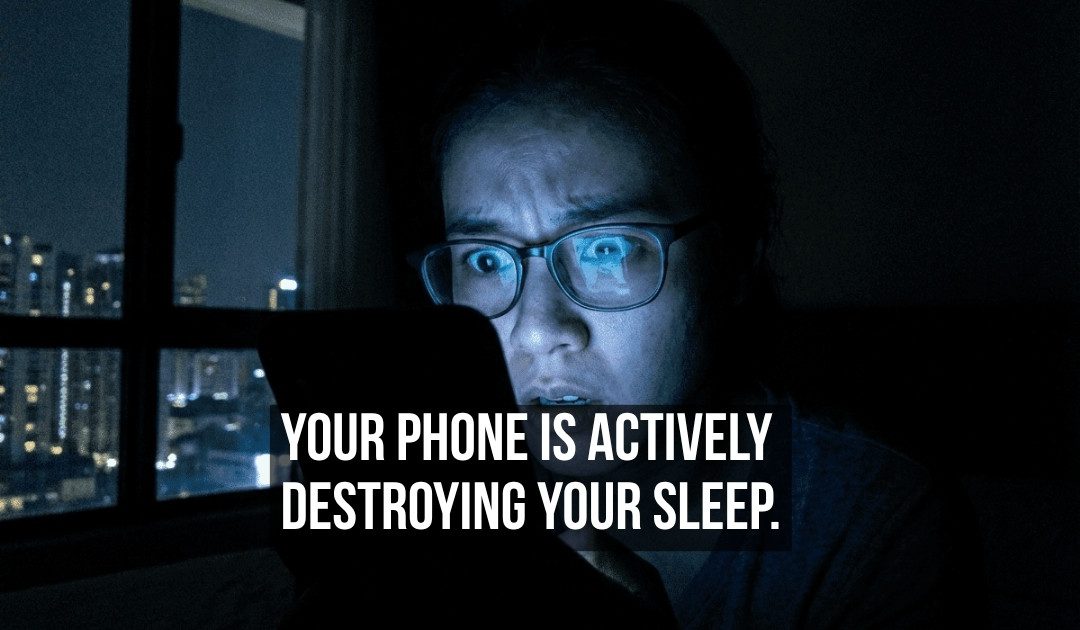
Your Phone Is Actively Destroying Your Sleep and the Engineering Behind It Was Always Intentional
The last thing most people look at before closing their eyes is also the thing most efficiently designed to prevent them from sleeping. This is not an accident.
The Two-Layer Problem
The conversation about phones and sleep has been almost entirely captured by the blue light narrative — the idea that short-wavelength light from screens suppresses melatonin production and delays sleep onset. That effect is real and well-documented. But it is the less significant half of the problem.
The more substantial damage is cognitive and neurochemical. Social media platforms, news feeds, and messaging apps are engineered to produce small, unpredictable rewards — the variable ratio reinforcement schedule that behavioral scientists identify as the most potent driver of compulsive behavior. Checking a phone before sleep does not just expose the retina to light. It activates the same dopaminergic anticipation pathways that slot machines exploit. The brain enters a state of alert seeking, which is the neurological opposite of the descending arousal required for sleep onset.
Research published in the journal SLEEP in 2020, examining over 1,000 adults, found that participants who used social media within 30 minutes of bedtime took significantly longer to fall asleep and reported poorer sleep quality — independent of total screen time earlier in the day. The proximity to sleep onset was the variable that mattered most, not the duration of use.
The Architecture That Captures You
Sleep architecture describes the cycles of light sleep, deep sleep, and REM that constitute a full night’s rest. Stress and anxious cognition — the mental state that late-night news and social feeds reliably produce — preferentially disrupt slow-wave deep sleep and REM, the phases most critical for emotional processing and memory consolidation. Users waking at 2am to check a notification are not just losing those minutes. They are fragmenting cycles that cannot simply be restarted.
Technology companies understand this. Former Google design ethicist Tristan Harris described in testimony to the US Senate the explicit use of psychological research to maximize engagement time, including nocturnal engagement. The infinite scroll was patented specifically to eliminate the natural stopping cues of paginated content — no chapter end, no page bottom, no visual signal that it is appropriate to stop.
Charging the phone outside the bedroom is the most effective single intervention identified in sleep hygiene research — more effective than melatonin supplements and more effective than blackout curtains. The problem is that it requires going to sleep without the device, which for many adults has functionally become inseparable from going to sleep at all.
The asymmetry of incentives is worth naming directly. The technology companies whose products impair sleep bear no regulatory obligation to disclose this effect or design products with sleep protection as a priority. The individual bears the full cost — in health, in cognitive performance, in eroded recovery — while the commercial structure extracts value from the nocturnal engagement it creates. The phone on the nightstand is a commercial relationship operating inside your bedroom, and understanding it that way changes the calculation about whether it should be there at all.
The most evidence-supported recommendation — charging the phone in another room — requires confronting what the phone has actually become: the alarm clock, the white noise machine, the contact point for emergencies, the reading device, the last thing checked and the first thing reached for. Removing it involves replacing a cluster of functions that have been progressively colonised, one convenience at a time, over the course of a decade. That is the reason the simple advice is so rarely followed. The phone did not arrive in the bedroom uninvited.
The phone on the nightstand is not a neutral object. It is a device whose entire engineering purpose is to sustain your engagement. Treating it as a passive presence in the bedroom is a fundamental misreading of what it is and what it is doing while you try to rest.
Something went wrong. Please refresh the page and/or try again.
Help us improve your journey
We use cookies to personalize your experience and understand how you use our site. By clicking 'Yes, I'm in!', you help us show you content you'll actually love. If you prefer to keep things simple, you can stick to the essentials. You can change your mind anytime!
Necessary
Always active
The technical storage or access is strictly necessary for the legitimate purpose of enabling the use of a specific service explicitly requested by the subscriber or user, or for the sole purpose of carrying out the transmission of a communication over an electronic communications network.
Preferences
The technical storage or access is necessary for the legitimate purpose of storing preferences that are not requested by the subscriber or user.
Analytics
The technical storage or access that is used exclusively for statistical purposes.The technical storage or access that is used exclusively for anonymous statistical purposes. Without a subpoena, voluntary compliance on the part of your Internet Service Provider, or additional records from a third party, information stored or retrieved for this purpose alone cannot usually be used to identify you.
Advertising
The technical storage or access is required to create user profiles to send advertising, or to track the user on a website or across several websites for similar marketing purposes.




Leave a Reply