The Serious Linguistic Case for Swearing That Polite Society Has Never Wanted You to Hear
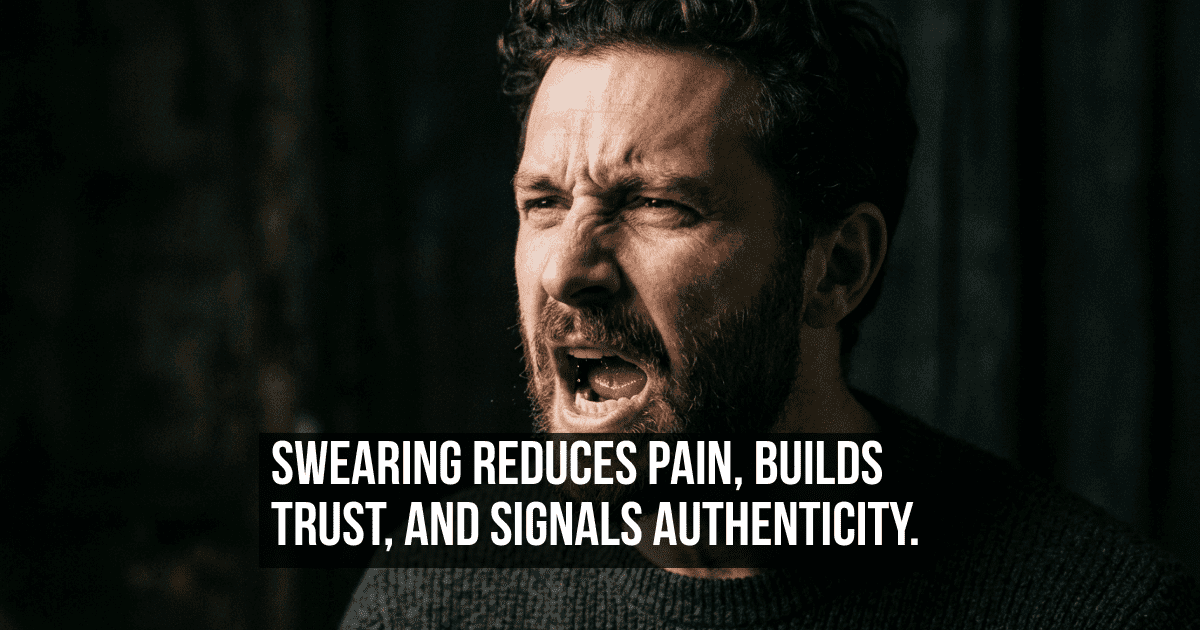
The linguistics of profanity is one of the more peculiar specialisms in language science. Swear words are processed differently in the brain from other vocabulary: they activate the amygdala and are retained more robustly in long-term memory, they survive in patients with aphasia who have lost the capacity to produce most other language, and they release measurable physiological stress in those who hear them. They are, by every neurological measure, among the most potent words in any language.
They are also, in polite society, systematically suppressed, contextualised within elaborate social rules about when and with whom they may be used, and deployed by children as acts of rebellion precisely because their power is so legibly real. The argument for swearing — the case that profanity serves genuine and sophisticated functions that its social prohibition ignores — is considerably stronger than its critics have acknowledged.
The Pain Relief That Works
The most robustly replicated finding in profanity research is the effect of swearing on pain tolerance. A 2009 study by Richard Stephens and colleagues at Keele University asked participants to hold their hand in ice water for as long as possible while either repeating a swear word or a neutral word. Those who swore were able to tolerate the pain significantly longer and rated it as less intense. The effect was replicated and extended in subsequent studies, including research suggesting that swearing triggers an adrenergic stress response that activates the fight-or-flight system and its associated analgesic effects.
The mechanism is physiological. Swearing at pain is not merely expressive — it is a functional intervention that measurably changes how pain is experienced. People have been doing this intuitively for as long as language has existed. The research simply explained why it works.
The Emotional Accuracy of Profanity
Swear words derive their force from the specific social prohibition against them. A word that costs nothing to say carries less expressive weight than a word whose utterance carries social risk. The deployment of a swear word in appropriate circumstances communicates, with high precision, the emotional intensity of the speaker’s state: this is bad enough, or this is surprising enough, or this is frustrating enough, to warrant the social cost of the word I just used. No euphemism delivers the same information.
Psycholinguist Timothy Jay, who has studied profanity for over forty years, has argued that swear words function as what he calls emotional intensifiers — vocabulary that carries an emotional payload that standard language cannot replicate. The restriction of this vocabulary from professional and formal contexts does not eliminate the emotional states the words describe. It eliminates the most efficient vocabulary for expressing them, which is a communicative loss, whatever its social benefits.
The Social Bonding Function
Research on informal language use in workplace and social settings has found consistent positive correlations between shared profanity use and group cohesion. Teams that swear together, within contexts where it is mutually understood as acceptable, report higher trust levels and greater comfort with direct communication. The shared violation of formal linguistic norms creates an in-group signal: we are past the point of formal performance with each other.
A 2016 study published in Social Psychological and Personality Science found that people who reported using profanity more frequently were judged by independent raters as more authentic, and scored higher on measures of integrity and honesty. The correlation is not causal, and authenticity is not always a virtue in every context. But the finding complicates the common assumption that swearing signals low intelligence or poor character. The evidence suggests it more reliably signals reduced concern with impression management, which is a different thing.
The Intelligence Question
The stereotype that swearing reflects a limited vocabulary has been directly tested and found wanting. A 2015 study by Kristin and Timothy Jay asked participants to name as many words as possible beginning with a specific letter, and then as many swear words as possible. Fluency in both tasks was positively correlated: people who could produce more standard vocabulary could also produce more swear words. The two vocabularies draw on the same underlying linguistic resource. Proficiency in one does not indicate deficiency in the other.
The person with the most sophisticated grasp of profanity’s social rules — who knows precisely when it is appropriate, with whom, in which register, for which communicative purpose — is exercising a form of sociolinguistic competence that is neither simple nor accidental. Polite society declined to give them credit for it. The research did not have the same reluctance.
Something went wrong. Please refresh the page and/or try again.
Help us improve your journey
We use cookies to personalize your experience and understand how you use our site. By clicking 'Yes, I'm in!', you help us show you content you'll actually love. If you prefer to keep things simple, you can stick to the essentials. You can change your mind anytime!
Necessary
Always active
The technical storage or access is strictly necessary for the legitimate purpose of enabling the use of a specific service explicitly requested by the subscriber or user, or for the sole purpose of carrying out the transmission of a communication over an electronic communications network.
Preferences
The technical storage or access is necessary for the legitimate purpose of storing preferences that are not requested by the subscriber or user.
Analytics
The technical storage or access that is used exclusively for statistical purposes.The technical storage or access that is used exclusively for anonymous statistical purposes. Without a subpoena, voluntary compliance on the part of your Internet Service Provider, or additional records from a third party, information stored or retrieved for this purpose alone cannot usually be used to identify you.
Advertising
The technical storage or access is required to create user profiles to send advertising, or to track the user on a website or across several websites for similar marketing purposes.




Leave a Reply