Loneliness Rewires the Brain Like Physical Pain and the Long Term Health Consequences Are Measurable
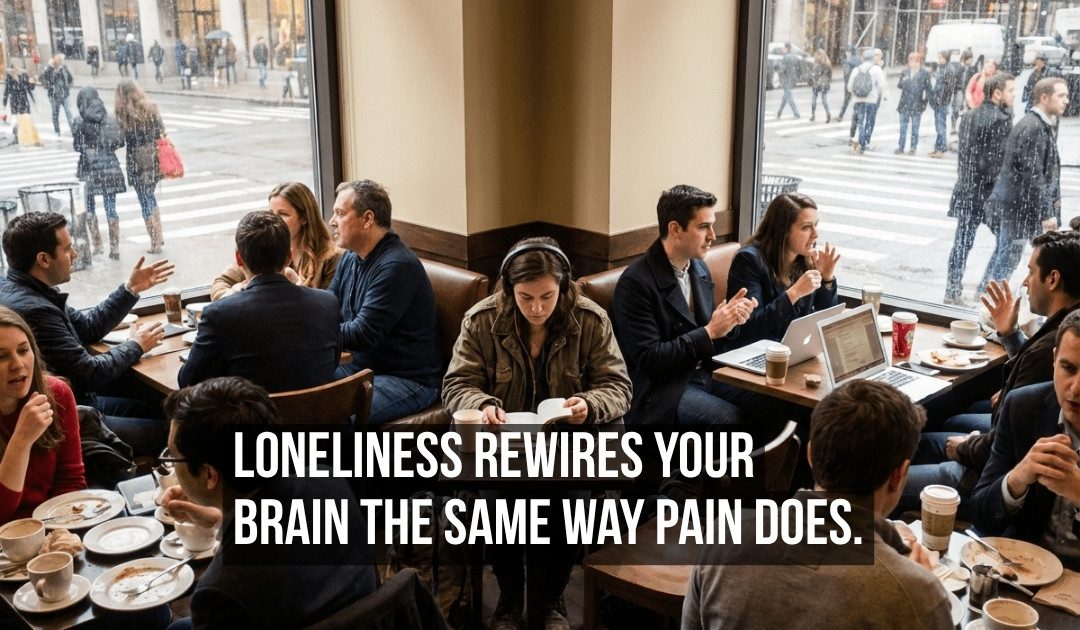
Loneliness has been treated as a social problem, a psychological state, and a modern epidemic. It is also a biological event — one that activates the same neural architecture as physical pain and triggers cascading physiological changes that accumulate like any chronic condition. The broader patterns driving social disconnection are documented in what is already recognised as a loneliness epidemic.
The Biology of Social Disconnection
The neurological overlap between social exclusion and physical pain is not metaphorical. John Cacioppo, the University of Chicago neuroscientist who dedicated his career to studying loneliness, demonstrated through brain imaging that social rejection and physical injury activate many of the same brain regions — the dorsal anterior cingulate cortex and the anterior insula. The brain treats being cut off from others as a threat to survival. Which, for most of human evolutionary history, it genuinely was.
When that threat signal becomes chronic, the physiological consequences compound. Cacioppo’s longitudinal research found that persistently lonely individuals show elevated cortisol and increased inflammatory markers. Over time, chronic inflammation is implicated in cardiovascular disease, diabetes, and accelerated cellular aging. A 2015 meta-analysis in Perspectives on Psychological Science concluded that social isolation increases mortality risk by approximately 26 percent — a figure comparable to smoking up to 15 cigarettes per day.
The mechanism is partly behavioral: lonely people tend to sleep less, exercise less, eat worse, and are less likely to seek medical care. But the damage is also directly physiological. The inflammatory pathways activated by chronic loneliness cause harm independently of lifestyle factors, measurable in bloodwork even when behavior is controlled for.
Why It Is Hard to Detect and Treat
Loneliness is notoriously difficult to identify from the outside. Unlike depression or anxiety, which often produce visible behavioral changes, loneliness can be masked by apparently normal social functioning. A person can attend parties, maintain professional relationships, and appear entirely socially integrated while experiencing severe subjective isolation. The subjective sense of connection is what matters; the quantity of social contacts does not.
The condition tends to self-perpetuate. Cacioppo’s research showed that lonely individuals exhibit heightened social threat vigilance — they are more likely to interpret ambiguous social signals as hostile or rejecting. This creates a feedback loop in which loneliness makes re-engagement harder, reinforcing the isolation it was meant to escape. The structural conditions that produced the loneliness epidemic — remote work, digital substitution for in-person contact — are examined in why remote work and office produce identical loneliness.
Public health responses have begun to take this seriously. The United Kingdom appointed a Minister for Loneliness in 2018, and several countries now include social connectedness in their national health strategies. The evidence base for community-level interventions — structured group activities, intergenerational programs, investment in third places — is growing.
Workplace loneliness deserves particular attention as a distinct and underexamined dimension of the problem. A 2020 Cigna survey of over 10,000 American adults found that 61 percent reported feeling lonely, with the highest rates among workers describing their office as having no close friendships. Remote and hybrid work has restructured the professional environment in ways that eliminated many incidental social contacts — the brief corridor exchange, the shared lunch, the informal problem-solving that occurred organically — without replacing them with anything equivalent. The resulting deficit is physiologically real, measurable, and accumulating silently in populations who describe themselves as busy rather than isolated. This connects to the erosion of casual interaction documented in why nobody is listening anymore.
Community design matters in ways that policy rarely acknowledges. The built environment shapes loneliness in measurable ways: walkable neighbourhoods with third places — cafes, libraries, parks, community centres — produce lower rates of social isolation than car-dependent suburbs where incidental social contact is structurally eliminated. Loneliness is not only a psychological condition. It is partly an architectural one, and treating it as purely individual mislocates the lever most available for change.
Loneliness is not a weakness or a personality failure. It is a biological warning system that, when left chronically active, begins damaging the machinery it was designed to protect. Understanding it as a health condition rather than a character flaw changes what we look for, who we ask about it, and what we choose to build.
Something went wrong. Please refresh the page and/or try again.
Help us improve your journey
We use cookies to personalize your experience and understand how you use our site. By clicking 'Yes, I'm in!', you help us show you content you'll actually love. If you prefer to keep things simple, you can stick to the essentials. You can change your mind anytime!
Necessary
Always active
The technical storage or access is strictly necessary for the legitimate purpose of enabling the use of a specific service explicitly requested by the subscriber or user, or for the sole purpose of carrying out the transmission of a communication over an electronic communications network.
Preferences
The technical storage or access is necessary for the legitimate purpose of storing preferences that are not requested by the subscriber or user.
Analytics
The technical storage or access that is used exclusively for statistical purposes.The technical storage or access that is used exclusively for anonymous statistical purposes. Without a subpoena, voluntary compliance on the part of your Internet Service Provider, or additional records from a third party, information stored or retrieved for this purpose alone cannot usually be used to identify you.
Advertising
The technical storage or access is required to create user profiles to send advertising, or to track the user on a website or across several websites for similar marketing purposes.




Leave a Reply