What Your Body Is Actually Doing During the Three O’Clock Energy Crash That Hits Everyone
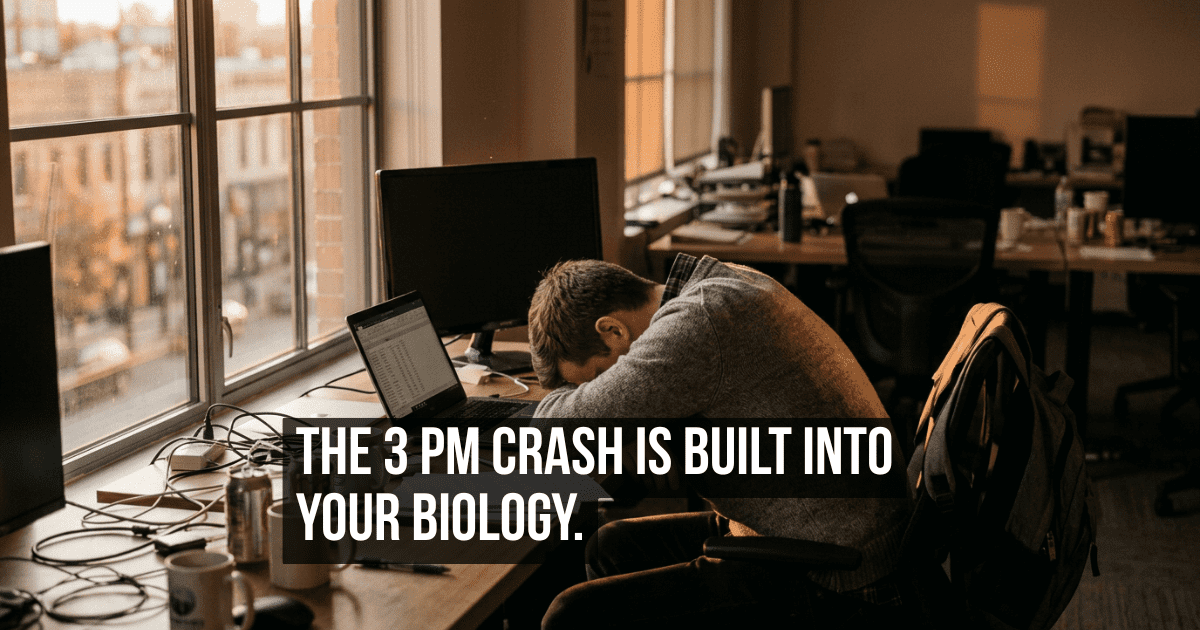
It arrives at approximately the same time every afternoon. Between two-thirty and three-thirty, depending on when you woke up, a specific quality of heaviness settles: the eyes are slightly harder to keep fully open, concentration costs more than it did an hour ago, the screen looks slightly less sharp. The post-lunch dip, as it is commonly known, is so consistent and so widely experienced that it has given rise to an entire industry of interventions — afternoon coffee, energy drinks, power naps, strategic snacking — all aimed at getting through the period without noticeable impairment.
The energy crash is not caused by lunch, despite what its colloquial name implies. It is caused by something considerably more fundamental, operating on a timescale that predates industrialised working hours by a considerable margin.
The Two-Process Model of Alertness
Human alertness is regulated by two overlapping systems that operate simultaneously. The first is the circadian process: a biological clock, driven by light exposure and the hormone melatonin, that organises the body’s physiology around a roughly 24-hour cycle. The second is the homeostatic process: the progressive accumulation of adenosine — a neurotransmitter that builds up in the brain during waking hours and creates sleep pressure — which caffeine works by blocking.
The afternoon trough appears in the circadian rhythm independently of when or whether a person has eaten. Chronobiologists studying populations without regular meal patterns find the same mid-afternoon dip in alertness and performance. The dip is a feature of the circadian oscillation itself, not a response to food. Eating a heavy lunch can compound it, but the underlying cause is the daily rhythm of the biological clock.
The Genetic Variation
Not everyone experiences the dip equally. Research on chronotype — the individual variation in the timing of the body’s circadian clock — has found that the severity and timing of the afternoon alertness trough varies significantly between individuals. Evening chronotypes (“owls”) tend to have a later and more pronounced afternoon dip than morning chronotypes (“larks”), because the alignment between their biological clock and the hours of conventional working life is worse. The person who struggles severely with the two PM energy crash may be experiencing the compound effect of their natural clock misaligned with the schedule they are required to maintain.
Genetic variations in the PERIOD3 gene, which codes for a core component of the circadian clock mechanism, have been associated with measurable differences in afternoon alertness patterns. The yawning that occurs at the same time every afternoon is not a personal failure of discipline. It is a biological schedule.
The Adenosine Accumulation
Alongside the circadian trough, adenosine has been accumulating since waking. Adenosine is a byproduct of neural activity, and its concentration in the brain increases continuously through the day, progressively increasing the homeostatic pressure toward sleep. By mid-afternoon, for someone who has been awake since seven AM, adenosine levels are meaningfully elevated — not yet at the levels that produce sleep, but sufficient to compound the circadian dip and produce the specific texture of afternoon impairment: the inability to concentrate on demanding tasks, the tendency toward mind-wandering, the increased attractiveness of any activity that doesn’t require sustained attention.
Caffeine’s mechanism — blocking adenosine receptors rather than reducing adenosine itself — means that the adenosine continues accumulating even during caffeination. When the caffeine wears off, the adenosine that was blocked during the period of caffeination releases simultaneously, producing the “caffeine crash” that many heavy coffee consumers experience. The timing of afternoon coffee consumption matters: caffeine consumed after approximately two PM has a half-life that extends into the sleeping hours, reducing sleep quality and increasing the following day’s sleep debt and adenosine accumulation.
The Nap That Actually Works
The intervention with the most consistent evidence base for the afternoon trough is the brief nap. Research from NASA, from multiple sleep laboratories, and from operational contexts including aviation and medicine, consistently finds that a nap of ten to twenty minutes during the mid-afternoon window measurably restores alertness, improves performance on attention and cognitive tasks, and reduces error rates. Longer naps — beyond about twenty-five minutes — enter slow-wave sleep stages, producing sleep inertia on waking that can extend the impairment rather than resolving it.
The siesta traditions maintained in parts of Southern Europe, the Middle East, and South Asia represent an adaptation to this biological fact that industrialised work schedules elsewhere have declined to accommodate. The cultures that structured midday rest into daily life were not demonstrating a cultural preference for leisure. They were aligning their working hours with the oscillation that their biology was already running.
Something went wrong. Please refresh the page and/or try again.
Help us improve your journey
We use cookies to personalize your experience and understand how you use our site. By clicking 'Yes, I'm in!', you help us show you content you'll actually love. If you prefer to keep things simple, you can stick to the essentials. You can change your mind anytime!
Necessary
Always active
The technical storage or access is strictly necessary for the legitimate purpose of enabling the use of a specific service explicitly requested by the subscriber or user, or for the sole purpose of carrying out the transmission of a communication over an electronic communications network.
Preferences
The technical storage or access is necessary for the legitimate purpose of storing preferences that are not requested by the subscriber or user.
Analytics
The technical storage or access that is used exclusively for statistical purposes.The technical storage or access that is used exclusively for anonymous statistical purposes. Without a subpoena, voluntary compliance on the part of your Internet Service Provider, or additional records from a third party, information stored or retrieved for this purpose alone cannot usually be used to identify you.
Advertising
The technical storage or access is required to create user profiles to send advertising, or to track the user on a website or across several websites for similar marketing purposes.




Leave a Reply