Why Doing the Dishes by Hand Is Far More Psychologically Restorative Than Almost Any Meditation App
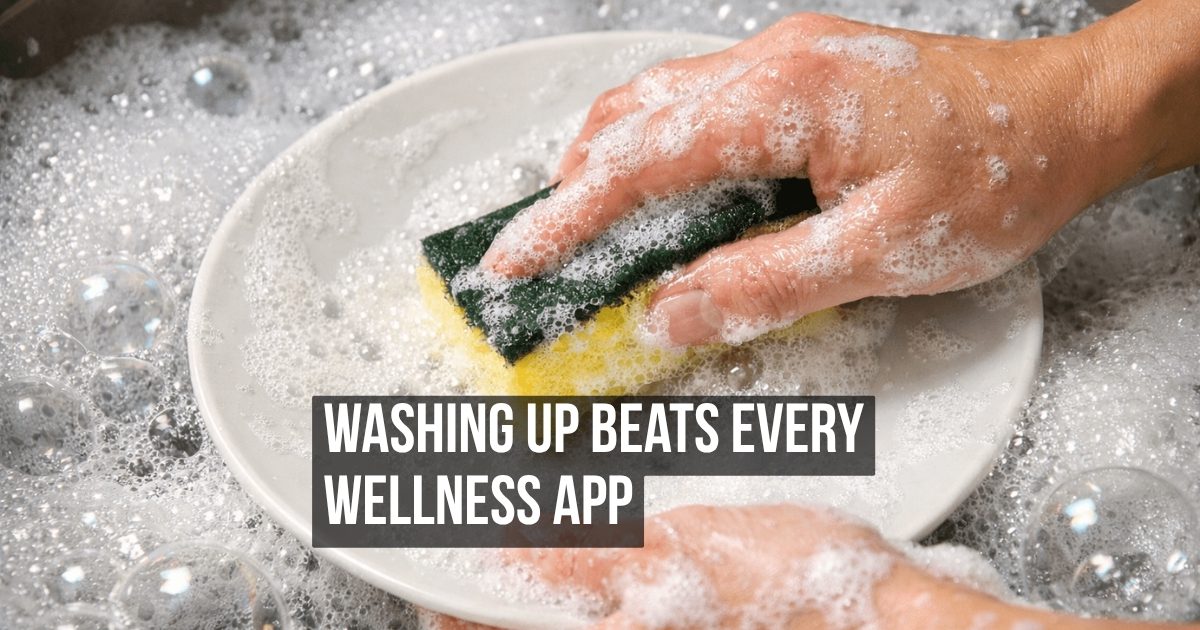
You stand at the sink. Warm water runs over your hands. A plate goes in dirty and comes out clean. Then another. Then a glass, a pot, a spatula encrusted with something that requires extra attention. Ten minutes pass. When you step away, the rack is full, the counter is clear, and something in your head feels different — quieter, more settled, fractionally less overwhelmed than when you started. You didn’t meditate. You didn’t breathe in for four and out for seven. You washed dishes. And the psychological effect may have been more restorative than anything your meditation app delivered this week.
The Florida State Study
In 2015, researchers at Florida State University published a study in the journal Mindfulness that asked a straightforward question: could washing dishes, performed with focused attention, produce measurable psychological benefits? Fifty-one participants were divided into two groups. One read a descriptive passage about dishwashing before doing the task. The other read a mindfulness-oriented passage encouraging them to focus on the sensory experience — the warmth of the water, the feel of the plates, the scent of the soap. Both groups then washed dishes for six minutes.
The mindful dishwashing group reported a 27 percent decrease in nervousness and a 25 percent increase in mental inspiration compared to the control group. Six minutes. No app, no subscription, no guided audio, no retreat. Just water, soap, and attention directed at the task at hand.
Why Hands Matter
The hands are the most densely innervated body surface after the lips and tongue. Each fingertip contains approximately 2,500 mechanoreceptors per square centimetre, capable of detecting texture, temperature, pressure, and vibration with extraordinary precision. When your hands are submerged in warm water, manipulating objects of varying shape, weight, and surface texture, the sensory input to the somatosensory cortex is rich and continuous — far richer than the minimal physical input provided by sitting still with your eyes closed.
This sensory density is part of why dishwashing feels grounding in a way that seated meditation often doesn’t. Meditation asks you to generate focus from nothing — to anchor attention on the breath, a mantra, or a body scan against the pull of an unoccupied mind. Dishwashing provides an external anchor automatically: the hands are busy, the water is warm, the task has a rhythm and a sequence. The attention doesn’t need to be manufactured. It’s drawn out by the activity itself.
The Completion Effect
Washing dishes has a property that many daily tasks lack and that meditation explicitly avoids: visible, tangible completion. A dirty plate enters the water and emerges clean. The sink fills with clutter and empties into a drying rack. The transformation is concrete, undeniable, and immediate. In a world where most work is abstract, ongoing, and never fully finished — emails, projects, to-do lists that regenerate overnight — the dish rack’s finality provides a small but genuine psychological reward.
The Zeigarnik effect, described by psychologist Bluma Zeigarnik in 1927, holds that incomplete tasks create persistent cognitive tension — a mental itch that occupies background processing until the task is resolved. Completing the dishes closes an open loop. The kitchen moves from disordered to ordered. The visual environment shifts from demanding attention to releasing it. This closure is not available in meditation, which by design has no completion state: you sit, you breathe, and then you stop. There is no “done.” There is only “enough for now.”
The Case Against App-Based Mindfulness
Meditation apps — Calm, Headspace, Insight Timer, and their competitors — have delivered mindfulness practice to millions of users who would never have attended a retreat or joined a meditation group. Their contribution to public mental health awareness is genuine. But the delivery mechanism introduces contradictions that the kitchen sink does not.
Using a meditation app requires picking up a phone — the device most associated with distraction, notification anxiety, and compulsive checking. Opening the app often means passing through a home screen populated with competing demands. The app itself may send push notifications reminding you to meditate, creating a small irony: stress about not meditating, delivered by the platform that was supposed to reduce stress. And the guided audio, however well-produced, is a digital input — a voice from a speaker, processed through the same auditory channel that processes podcasts, music, and phone calls.
Dishwashing requires no device. It involves no screen. It sends no reminders. It occupies the hands, which means the phone is physically inaccessible for the duration. The practice is inherently device-free in a way that app-based meditation, by structural definition, cannot be.
Embodied Cognition and Domestic Labour
The emerging field of embodied cognition argues that thought is not confined to the brain but is distributed across the body and its interactions with the physical environment. Washing dishes is an embodied cognitive act: the body is engaged, the senses are active, and the mind processes the activity through physical feedback rather than abstract instruction. Embodied activities consistently outperform disembodied ones in studies of affect regulation — managing emotional states through action rather than reflection.
Gardening, knitting, woodworking, and cooking have all been shown to produce therapeutic effects comparable to or exceeding those of seated mindfulness practice in clinical populations. The common thread is not the specific activity but the combination of sensory richness, manual engagement, rhythmic repetition, and concrete outcome. Washing dishes shares every one of these properties, and it has the additional advantage of being a task that needs doing anyway — meaning the psychological benefit comes at zero additional time cost.
The Restoration Nobody Values
Dishwashing is classified as chore — a word that implies obligation, drudgery, and low status. Nobody puts “washed dishes” on a wellness routine. Nobody posts about it. The activity carries zero cultural prestige, which is precisely why it remains available as genuine rest. It has not been commodified, optimised, tracked, or branded. There is no leaderboard, no streak counter, no premium tier. Just a sink, hot water, and ten minutes of undisturbed sensory engagement with a task that starts messy and ends clean. The most restorative ritual in your daily life may be the one you’ve been complaining about.
Something went wrong. Please refresh the page and/or try again.
Help us improve your journey
We use cookies to personalize your experience and understand how you use our site. By clicking 'Yes, I'm in!', you help us show you content you'll actually love. If you prefer to keep things simple, you can stick to the essentials. You can change your mind anytime!
Necessary
Always active
The technical storage or access is strictly necessary for the legitimate purpose of enabling the use of a specific service explicitly requested by the subscriber or user, or for the sole purpose of carrying out the transmission of a communication over an electronic communications network.
Preferences
The technical storage or access is necessary for the legitimate purpose of storing preferences that are not requested by the subscriber or user.
Analytics
The technical storage or access that is used exclusively for statistical purposes.The technical storage or access that is used exclusively for anonymous statistical purposes. Without a subpoena, voluntary compliance on the part of your Internet Service Provider, or additional records from a third party, information stored or retrieved for this purpose alone cannot usually be used to identify you.
Advertising
The technical storage or access is required to create user profiles to send advertising, or to track the user on a website or across several websites for similar marketing purposes.




Leave a Reply