What a Handshake Is Actually Communicating and Why Humans Have Used It for Thousands of Years
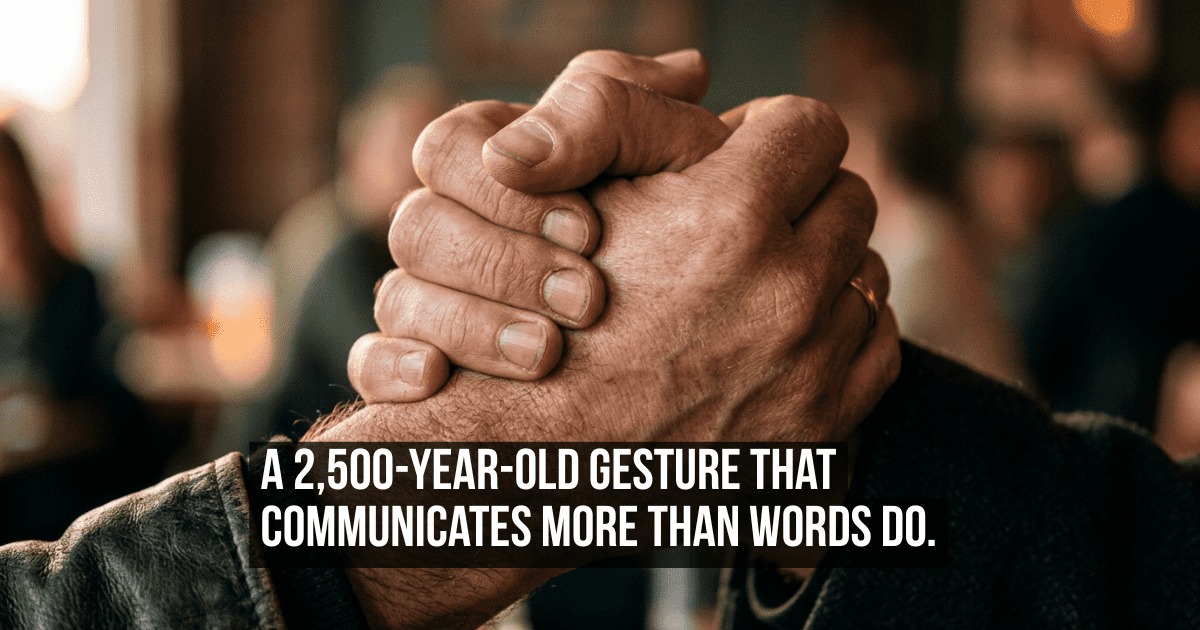
Every day, billions of people extend a right hand toward a stranger, another stranger takes it, they apply moderate pressure simultaneously and move the joined hands briefly up and down, then release. The action is performed without instruction, requires no explanation in most cultural contexts, lasts between two and five seconds, and communicates a set of social signals that no verbal equivalent fully replicates. It has been used in this form, in cultures across the Mediterranean and Europe, for at least two and a half thousand years. And almost nobody thinks about why.
The handshake is one of the most widely practiced physical rituals in human social life, and one of the least examined. Examining it reveals something both specific about touch and general about the kind of social information that no other communication channel efficiently transmits.
The Weapon-Check Theory
The most commonly cited historical explanation for the handshake is the weapon check: extending the empty right hand demonstrated that you were not holding a sword, and gripping and shaking it verified the same for the person opposite. Ancient Greek carvings from as early as the fifth century BC depict the gesture in contexts of treaty-making and alliance formation — the handshake as the conclusion of an agreement, the sealing of terms between parties who had reason to distrust each other.
The weapon-check theory is plausible and probably partially true, but it does not explain why the handshake survived into contexts where weapons are neither expected nor possible. The neurological functions of touch are a better explanation for its persistence.
What Touch Does That Sight and Sound Cannot
Touch is the only sense that requires reciprocal physical contact — you cannot touch someone without being touched in return. This reciprocity makes it the only social channel that is inherently mutual and that cannot be faked in one direction only. A smile can be performed without genuine feeling. A handshake produces identical physical input for both parties regardless of how either is managing their social presentation.
The neurological pathway of skin-to-skin contact activates C-tactile afferents — nerve fibres specialised for social touch — which project directly to the insular cortex and trigger the release of oxytocin, the neuropeptide associated with trust and social bonding. A handshake of appropriate pressure and duration produces a measurable neurochemical response in both parties before any verbal communication has occurred. The social bonding is not metaphorical. It is physiological.
The Information Encoded in the Grip
Research on handshake qualities and social perception has consistently found that grip characteristics — pressure, duration, dryness, completeness of the web-to-web contact — predict first impressions of personality with modest but meaningful accuracy. A 2000 study by William Chaplin at the University of Alabama found that people with firm, complete handshakes were rated as more extroverted, open to experience, and emotionally stable than people with weak or incomplete grips. The ratings held up when the judges were blinded to other information about the participants.
Whether the grip accurately encodes personality is less important than the fact that people reliably read it as doing so. The handshake creates a rapid, haptic first impression that operates independently of the visual and verbal impressions forming simultaneously. Negotiators and salespeople have studied and trained the handshake precisely because its effect on social evaluation is real and largely involuntary.
The Pandemic Pause and What It Revealed
The COVID-19 pandemic produced the most widespread temporary suspension of handshaking in modern history. The absence revealed the function more clearly than its presence had. Without the handshake, professional first meetings had a specific flatness: the verbal greeting happened, the eye contact happened, but something that usually preceded speech and operated below conscious awareness was missing. Substitutes — the elbow bump, the head nod, the placed-hand-on-chest — each addressed part of the greeting ritual without replicating the neurochemical and informational content of the handshake itself.
The handshake returned in most cultures within a year or two of pandemic restrictions lifting, despite public health arguments for maintaining alternative greetings. Its persistence is not merely habitual. It encodes something — trust initiation, mutual physical acknowledgment, the brief suspension of normal physical boundaries between strangers — that its substitutes do not efficiently replicate. Two and a half thousand years of continuous use suggest it solved a problem well enough that no better solution has displaced it.
Something went wrong. Please refresh the page and/or try again.
Help us improve your journey
We use cookies to personalize your experience and understand how you use our site. By clicking 'Yes, I'm in!', you help us show you content you'll actually love. If you prefer to keep things simple, you can stick to the essentials. You can change your mind anytime!
Necessary
Always active
The technical storage or access is strictly necessary for the legitimate purpose of enabling the use of a specific service explicitly requested by the subscriber or user, or for the sole purpose of carrying out the transmission of a communication over an electronic communications network.
Preferences
The technical storage or access is necessary for the legitimate purpose of storing preferences that are not requested by the subscriber or user.
Analytics
The technical storage or access that is used exclusively for statistical purposes.The technical storage or access that is used exclusively for anonymous statistical purposes. Without a subpoena, voluntary compliance on the part of your Internet Service Provider, or additional records from a third party, information stored or retrieved for this purpose alone cannot usually be used to identify you.
Advertising
The technical storage or access is required to create user profiles to send advertising, or to track the user on a website or across several websites for similar marketing purposes.




Leave a Reply