The Surprisingly Complex Supply Chain Behind a Single Banana Reaching Your Kitchen Counter
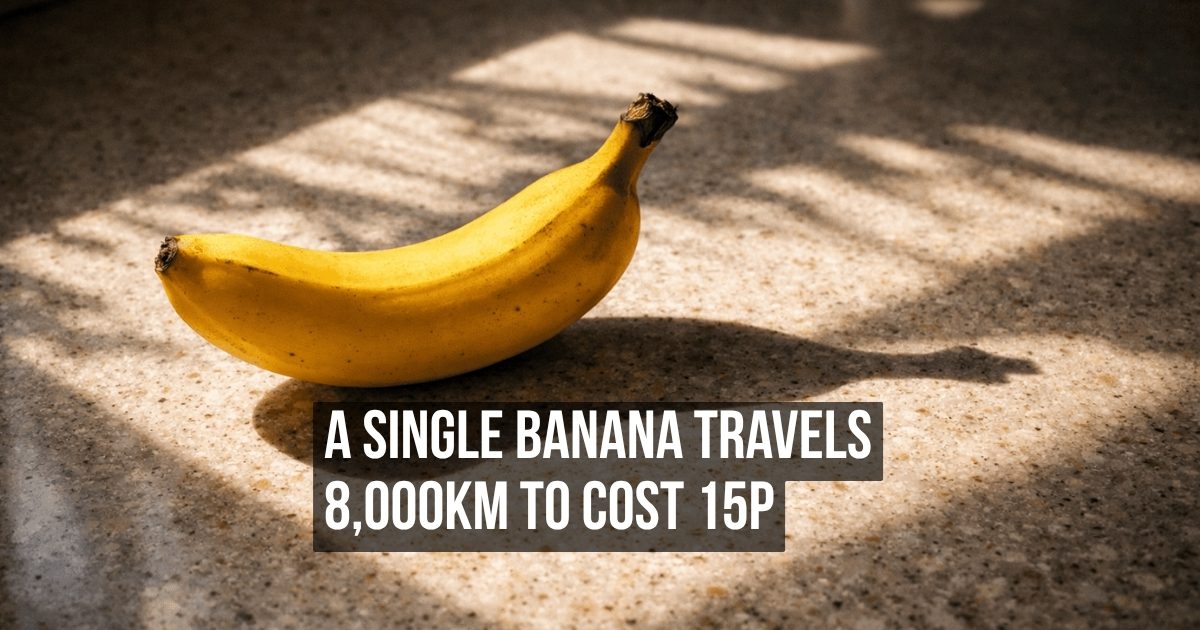
You pick up a banana at a supermarket in London. It costs 15 pence. It weighs approximately 120 grams. It travelled roughly 8,000 kilometres to reach your hand, crossed at least three national borders, was handled by a minimum of six separate organisations, and was kept within a 2-degree temperature window for the entire journey. The banana is the cheapest item in your basket and the most logistically complex. Understanding how it got there reveals a supply chain so tightly orchestrated that a single misjudged degree of temperature at any stage can destroy an entire shipping container of fruit worth tens of thousands of pounds.
Origin: The Plantation
Approximately 85 percent of bananas exported globally come from Latin America and the Caribbean, with Ecuador, Costa Rica, Colombia, and Guatemala as the dominant suppliers. The Cavendish variety — the banana you almost certainly buy — is grown on large-scale monoculture plantations where bunches are harvested green, typically 10 to 14 weeks after flowering, at a precise stage of maturity measured by caliper readings of individual fingers.
Harvesting is manual. Workers cut bunches weighing 25 to 40 kilograms from plants that grow to heights of 3 to 5 metres, then carry them on their shoulders to cable transport systems that convey the bunches to the packing station. At the packing station, bunches are separated into “hands” (the clusters you see in shops), washed in tanks treated with fungicide to prevent crown rot, labelled, weighed, and packed into corrugated cardboard boxes weighing approximately 18.14 kilograms — a standard that has remained unchanged for decades because the entire downstream logistics chain is calibrated to that weight.
The Cold Chain Begins
From the moment the banana is cut from the plant, a clock starts. The fruit is alive — it continues to respire, producing ethylene gas and generating metabolic heat. If the temperature is not reduced rapidly, the respiration rate accelerates, the fruit ripens prematurely, and a container of green bananas becomes a container of unsaleable yellow ones before it reaches port.
Packed boxes are loaded into refrigerated containers (reefers) set to precisely 13.3 degrees Celsius. Not 13. Not 14. The temperature window is critical: below 12 degrees, Cavendish bananas suffer chilling injury — a cellular breakdown that turns the skin grey-brown and the flesh glassy. Above 15 degrees, ripening accelerates uncontrollably. The 2-degree operational margin between damage and premature ripening is one of the tightest in the entire fresh produce cold chain.
The reefer also controls atmosphere. Many banana shipments use modified atmosphere technology: the container’s oxygen level is reduced to approximately 3 to 5 percent and carbon dioxide is elevated to 3 to 5 percent, which suppresses respiration and slows ripening. The bananas are effectively put into suspended animation — alive but barely metabolising, waiting for the signal to ripen that will be delivered deliberately, under controlled conditions, thousands of kilometres from where they grew.
The Sea Crossing
A container ship carrying bananas from Ecuador to the UK takes approximately 12 to 14 days via the Panama Canal. Dedicated banana carriers — vessels purpose-built for fruit transport — still operate on some routes, though containerisation has increasingly replaced them. A single vessel may carry 3,000 to 5,000 reefer containers, each holding approximately 1,100 boxes, each box containing roughly 100 individual bananas. The arithmetic: a single ship can carry over 500 million bananas in one crossing.
Temperature monitoring is continuous. Modern reefer containers transmit telemetry data via satellite, allowing logistics managers to track the temperature of individual containers in real time. A single alarm — a container whose cooling unit has failed, or whose temperature has drifted outside the 12-to-15-degree window — triggers intervention protocols that may involve rerouting the container to a closer port or prioritising its unloading to salvage the cargo.
The Ripening Room
When the container arrives at a UK port — typically Sheerness, Tilbury, or Portsmouth — the bananas are still green. They are not yet edible. Ripening is triggered artificially, in purpose-built ripening rooms operated by specialist firms or by the retailers themselves.
The process is precise. Rooms are loaded with green banana boxes, sealed, and flooded with ethylene gas at a concentration of approximately 100 to 150 parts per million for 24 to 48 hours. The temperature is raised to 17 to 18 degrees and the humidity set to 90 to 95 percent. The ethylene acts as a hormonal signal, triggering the enzymatic conversion of starch to sugar, the breakdown of chlorophyll (green to yellow), and the softening of cell walls that produces the edible texture consumers expect.
Ripening rooms operate on a colour-stage system numbered 1 (fully green) to 7 (fully yellow with brown spots). Supermarkets typically order bananas at stage 3 to 4 (more green than yellow) because the fruit continues to ripen during distribution and on the shelf. A banana delivered at stage 5 would be overripe by the time a consumer picks it up two days later. The ripening room operator must calibrate the gas exposure, temperature, and timing to deliver exactly the colour stage the retailer ordered — not a stage earlier, not a stage later.
The Last Mile
From the ripening room, bananas are loaded into temperature-controlled trucks and delivered to regional distribution centres, where they are cross-docked — transferred directly from incoming vehicles to outgoing store-delivery vehicles without entering warehouse storage. The goal is speed: every hour at ambient temperature accelerates ripening and shortens shelf life. A banana that spends an extra four hours at 20 degrees arrives at the store measurably closer to overripeness than one that was cross-docked immediately.
At the supermarket, bananas are placed on open display shelves at ambient temperature — the only point in the entire 8,000-kilometre chain where temperature is not controlled. The banana’s engineered suspended animation is over. It is now ripening freely, at whatever rate the store’s internal climate permits. From this point, the banana has approximately three to five days before it passes the visual acceptability threshold for most consumers and is either reduced in price or discarded.
The Price That Doesn’t Make Sense
A banana costs 15 pence. That price covers the plantation labour (often paid at or near minimum wage in the country of origin), the packing, the refrigerated container, the two-week ocean crossing, the port handling, the ripening facility, the distribution logistics, the retail overhead, and the retailer’s margin. At every stage, the banana was handled with more precision than most pharmaceuticals. Its temperature was monitored with more diligence than most human blood supplies. Its atmosphere was controlled with more sophistication than many clean rooms.
And it costs less than a text message used to cost. The banana on your kitchen counter is one of the most logistically intensive, thermally sensitive, and globally distributed consumer products in existence. Its price suggests it is trivial. Its journey proves it is anything but.
Something went wrong. Please refresh the page and/or try again.
Help us improve your journey
We use cookies to personalize your experience and understand how you use our site. By clicking 'Yes, I'm in!', you help us show you content you'll actually love. If you prefer to keep things simple, you can stick to the essentials. You can change your mind anytime!
Necessary
Always active
The technical storage or access is strictly necessary for the legitimate purpose of enabling the use of a specific service explicitly requested by the subscriber or user, or for the sole purpose of carrying out the transmission of a communication over an electronic communications network.
Preferences
The technical storage or access is necessary for the legitimate purpose of storing preferences that are not requested by the subscriber or user.
Analytics
The technical storage or access that is used exclusively for statistical purposes.The technical storage or access that is used exclusively for anonymous statistical purposes. Without a subpoena, voluntary compliance on the part of your Internet Service Provider, or additional records from a third party, information stored or retrieved for this purpose alone cannot usually be used to identify you.
Advertising
The technical storage or access is required to create user profiles to send advertising, or to track the user on a website or across several websites for similar marketing purposes.




Leave a Reply