Why the Daily Commute Most People Hate Is Also the Only Time They Are Truly Alone
Most people who commute hate their commute. The surveys are consistent: it is ranked among the least enjoyable activities of the working day, below meetings, below administrative tasks, below the work itself. The time spent in transit is understood as lost — a structural tax on working life, extracted before and after every day, producing nothing except the presence of the body at its required location.
This understanding is mostly correct and almost entirely misses what the commute is also doing.
The Transition Space
The daily commute functions, for many people, as one of the only reliable transition spaces in an otherwise continuous environment. Before smartphones flattened the boundaries between work and home, the commute provided a physical and temporal boundary between two very different behavioral modes. Getting dressed for work, traveling to the workplace, and traveling back home were ritualized transitions that allowed the brain to shift registers: from domestic to professional, from professional to domestic.
A 2021 study published in Organizational Behavior and Human Decision Processes found that when remote workers lost their commute during the pandemic, many reported difficulty psychologically leaving work behind at the end of the day. In the absence of a commute, work bled continuously into domestic life because the spatial and temporal cues that previously signaled the end of the workday had been removed. The transition space, resented when it existed, revealed its function in its absence.
The Paradox of Alone Time in Shared Space
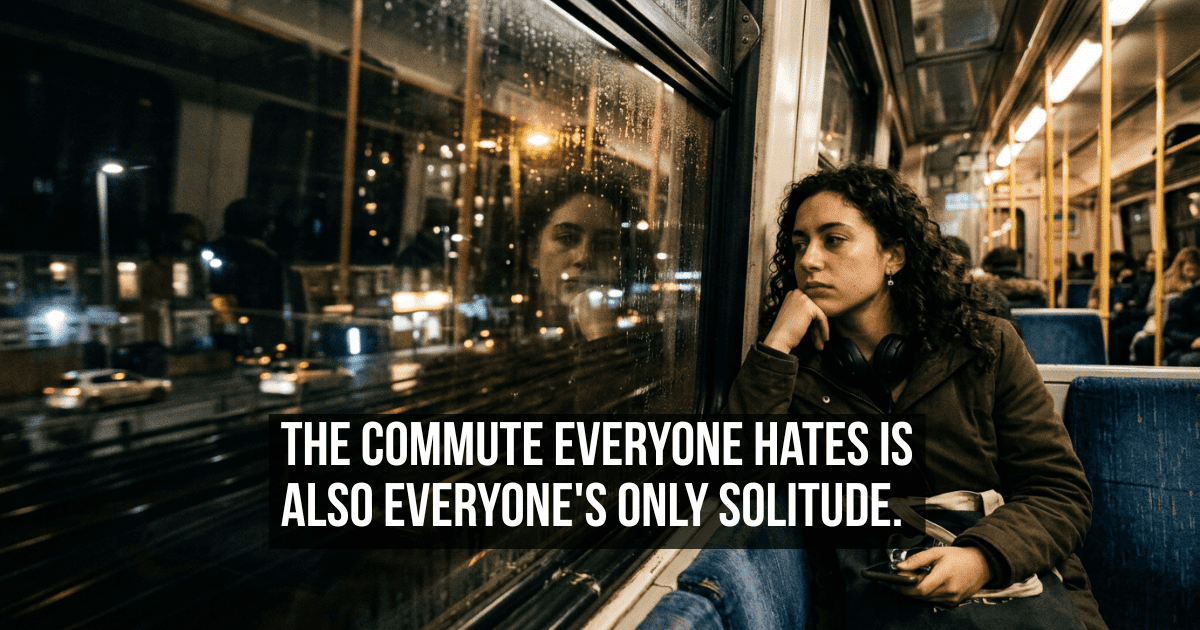
The commute is also, for many people, the only time in the day they spend in genuine solitude. Not the solitude of a room where others might enter, not the theoretical solitude of closed office doors, but the functionally uninterrupted solitude of being surrounded by strangers who have no claim on your attention and no expectation of your engagement.
A suburban parent of young children, a person living with family or housemates, a worker in an open-plan office: for each of these, the commute may represent the longest uninterrupted period of each day in which no one is making demands. The forty minutes on the train, even crowded, even standing, constitutes a protected interval. Headphones complete the isolation. A book or a podcast supplies the permission to be entirely elsewhere without social consequence.
What You Do With the Time
The activities people choose for their commutes are revealing. Podcast listening is the most common addition to commuting behavior in the past decade, with approximately 30 percent of podcast listening occurring during commutes. Music listening is similarly concentrated in this period. Reading is the most commonly expressed aspiration of would-be commuters.
None of these activities is primarily productive in the economic sense. They are activities of mental enrichment, entertainment, or rest that the commuter has chosen because this time — unclaimable by employers, uninterrupted by domestic obligations — is genuinely theirs. The commute is hated while it is happening and protected through the choice of how to use it.
The Grief of Losing It
Remote workers who report missing the commute — and many do, eventually, despite having celebrated its elimination — are typically not missing the transit itself. They are missing the structure it imposed, the permission it granted, and the reliable daily interval of being unavailable to everyone in their life. The commute was not pleasant. It was, in the specific and limited sense of being a period of transition and protected time that belonged to no one else, something closer to necessary.
The most productive thing many people did on their commute was nothing in particular. That is not a trivial claim. The capacity to do nothing in particular, without guilt, in a context that makes demands impossible, is genuinely rare. The commute provided it five days a week, disguised as an obligation.
Something went wrong. Please refresh the page and/or try again.
Help us improve your journey
We use cookies to personalize your experience and understand how you use our site. By clicking 'Yes, I'm in!', you help us show you content you'll actually love. If you prefer to keep things simple, you can stick to the essentials. You can change your mind anytime!
Necessary
Always active
The technical storage or access is strictly necessary for the legitimate purpose of enabling the use of a specific service explicitly requested by the subscriber or user, or for the sole purpose of carrying out the transmission of a communication over an electronic communications network.
Preferences
The technical storage or access is necessary for the legitimate purpose of storing preferences that are not requested by the subscriber or user.
Analytics
The technical storage or access that is used exclusively for statistical purposes.The technical storage or access that is used exclusively for anonymous statistical purposes. Without a subpoena, voluntary compliance on the part of your Internet Service Provider, or additional records from a third party, information stored or retrieved for this purpose alone cannot usually be used to identify you.
Advertising
The technical storage or access is required to create user profiles to send advertising, or to track the user on a website or across several websites for similar marketing purposes.




Leave a Reply