Why You Start Pacing in Circles the Moment You Answer a Phone Call
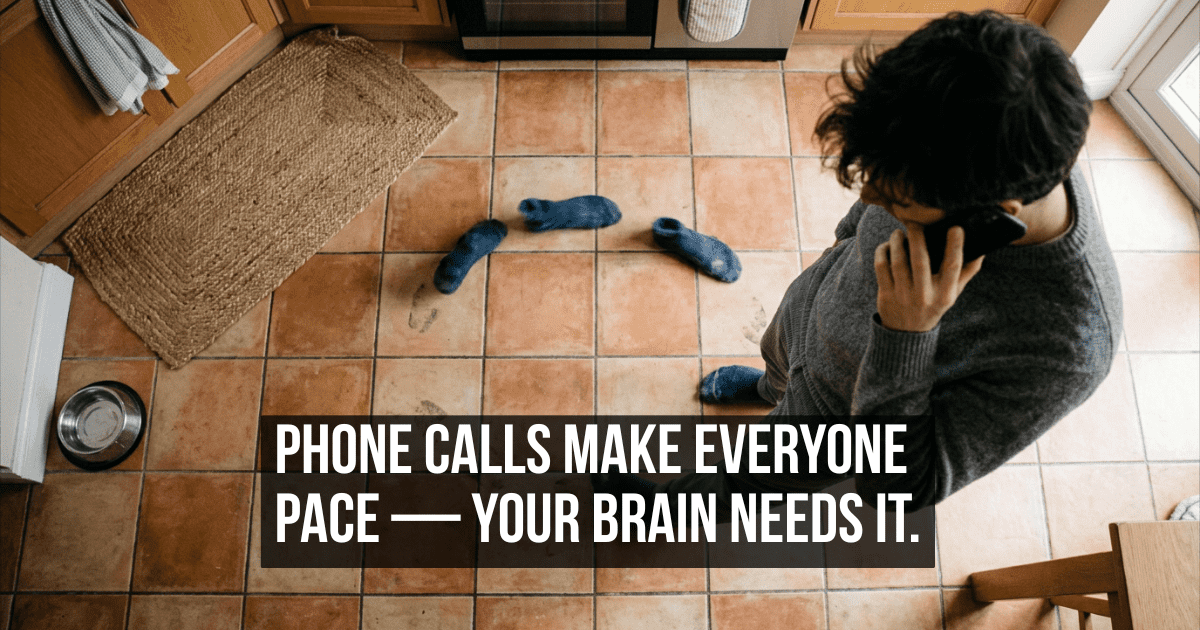
The phone rings. You answer. And within ten seconds, your body is in motion — drifting from the kitchen to the hallway, tracing a slow ellipse around the living room, stopping in front of the window for no particular reason, then turning back. You don’t decide to do this. It just happens.
If you’ve noticed, you probably assumed it was nervous energy, or boredom, or something vaguely restless about your personality. It’s none of those things.
Your Brain Is Self-Optimizing
Pacing during phone calls is one of the most consistent and least examined behaviors in everyday human movement — and the reason behind it is counterintuitive. You don’t pace because you’re distracted. You pace because your brain is working harder than usual, and movement is how it compensates.
Cognitive neuroscientists refer to this as embodied cognition — the established relationship between physical movement and mental processing. Moving your body while thinking, particularly in repetitive low-effort patterns like walking in circles, appears to free up processing capacity in the prefrontal cortex for the task at hand. The movement handles part of the body’s regulatory load, leaving more cognitive space for listening and responding in real time.
What a Phone Call Takes Away
Face-to-face conversation gives your brain a constant stream of visual information — facial expressions, gestures, eye contact — all of which it processes alongside the words it’s hearing. On a phone call, that entire channel goes dark. The brain, deprived of its usual input, compensates by attending more intensely to sound and meaning. That increased cognitive load needs somewhere to go. Movement provides it.
A widely cited Stanford study from 2014 found that creative output increased by an average of 81 percent while walking compared to sitting — suggesting that movement and higher-order thought are linked more tightly than most people assume. A phone call that requires careful listening, real-time negotiation, or emotional attunement is exactly the kind of task that benefits from the accompanying rhythm of steps.
The Oldest Thinking Technology
Walking while thinking is not a modern habit. Aristotle reportedly taught his students while moving through the Lyceum’s colonnaded paths — his followers became known as the Peripatetics, from the Greek word for walking. Thoreau wrote that he could not preserve his health or spirits unless he spent four hours a day on foot. The connection between motion and thought was observed long before anyone had language to describe the mechanism.
What the phone changed is not the behavior but its context. Pacing during conversation was always present — it simply became visible in a new way when calls moved indoors, into offices and kitchens and living rooms where the movement could be noticed. The self-consciousness some people feel about it is new. The pacing itself is ancient. And both the Stoics and the neuroscientists, arriving from entirely different directions, reached the same conclusion about it.
The Body Knew Before You Did
The pacing isn’t a quirk. It’s your nervous system doing what it was built to do, automatically, without being asked.
This also explains why phone calls feel harder to sustain while sitting still — particularly when they’re emotionally complicated or require close attention. The impulse to stand, drift toward the window, trace the same slow ellipse again: it’s not distraction. It’s your body acting as a cognitive tool.
Next time you notice yourself pacing during a call, don’t try to stop. You were already helping yourself think. You just didn’t know you were doing it.
Something went wrong. Please refresh the page and/or try again.
Help us improve your journey
We use cookies to personalize your experience and understand how you use our site. By clicking 'Yes, I'm in!', you help us show you content you'll actually love. If you prefer to keep things simple, you can stick to the essentials. You can change your mind anytime!
Necessary
Always active
The technical storage or access is strictly necessary for the legitimate purpose of enabling the use of a specific service explicitly requested by the subscriber or user, or for the sole purpose of carrying out the transmission of a communication over an electronic communications network.
Preferences
The technical storage or access is necessary for the legitimate purpose of storing preferences that are not requested by the subscriber or user.
Analytics
The technical storage or access that is used exclusively for statistical purposes.The technical storage or access that is used exclusively for anonymous statistical purposes. Without a subpoena, voluntary compliance on the part of your Internet Service Provider, or additional records from a third party, information stored or retrieved for this purpose alone cannot usually be used to identify you.
Advertising
The technical storage or access is required to create user profiles to send advertising, or to track the user on a website or across several websites for similar marketing purposes.




Leave a Reply