You Own Multiple Chargers and Cannot Find One When You Actually Need It
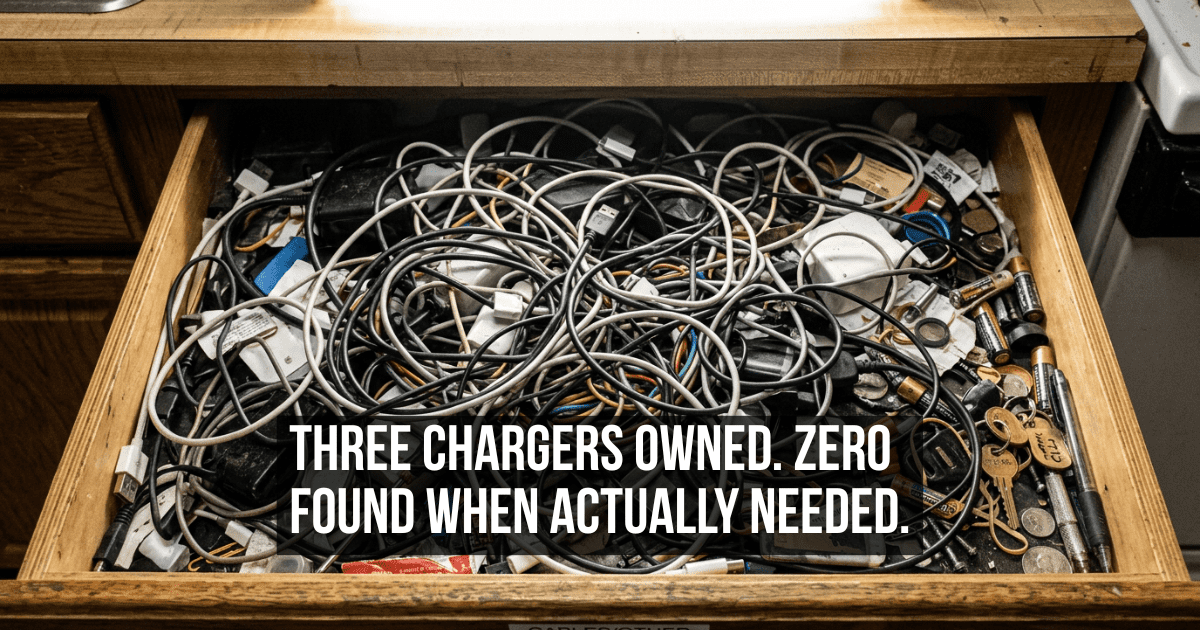
The phone is at four percent. You know you have a charger — you have several, actually, distributed across various rooms in a system that made sense at the time. The desk. The bedside table. Possibly a drawer. You check the desk. You check the drawer. You find a cable for a device you no longer own.
Somewhere in this apartment, there are three chargers. None of them are here.
The Entropy of Small Objects
Chargers occupy a specific category of domestic object: essential, small, identical to other essential small objects, and entirely resistant to organization. Unlike keys, which have the benefit of single-point storage logic, chargers resist consolidation because they’re needed in multiple places. You need one by the bed. One in the bag. One at the desk. The moment you commit to one location, you’ve created a problem somewhere else.
And so you buy another. And another. And somehow you still can’t find one.
The charger problem is really the object-dispersal problem, a specific kind of domestic entropy that scales with the number of devices and the size of the living space. A study from the University of California found that American families collectively spend an average of 2.5 days per year searching for misplaced household items — with small, frequently used objects like cables and chargers among the most common culprits.
The Logic of Accumulation
What makes charger ownership genuinely strange is the accumulation pattern. Most people have more chargers than they need and fewer than they can find. They breed in certain drawers and vanish from certain rooms, following a logic that feels almost deliberate.
The reason is context migration. Chargers travel with the device, then get left where the device was last used, then become invisible because small objects on surfaces become part of the background. After two days in the same spot, a charger is no longer a charger — it’s scenery.
The solution that works — color-coding, designated charging stations, dedicated cable storage — requires a degree of system-building that the urgency of a four-percent battery simply never produces. You solve the immediate crisis with a borrowed cable or a frantic room search, and the conditions that produced it remain entirely unchanged.
The Relief of Buying Another
The most revealing moment in the charger problem is not the four-percent panic. It’s the thought, about ninety seconds into the search, that it would be faster to just order a new one.
This thought is usually correct as a time calculation. A replacement cable arrives tomorrow. Finding the existing ones might take twenty minutes and produce nothing. What the purchase also does, though, is sidestep the organizing problem entirely. You don’t need a system; you need more inventory. The new charger goes by the desk. The ones elsewhere stay wherever they are. In a week, you’ll have four chargers you cannot locate and two you can.
The Real Frustration
The charger problem isn’t really about chargers. It’s about the gap between the organizational systems you intend to implement and the ones you actually maintain under the actual conditions of your actual life.
You know how to solve this. You have solved it, briefly, twice. And within a week, the cables had migrated back to wherever cables go when no one is looking.
The phone is now at two percent. One of the chargers will turn up eventually. It always does.
Something went wrong. Please refresh the page and/or try again.
Help us improve your journey
We use cookies to personalize your experience and understand how you use our site. By clicking 'Yes, I'm in!', you help us show you content you'll actually love. If you prefer to keep things simple, you can stick to the essentials. You can change your mind anytime!
Necessary
Always active
The technical storage or access is strictly necessary for the legitimate purpose of enabling the use of a specific service explicitly requested by the subscriber or user, or for the sole purpose of carrying out the transmission of a communication over an electronic communications network.
Preferences
The technical storage or access is necessary for the legitimate purpose of storing preferences that are not requested by the subscriber or user.
Analytics
The technical storage or access that is used exclusively for statistical purposes.The technical storage or access that is used exclusively for anonymous statistical purposes. Without a subpoena, voluntary compliance on the part of your Internet Service Provider, or additional records from a third party, information stored or retrieved for this purpose alone cannot usually be used to identify you.
Advertising
The technical storage or access is required to create user profiles to send advertising, or to track the user on a website or across several websites for similar marketing purposes.




Leave a Reply