That One Drawer Maps Everything You Started and Never Got Around to Finishing
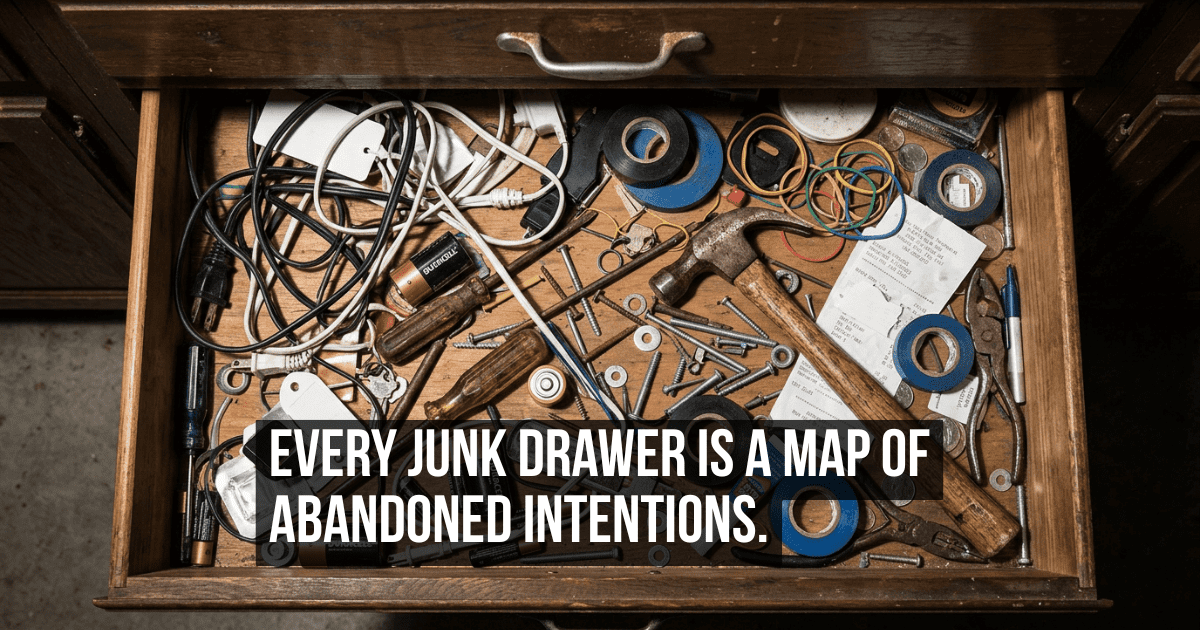
Every home has one. A kitchen drawer, or a box, or a corner of the desk that’s become semi-permanent. Inside: a battery of uncertain charge, a cable for something that no longer exists, takeaway menus for restaurants you’ve never ordered from, a button that came with a coat, a USB stick from 2014, a key with no door.
You know exactly which drawer this is. You probably haven’t opened it in three weeks.
The Archive of Intentions
The junk drawer is one of the most democratic domestic objects. It exists across income levels, living arrangements, and organizational philosophies with a consistency that suggests it’s meeting a need that the organized home doesn’t officially provide. The person with a minimalist apartment and a strict tidying practice still has a junk drawer. They may have relocated it — to a box, a shelf, a bag — but it exists.
The contents have a specific character: they’re almost never genuine rubbish. Actual rubbish gets thrown away. The junk drawer holds things that you might need, or that have sentimental weight too slight for display but too real for the bin, or that belong in a category you haven’t created yet. Everything in it was put there by a decision to defer — to postpone the question of where it belongs until the question becomes urgent, which it never does.
What Gets Kept and Why
Research on hoarding behavior — at its functional, non-clinical end — consistently finds that objects are kept less because of their utility and more because of the decision cost of discarding them. Throwing something away is irreversible. Putting it in the drawer is not. The drawer defers the choice indefinitely at minimal spatial cost, which makes it the rational option for every object whose value is ambiguous.
The battery might still work. The key might matter. The USB stick might contain something. The calculation is always the same: the cost of keeping it is negligible, the cost of discarding it and being wrong is non-trivial. Into the drawer it goes.
Over time, the drawer becomes a sedimentary record of every ambiguous object the home has produced. The layers at the bottom are months old. The things on top are from this week. Between them, if you were to excavate, you’d find a fairly accurate timeline of the projects started, the promises made, the categories that never got organized.
The Cleaning Out You Keep Postponing
The junk drawer is periodically opened with the intention of sorting. The contents spread across the counter. Five minutes in, you’ve identified three things as definitely rubbish, two as definitely keepers, and seventeen as still ambiguous. The drawer is reconstituted at approximately the same volume. The project is abandoned.
This pattern is almost universal. Sorting requires a series of small but real decisions about objects whose category is genuinely uncertain — and uncertainty is cognitively expensive. Each object requires its own evaluation: does the key belong to anything, is the warranty still valid, does anyone still make the device the cable fits. The task is boring and hard at the same time, which is the worst combination for completion. The drawer survives not because people are lazy, but because the alternative is genuinely demanding.
The Map It Draws
The junk drawer is an unintentional autobiography. Not of who you are, but of the gap between your intentions and your follow-through on small administrative tasks over the past few years.
Everything in there was put there by a version of you who meant to deal with it eventually. Most of it will stay there until you move house, at which point it will be emptied into a bag and approximately half of it will turn out to be genuinely dispensable after all.
You already know which half. You’ve known for a while.
Something went wrong. Please refresh the page and/or try again.
Help us improve your journey
We use cookies to personalize your experience and understand how you use our site. By clicking 'Yes, I'm in!', you help us show you content you'll actually love. If you prefer to keep things simple, you can stick to the essentials. You can change your mind anytime!
Necessary
Always active
The technical storage or access is strictly necessary for the legitimate purpose of enabling the use of a specific service explicitly requested by the subscriber or user, or for the sole purpose of carrying out the transmission of a communication over an electronic communications network.
Preferences
The technical storage or access is necessary for the legitimate purpose of storing preferences that are not requested by the subscriber or user.
Analytics
The technical storage or access that is used exclusively for statistical purposes.The technical storage or access that is used exclusively for anonymous statistical purposes. Without a subpoena, voluntary compliance on the part of your Internet Service Provider, or additional records from a third party, information stored or retrieved for this purpose alone cannot usually be used to identify you.
Advertising
The technical storage or access is required to create user profiles to send advertising, or to track the user on a website or across several websites for similar marketing purposes.




Leave a Reply