Why You Follow the Exact Same Route Every Time You Go Grocery Shopping
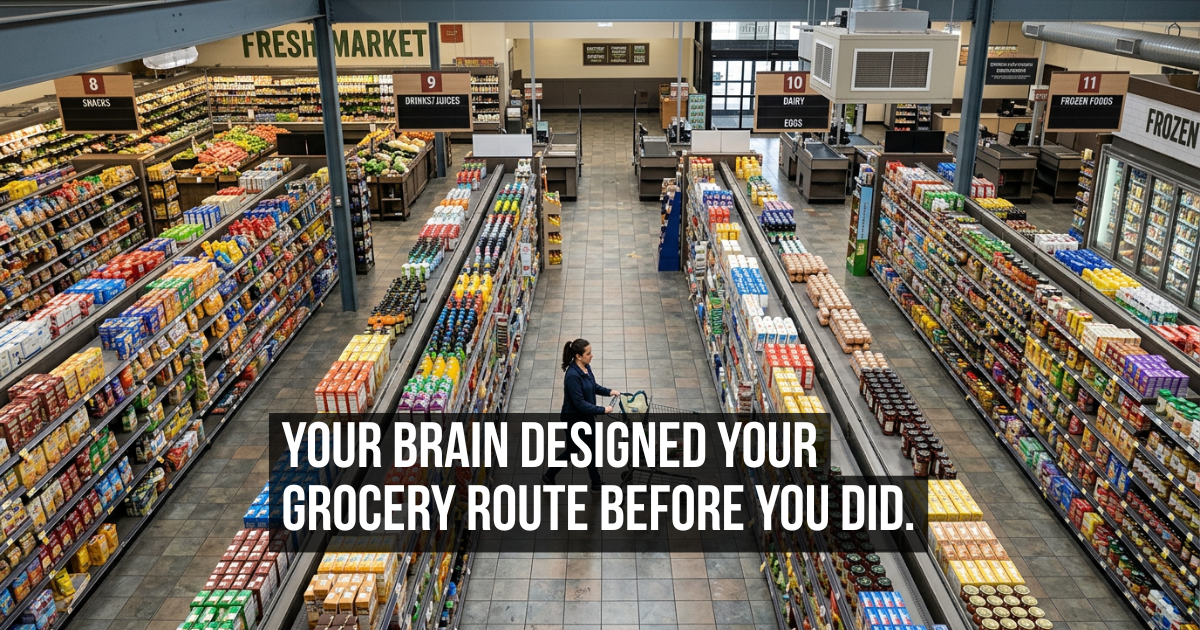
You enter through the same door. You go to the same section first — produce, usually, or whatever the habit is — and you trace the same approximate path, aisle by aisle, in the same direction, finishing in roughly the same corner before the checkout. You’ve been doing this in this particular shop for two years. You’ve never thought about it once.
It looks like efficiency. The reality is more interesting.
The Cognitive Cost of a Supermarket
A modern supermarket contains between 15,000 and 50,000 distinct products. Every visit involves hundreds of micro-decisions: what to take, what to leave, what to compare, what to evaluate. The physical environment is designed — deliberately and in significant detail — to maximize the number of decisions you make while inside, because more decisions produce more purchases.
The habitual route is your response to this. Not a conscious counter-strategy, but an evolved one: the repetition of a path that worked before, preserved because varying it costs more than it gains. Neuroscience research on navigation and habit formation shows that familiar routes activate basal ganglia circuits — the brain’s habit system — rather than the prefrontal cortex, which handles deliberate decision-making. The familiar route runs cheap. A new one costs attention you might need elsewhere.
What the Route Is Actually Doing
The fixed grocery route is a form of environmental automation. By establishing a predictable path, you outsource the navigational decisions to memory and free cognitive resources for the decisions that actually matter: whether you need more of something, whether a price seems right, whether to deviate for something unplanned.
Shoppers who deviate from habitual routes — by entering through a different door, or visiting a different branch — consistently spend more. Research from the Journal of Marketing Research found that environmental disruption in retail settings increases exploratory behavior, which translates directly into additional unplanned purchases. The unfamiliar route exposes you to products you’ve trained yourself not to see.
Your habitual route, in other words, is a partial defense against the store’s design. Not a complete one, but something.
The Unfamiliar Store
The extent of your reliance on the habitual route becomes clear the first time you shop somewhere unfamiliar. A different branch, a different shop entirely, the local supermarket in a holiday destination. The cognitive load is immediate and surprising: you’re making explicit navigational decisions that you haven’t consciously made in years.
Where is the bread? Is dairy at the back or the side? Where do they keep the pasta? Simple questions, answerable in seconds, but requiring active problem-solving in a way your usual shop doesn’t. You spend more time. You miss things. You buy things you didn’t need because you walked past them while looking for something else.
The disorientation isn’t incompetence. It’s evidence of how much invisible competence the habitual route was supplying.
The Section You Always Skip
Every fixed route has a section it avoids. The aisle you’ve never had a reason to enter, the corner that’s always slightly out of the way, the products you’ve never needed and therefore never noticed. The route is partly defined by what it excludes.
The next time you buy something from a section outside your usual path, pause and notice what prompted the deviation. Something broke the pattern — a display, a promotion, a recommendation, a moment of boredom. The store produced it. The path you always take exists, in part, to resist it.
You didn’t develop the habit consciously. But it’s been protecting you anyway.
Something went wrong. Please refresh the page and/or try again.
Help us improve your journey
We use cookies to personalize your experience and understand how you use our site. By clicking 'Yes, I'm in!', you help us show you content you'll actually love. If you prefer to keep things simple, you can stick to the essentials. You can change your mind anytime!
Necessary
Always active
The technical storage or access is strictly necessary for the legitimate purpose of enabling the use of a specific service explicitly requested by the subscriber or user, or for the sole purpose of carrying out the transmission of a communication over an electronic communications network.
Preferences
The technical storage or access is necessary for the legitimate purpose of storing preferences that are not requested by the subscriber or user.
Analytics
The technical storage or access that is used exclusively for statistical purposes.The technical storage or access that is used exclusively for anonymous statistical purposes. Without a subpoena, voluntary compliance on the part of your Internet Service Provider, or additional records from a third party, information stored or retrieved for this purpose alone cannot usually be used to identify you.
Advertising
The technical storage or access is required to create user profiles to send advertising, or to track the user on a website or across several websites for similar marketing purposes.




Leave a Reply