Nobody Has Fully Explained Why Standing Silently in a Queue Feels Like a Social Contract
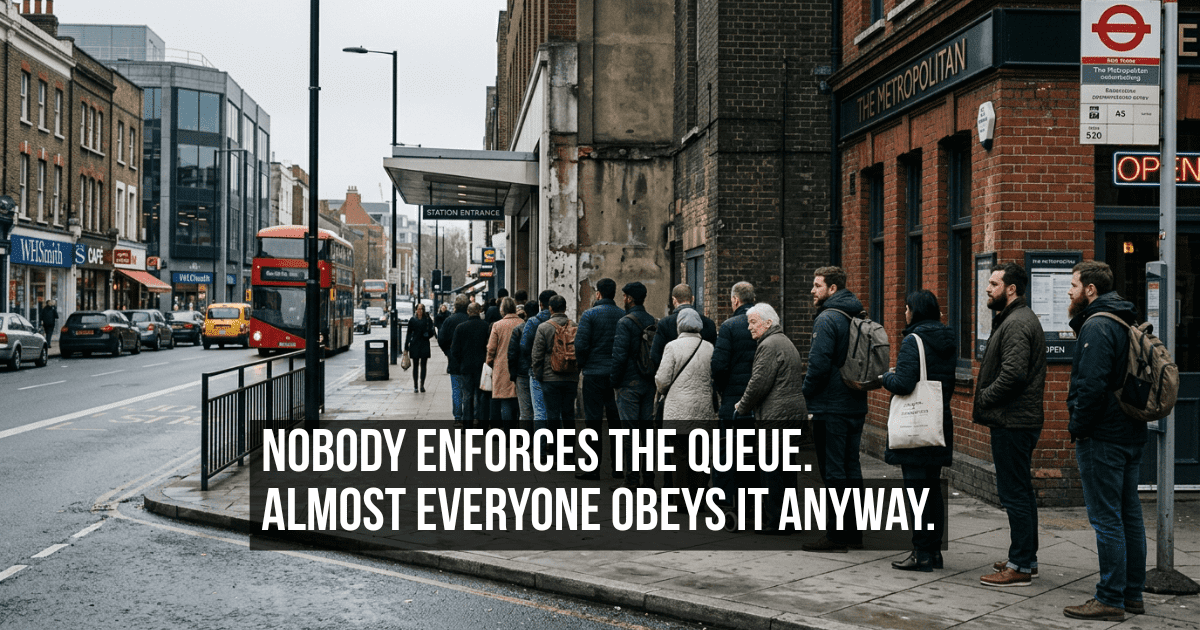
The queue is a remarkable social institution. Without formal agreement, without legal enforcement, without any mechanism beyond mutual expectation, thousands of strangers line up behind one another at bus stops, supermarket checkouts, passport control booths, and hospital waiting rooms — and wait, in largely voluntary order, for their turn. Someone who has been waiting longer goes first. Someone who arrives later waits. The rule is understood universally in contexts where queues form, almost never articulated, and almost never questioned.
Why is it so stable? Why do people follow it when the cost of not following it — simply walking to the front — is usually only social disapproval? And what happens, in the mind of someone standing in a queue, that sustains the behavior without any authority requiring it?
The Queue as Informal Institution
Economists and sociologists who study queue behavior have identified it as one of the most robust informal institutions in public life. Unlike formal institutions, which require explicit rules, enforcement mechanisms, and assigned authority, the queue sustains itself through a shared normative framework: the principle of first-in, first-served is experienced as fair, and fairness generates compliance even when non-compliance would go unpunished.
Experimental studies consistently find that people will abandon their position in a queue rather than jump it, even when jumping would cost them nothing except a momentary social discomfort. The aversion to being seen as a queue-jumper is stronger than the rational calculation of what queue-jumping would save. The social sanction — disapproving looks, audible complaints from other waiters — functions as sufficient deterrent in most contexts.
The Silence Is Part of the Contract
What is rarely acknowledged is how much the silence in a queue does. Standing in a queue requires a specific behavioral package: forward orientation, minimal lateral movement, no attempt to engage with those ahead unless they have initiated contact, and the suppression of impatience beyond a socially legible minimum. The queue demands that you perform waiting credibly, even when the waiting is uncomfortable.
The silence functions as mutual acknowledgment: I am accepting my position in this order and you are accepting yours. To break the silence with complaints, conversation, or attempts to negotiate priority is to break the social contract that the queue is built on. The silence is not antisocial — it is the queue’s operating language.
Cross-Cultural Variation and Its Limits
The queue is sometimes described as a specifically British institution, and Britons do exhibit queue behavior with unusual consistency and what appears to be genuine emotional investment in its maintenance. In other cultural contexts, the queue is less absolute: in parts of Southern Europe, the Middle East, and South Asia, social proximity, personal relationships, and verbal assertion can legitimately override strict first-in order in ways that British queue culture would register as serious violations.
The variation reveals that the specific form of the queue — its silence, its physical linearity, its strict ordinal logic — is culturally specific. The underlying principle it encodes — that people who have been waiting longer have some kind of prior claim — appears nearly universal. The implementation differs; the fairness norm that sustains it does not.
What the Queue Is Doing to You While You Wait
Psychological research on queuing has produced a consistent finding: the experience of waiting is shaped far more by the perceived fairness of the wait than by its actual duration. People who believe they are waiting in a fair system — one where order is maintained and jumping is not occurring — tolerate significantly longer waits than people in the same physical time period who perceive the system to be unfair.
The queue’s function, then, is partly administrative (managing access to a limited resource) and partly psychological (making the wait feel legitimate). The silence is not incidental to this second function. It is the mechanism through which the social contract is continuously reaffirmed. Each person waiting quietly in their position is, without saying anything, communicating that they accept the terms. The queue works because everyone in it simultaneously agrees to make it work, every minute it exists, without anyone having to say so.



Leave a Reply