Nobody Has Fully Explained Why Car Honking Culture Varies So Dramatically Between Cities
Drive through Cairo and the horn is continuous — not aggressive, but ambient, a layer of the city’s acoustic texture as natural as traffic noise. Drive through Tokyo and you might go an entire journey without hearing a single horn. In New York, honking is confrontational. In Beirut, it is conversational. In Stockholm, it is unusual enough to make passengers look up.
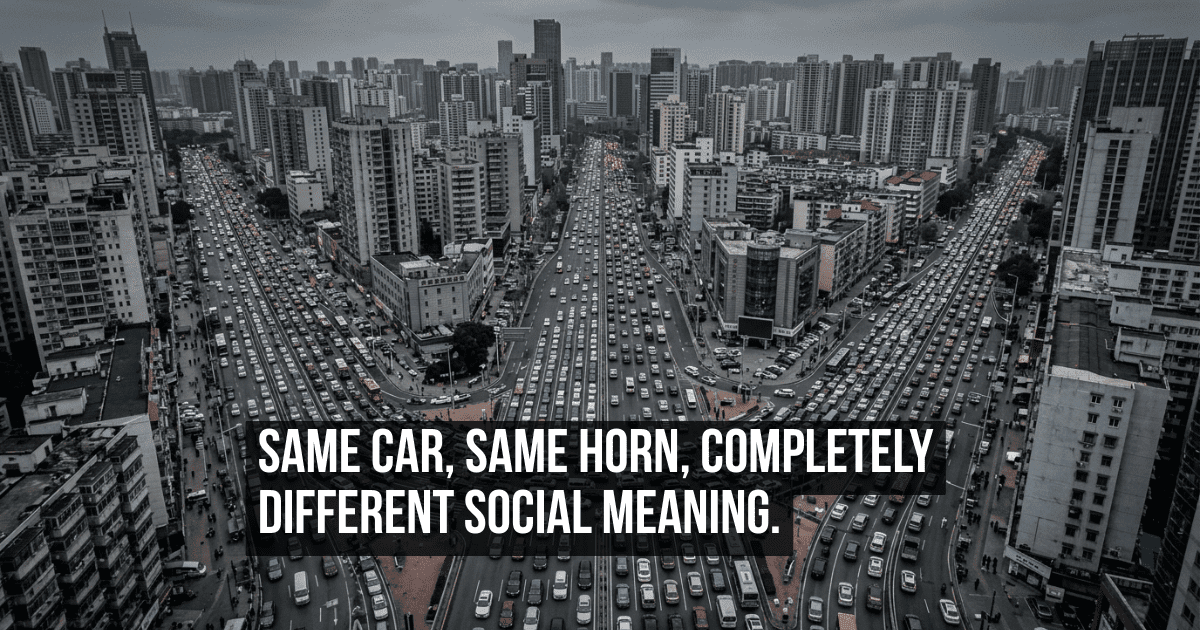
The same physical action — a driver pressing a button that produces a sound — carries completely different social meanings depending on where it happens. No international agreement determined these meanings. No city planner designed them. They emerged from local social contracts about what public space is for, and they are maintained by the same mechanism that maintains all social norms: the expectation that other people will behave consistently, and the mild social sanction applied to those who don’t.
The Horn as Communication System
In high-honking cultures, the horn is a communication tool with a developed grammar. Different patterns of honking carry distinct meanings that experienced drivers read automatically. A short single tap in Cairo traffic can mean “I’m passing on your left.” Two quick taps from a taxi mean “I have seen you and I’m available.” A sustained horn in a gridlocked intersection is closer to a collective expression of displeasure than a message directed at any individual. The horn, in these contexts, is not rude. It is informative — a real-time broadcast of spatial intention in an environment where vehicles interact at close range and high frequency.
In low-honking cultures, the horn has a much narrower semantic range and is reserved almost exclusively for emergency warning. Using it in circumstances that don’t constitute an emergency — to express frustration, to signal intention, to prompt a slow driver — reads as aggression or at minimum as social coarseness. The same sound carries the same information; the social frame in which it is interpreted makes it either useful communication or hostile act.
What Drives the Difference
Researchers studying cross-cultural variation in honking behavior have identified several correlating factors, none of which is individually sufficient to explain the variation but which together form a reasonably coherent picture.
Traffic density matters: cities where driving involves frequent close-proximity interaction develop richer horn communication because the spatial information it conveys is more frequently needed. Infrastructure design matters: cities where roads lack clear lane markings, where traffic lights are sparse, and where pedestrian and vehicle traffic mixes without strict separation develop honking as a safety communication tool. Cultural attitudes toward public expression of assertiveness and impatience also correlate: societies with higher tolerance for public confrontation tend to have higher honking rates. Legal frameworks matter at the margins but appear less significant than social norms — Paris technically bans non-emergency horn use in the city center; this law is observed with what might generously be described as flexibility.
The Norm Is Self-Reinforcing
What maintains the difference between high-honking and low-honking cultures is the same mechanism that maintains most social norms: the behavior of others sets the expectation, and deviation from the norm is socially costly. In Tokyo, honking without clear justification attracts negative social attention. The deterrent is sufficient to maintain a low-honking equilibrium even in dense traffic conditions that might, in another city, produce constant horn use.
The norm is also genuinely stable over time. Immigrants who drive in new cities typically adapt to local honking norms relatively quickly — not because they consciously learn rules, but because social feedback from other drivers and pedestrians calibrates their behavior toward the local baseline. The horn norm is absorbed the way most cultural norms are absorbed: through observation, imitation, and the mild discomfort of deviation.
What the Variation Reveals
Car horn culture is a minor phenomenon with a revealing implication: behaviors that feel entirely natural — so natural that their opposite seems aberrant — are entirely contingent on the social environment that produced them. The driver in Cairo who honks continuously would find Tokyo’s silence eerie and its driving somehow less safe, because the communication channel they rely on has gone dark. The Tokyo driver in Cairo finds the noise aggressive, because in their context it would mean something very different from what it means here.
Neither is wrong. They are each operating correctly within a different but internally coherent social system, built from the same object, expressing the same basic human need to navigate shared space, and arriving at entirely different solutions.
Something went wrong. Please refresh the page and/or try again.
Help us improve your journey
We use cookies to personalize your experience and understand how you use our site. By clicking 'Yes, I'm in!', you help us show you content you'll actually love. If you prefer to keep things simple, you can stick to the essentials. You can change your mind anytime!
Necessary
Always active
The technical storage or access is strictly necessary for the legitimate purpose of enabling the use of a specific service explicitly requested by the subscriber or user, or for the sole purpose of carrying out the transmission of a communication over an electronic communications network.
Preferences
The technical storage or access is necessary for the legitimate purpose of storing preferences that are not requested by the subscriber or user.
Analytics
The technical storage or access that is used exclusively for statistical purposes.The technical storage or access that is used exclusively for anonymous statistical purposes. Without a subpoena, voluntary compliance on the part of your Internet Service Provider, or additional records from a third party, information stored or retrieved for this purpose alone cannot usually be used to identify you.
Advertising
The technical storage or access is required to create user profiles to send advertising, or to track the user on a website or across several websites for similar marketing purposes.




Leave a Reply