The Secondhand Clothing Economy Is Still Fast Fashion With a More Expensive Environmental Conscience
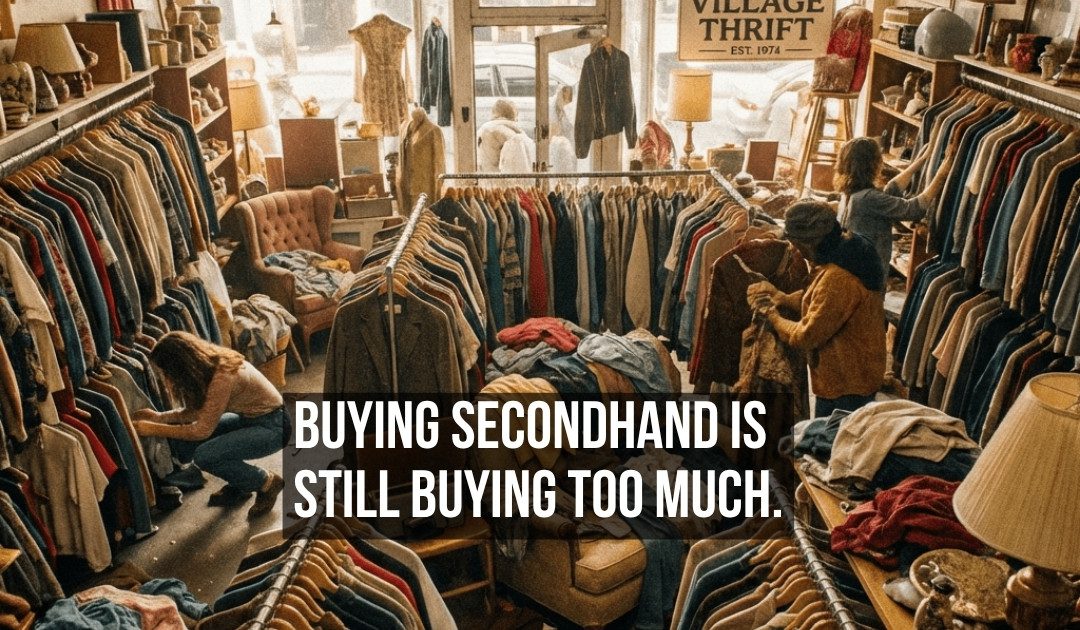
Buying secondhand feels like resistance. Scrolling through Vinted at midnight, filling a cart on Depop, sourcing vintage at the Sunday market — these feel like principled alternatives to the destruction of fast fashion. The math is more complicated. The same pattern is documented in how recycling became a corporate lie — a genuine idea absorbed into the commercial machinery it was meant to challenge.
The Rebound Effect
The secondhand market has grown explosively. ThredUp’s annual resale report estimates the global secondhand clothing market will reach $350 billion by 2027, growing three times faster than the broader apparel market, with Vinted alone reporting over 65 million users across Europe. The narrative is seductive: buying existing clothes reduces demand for new production, shrinks the carbon footprint of clothing consumption, and extends the useful life of garments that would otherwise be discarded.
The critical variable the narrative omits is total volume. The rebound effect, well documented in behavioral economics, describes what happens when the perceived cost of a behavior decreases through lower prices, environmental justification, or reduced guilt: consumption of that behavior tends to increase to compensate. Secondhand clothing is dramatically cheaper than new fast fashion. For many consumers, the result is not substitution but addition — buying the secondhand item while continuing to purchase new items at the same rate, having neutralized the guilt that might otherwise have acted as a brake.
A 2022 study in the Journal of Cleaner Production found that secondhand apparel purchases reduced new clothing purchases in some consumer segments, but in others — particularly younger urban consumers with high fashion engagement — secondhand shopping significantly increased total clothing acquisition volume. The platform that made ethical consumption convenient simultaneously made consumption itself far more frequent.
The Infrastructure Nobody Discusses
There is also a logistics problem. Shipping individual secondhand garments between individual buyers and sellers — the core of platform-based resale — generates per-unit carbon emissions that can approach or exceed those of buying a new, locally manufactured item. A secondhand jacket shipped from Berlin to Milan carries a footprint that the buyer never sees itemized at checkout, and the platform has no incentive to make it visible. The structural displacement of responsibility onto the consumer is the same mechanism examined in how big oil invented the carbon footprint.
The deeper issue is that the secondhand boom has become, for the fashion industry, a convenient deflection. H&M, Zara, and other fast fashion brands have launched their own resale platforms, branding themselves as circular economy participants while continuing to increase new production volumes. The resale market has been incorporated into the system it was meant to challenge.
The most ecologically sound behavior remains acquiring fewer garments, regardless of their origin. An unworn secondhand item still represents a resource extracted and a production process completed. The secondhand economy is real and growing. But it is also, increasingly, another shopping category — one whose ethical branding has been adopted so fluently by the commercial machinery it sought to avoid that the distinction is becoming difficult to locate.
The microfibre pollution dimension compounds the picture. Synthetic fabrics — polyester, nylon, acrylic — shed microscopic plastic fibres with every wash cycle, fibres that pass through standard wastewater treatment and enter waterways and marine food chains. The secondhand market recirculates these fabrics indefinitely; the fibres continue shedding regardless of how many times the garment has changed hands. The garment’s second or third owner generates the same microplastic pollution as its first, a cost that no circular economy framing has yet accounted for. The same consumer-responsibility displacement is at work in why electric cars won’t save the planet — individual choices cannot resolve systemic production failures.
The most accurate framing of the secondhand market is not that it is bad, but that it is insufficient as a primary strategy. It addresses the symptom — garment disposal — without touching the cause, which is production volume. An industry that produces 100 billion garments annually and recirculates 10 percent of them has not solved a problem. It has added a secondary market to an unresolved primary one, and given consumers a story that makes continued participation feel principled.
Buying secondhand is, in general, better than buying new — if the volumes stay equivalent. The problem is the framing that transforms shopping into activism. The most honest question to ask before any purchase, secondhand or new, remains the one the industry would prefer you not ask: do I need this at all?
Something went wrong. Please refresh the page and/or try again.
Help us improve your journey
We use cookies to personalize your experience and understand how you use our site. By clicking 'Yes, I'm in!', you help us show you content you'll actually love. If you prefer to keep things simple, you can stick to the essentials. You can change your mind anytime!
Necessary
Always active
The technical storage or access is strictly necessary for the legitimate purpose of enabling the use of a specific service explicitly requested by the subscriber or user, or for the sole purpose of carrying out the transmission of a communication over an electronic communications network.
Preferences
The technical storage or access is necessary for the legitimate purpose of storing preferences that are not requested by the subscriber or user.
Analytics
The technical storage or access that is used exclusively for statistical purposes.The technical storage or access that is used exclusively for anonymous statistical purposes. Without a subpoena, voluntary compliance on the part of your Internet Service Provider, or additional records from a third party, information stored or retrieved for this purpose alone cannot usually be used to identify you.
Advertising
The technical storage or access is required to create user profiles to send advertising, or to track the user on a website or across several websites for similar marketing purposes.




Leave a Reply