Brushing Your Teeth in the Same Sequence Every Morning Without Ever Having Chosen It
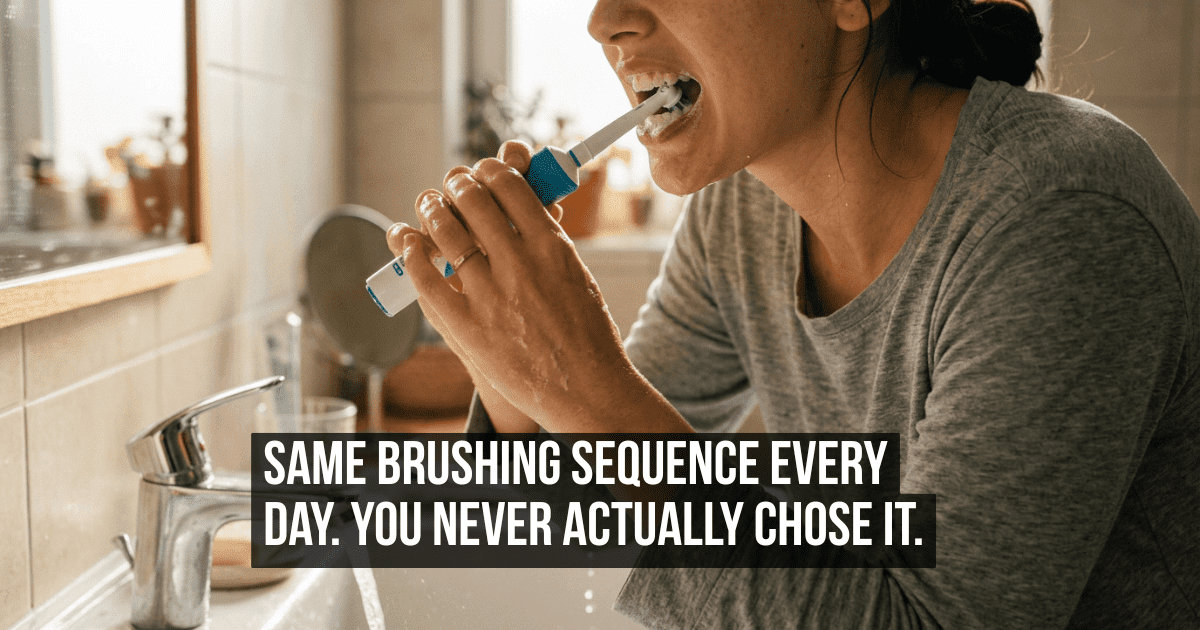
Top row of teeth first. Then bottom. Then back left, back right, front again. Or some version of this, a specific quadrant sequence, a particular direction of stroke, a duration at each section that you could probably reproduce to within a few seconds without thinking about it. You’ve been doing it this way since some point in childhood. You have never decided to do it this way.
Toothbrushing is one of the most automated sequences in daily human behavior, and nobody chose their version of it.
The Fully Automated Routine
Behavioral scientists who study habitual behavior use the phrase cognitive offloading to describe what happens when a frequently repeated sequence becomes automatic: the prefrontal cortex, which handles deliberate planning and decision-making, cedes control to the basal ganglia, which runs fixed motor programs efficiently and without conscious oversight. The sequence runs; the mind goes elsewhere.
Toothbrushing is the canonical example of this process. A 2006 study from Duke University, which tracked how much of daily behavior runs on automatic pilot, identified oral hygiene routines as among the most deeply habituated sequences in the adult repertoire. Not because brushing is complex, it isn’t, but because it happens at the same time, in the same location, in the same physical state, with the same equipment, twice daily, for decades. No behavior trains the automatic system more effectively than one this consistent.
What the Dentist Sees
The paradox of the automated brushing sequence is that it tends to preserve whatever errors were present when the habit was established. Most people have a consistent weak spot in their brushing, an area they reach less reliably, a surface they miss at the same angle each time. The routine that’s efficient because it’s automatic is also the routine that repeats its own mistakes without feedback.
Dentists observe this in the consistent plaque distribution of long-term patients: the same quadrant consistently less clean, the same surface consistently missed, across decades of twice-daily brushing. The sequence is thorough everywhere the sequence always was. The gap is wherever the original habit left a gap. Dental hygienists who teach proper technique advise breaking the sequence deliberately, starting from a different tooth, reversing direction, making the automatic conscious again. Most people find this surprisingly disorienting.
What Changes When You Travel
The disruption of environment is the single most reliable way to temporarily interrupt the automated brushing sequence. In a hotel bathroom, with different mirror placement, different lighting, and a travel toothbrush rather than the familiar one, the routine often runs differently. People start from the wrong quadrant, switch direction mid-sequence, take slightly longer because the automation hasn’t fully engaged with the unfamiliar spatial cues.
This is the same mechanism that makes hotel showers disruptive, and unfamiliar kitchens slower. The body’s automated sequences are stored with their environmental context. Remove the context, and the automation loses some of its efficiency. You notice this in the hotel bathroom. By the second or third night in the same room, the sequence is running automatically again, reconstructed from the new context. The efficiency is remarkable. The flexibility is minimal.
Two Minutes That Went Elsewhere
The average toothbrushing session, across most adults, runs between forty-five seconds and ninety, significantly short of the dentist-recommended two minutes. The sequence is automated, but the duration isn’t calibrated to any standard. It ends when it feels finished, which is when the routine has run its course, which is usually before two minutes have elapsed.
Where does the mind go during those forty-five seconds? Nowhere in particular. The routine runs without you. You’re already in the next thing, or still in the last one, or simply elsewhere, while your hands complete a sequence established before you were old enough to have a deliberate opinion about it.
The teeth get brushed. The sequence runs. You had almost nothing to do with it.
Something went wrong. Please refresh the page and/or try again.
Help us improve your journey
We use cookies to personalize your experience and understand how you use our site. By clicking 'Yes, I'm in!', you help us show you content you'll actually love. If you prefer to keep things simple, you can stick to the essentials. You can change your mind anytime!
Necessary
Always active
The technical storage or access is strictly necessary for the legitimate purpose of enabling the use of a specific service explicitly requested by the subscriber or user, or for the sole purpose of carrying out the transmission of a communication over an electronic communications network.
Preferences
The technical storage or access is necessary for the legitimate purpose of storing preferences that are not requested by the subscriber or user.
Analytics
The technical storage or access that is used exclusively for statistical purposes.The technical storage or access that is used exclusively for anonymous statistical purposes. Without a subpoena, voluntary compliance on the part of your Internet Service Provider, or additional records from a third party, information stored or retrieved for this purpose alone cannot usually be used to identify you.
Advertising
The technical storage or access is required to create user profiles to send advertising, or to track the user on a website or across several websites for similar marketing purposes.




Leave a Reply