Why Airports Make Perfectly Normal People Behave in Ways They Would Never Consider Anywhere Else
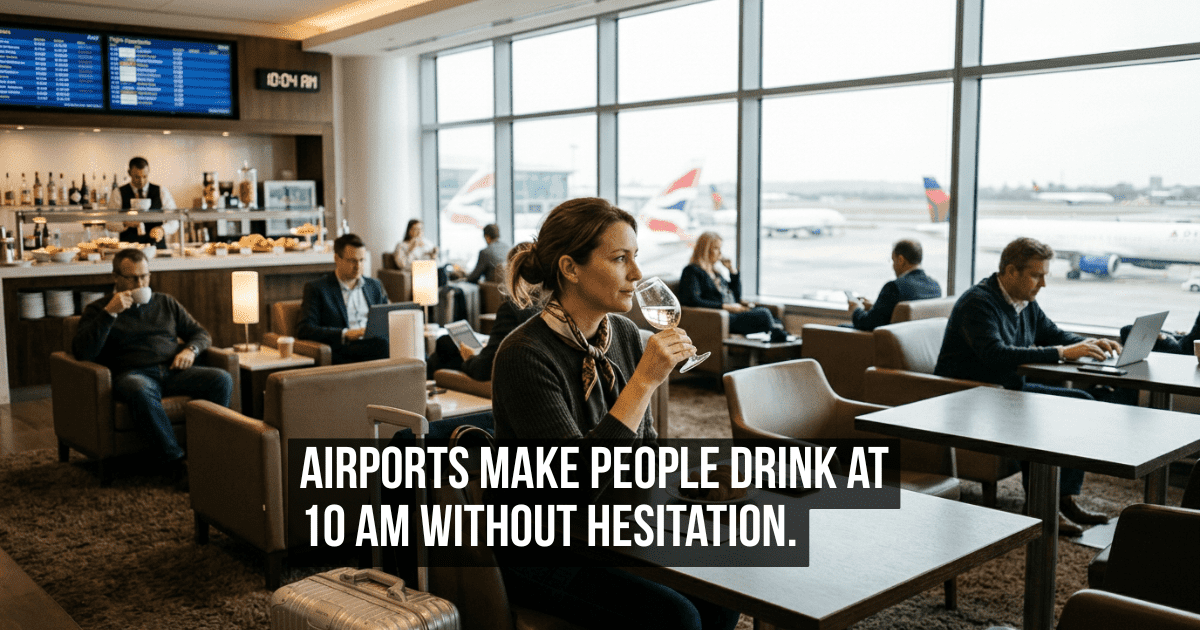
Something happens to people in airports. The person who would never eat a burger at nine in the morning orders one at the departure gate without apparent discomfort. The person who manages their alcohol intake carefully accepts a glass of wine at eleven AM because the flight is in two hours. The person who has not bought a novel in three years stands in WHSmith for fifteen minutes choosing one with total seriousness. Rules that govern ordinary life — about food timing, alcohol consumption, impulse purchasing, social interaction with strangers, and the general conduct of a disciplined adult — quietly suspend themselves, and the airport becomes a zone of temporary behavioral exception that most of its occupants neither planned nor consciously chose.
The airport is one of the few environments in contemporary life specifically engineered to produce this suspension — and the engineering is more deliberate than it appears.
The Liminal Zone
Anthropologists use the term liminal — from the Latin limen, threshold — to describe states of in-betweenness: the condition of being neither here nor there, neither what you were nor what you are about to become. Rituals of transition in traditional cultures involved liminal phases in which the normal social rules were suspended, the ordinary identity temporarily dissolved, and the person existed in a structurally ambiguous state between social positions.
The airport is a secular version of this structure. You have left your ordinary location but not arrived at your destination. Your usual social context — the people, places, and routines that constitute your daily identity — is absent. The people around you are strangers who will not witness your behavior in any social context where it might matter. You are nobody here in the specific sense that nobody knows who you are, and this anonymity licenses a temporary freedom from the behavioral constraints that your ordinary identity imposes.
The Architecture of Suspension
Airports are among the most carefully designed behavioral environments on earth. The placement of retail, food, and alcohol vendors within terminals is not accidental: airports negotiate revenue-sharing arrangements with their tenants and design pedestrian traffic flows to maximize exposure to commercial opportunities. The path from security to the gate passes through duty-free perfume sections, past restaurant frontages positioned at decision points, alongside shops that sell items — cashmere scarves, luxury chocolates, noise-cancelling headphones — whose price points would trigger resistance in an ordinary retail context but feel almost reasonable within the category of airport expenditure.
The suspension of normal time cues is deliberate: the absence of windows in many terminal areas removes natural light and with it the circadian signals that structure normal appetite and alertness. The airport operates in a kind of temporal neutrality — it is always the time to eat, to drink, to shop, to be delayed, to wait. The behavioral norms associated with time of day dissolve because time of day has been made illegible.
The Anxiety That Drives Spending
Flight anxiety — not necessarily a diagnosed fear of flying but the low-level stress of navigating security, managing timing, worrying about delays, and the general discomfort of surrendering control to a large and impersonal transportation system — activates a physiological stress response that is well-documented in consumer behavior research as increasing impulsive purchasing. The anxious consumer is more responsive to the immediate reward of acquisition and less concerned with the downstream cost. The airport’s retail environment, populated by anxious consumers in a liminal state with time to fill, captures this psychological condition with impressive efficiency.
The glass of wine at eleven AM is not, in this context, a failure of self-regulation. It is a rational response to a mild stress state: a socially legible way of managing the arousal of travel anxiety with a substance that reduces it. The airport has made this response available, accessible, and socially normalized precisely because its commercial model benefits from it.
The Stranger Conversations That Only Happen Here
The airport also produces a specific kind of social interaction that does not exist elsewhere: conversations with strangers of unusual openness and brevity. The person you have been sitting next to at the departure gate for forty minutes, with whom you have not spoken, sometimes becomes the person you tell something to that you would not tell your colleagues or your friends — because they are anonymous, because you will not see them again, because the liminal setting has temporarily relaxed the normal boundaries of social disclosure, and because you are both suspended in the same waiting, going nowhere, having nothing else to do.
The airport is a machine for producing behavioral exceptions: to diet, to schedule, to social convention, to spending discipline, to the ordinary management of a regulated adult life. It does this not by accident but by design, in a context that combines genuine psychological conditions — anonymity, anxiety, liminality — with a built environment specifically optimized to profit from them. What happens in airports is not a departure from normal behavior. It is normal behavior in an environment that has been engineered, with considerable skill, to temporarily rearrange the conditions under which normal behavior operates.
Something went wrong. Please refresh the page and/or try again.
Help us improve your journey
We use cookies to personalize your experience and understand how you use our site. By clicking 'Yes, I'm in!', you help us show you content you'll actually love. If you prefer to keep things simple, you can stick to the essentials. You can change your mind anytime!
Necessary
Always active
The technical storage or access is strictly necessary for the legitimate purpose of enabling the use of a specific service explicitly requested by the subscriber or user, or for the sole purpose of carrying out the transmission of a communication over an electronic communications network.
Preferences
The technical storage or access is necessary for the legitimate purpose of storing preferences that are not requested by the subscriber or user.
Analytics
The technical storage or access that is used exclusively for statistical purposes.The technical storage or access that is used exclusively for anonymous statistical purposes. Without a subpoena, voluntary compliance on the part of your Internet Service Provider, or additional records from a third party, information stored or retrieved for this purpose alone cannot usually be used to identify you.
Advertising
The technical storage or access is required to create user profiles to send advertising, or to track the user on a website or across several websites for similar marketing purposes.




Leave a Reply