Sleeping With One Foot Outside the Covers Is Not a Quirk — It Is Your Body Doing Its Job
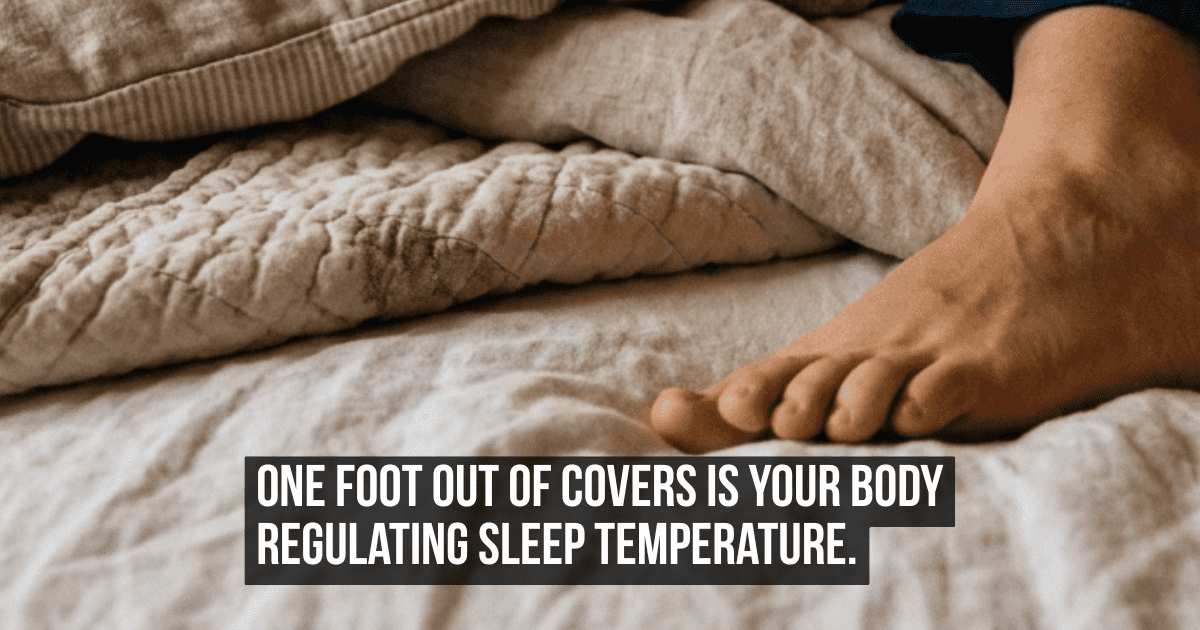
One foot is under the duvet. The other, usually the right one, often just the foot, sometimes the whole leg to the knee, is out. The window might be open. The fan might be running. And in this specific configuration, with the precise geometry of one limb in contact with the cool air and the rest of the body insulated, sleep arrives.
You’ve probably been doing this for years. The reason is physiological, not personal.
The Foot as a Thermostat
The human body regulates sleep through a well-documented process of core temperature reduction. In the hours before and during sleep onset, body temperature drops by approximately one to one and a half degrees Celsius, a cooling that signals to the brain that sleep is appropriate and facilitates the release of melatonin. The speed and depth of this temperature drop correlates directly with how quickly sleep arrives and how restorative it turns out to be.
The feet are a primary site of heat dissipation in the human body. The skin of the feet and hands contains a high density of arteriovenous anastomoses, specialized vascular structures that allow the body to rapidly transfer heat from the core to the surface for release into the environment. Exposing the feet to cooler air accelerates this process, giving the body’s thermoregulation system a faster exit route for the heat it needs to shed.
A 1999 study published in Nature found that the dilation of blood vessels in the extremities, which happens naturally as the body prepares for sleep and can be accelerated by cooling the feet, was one of the best predictors of how quickly subjects fell asleep. The foot outside the covers is not eccentricity. It’s unconscious thermoregulation.
Why One Foot Specifically
The single-foot configuration makes more physiological sense than it might appear. Full removal from the covers would accelerate heat loss beyond the optimal rate, particularly in cooler rooms. One foot provides a calibrated aperture: enough surface area to facilitate meaningful heat dissipation, regulated by the ambient temperature of the room, without overcooling the core.
Most people who do this developed the behavior during adolescence or early adulthood, when the body’s thermoregulatory demands shift. The habit persists because it works, not because someone learned it, but because the body found its own solution to the problem of falling asleep in an insulated environment and the solution stuck.
What Partners Do About It
The foot-out habit has a specific domestic dimension in shared beds. The person who runs warm and requires the aperture, sleeping next to the person who runs cold and requires full coverage, produces one of the more consistent minor incompatibilities in cohabitation. The cold-running partner frequently registers the foot-out as a temperature interference rather than a thermal regulation strategy. The warm-running partner cannot sleep comfortably without it.
Most couples arrive at a negotiated configuration: a specific corner of the duvet left accessible, or an understanding that one person’s foot will be near the edge, or a choice of separate blankets that removes the shared-cover geometry entirely. The foot is almost never discussed directly as a thermoregulation mechanism. It’s discussed as a quirk, a preference, a habit. Which it is. It’s also biology, managing a real problem in the most efficient way available without being asked to.
The People Who Don’t
People who sleep in cold rooms, or who run cold naturally, or who sleep under lighter covers, typically don’t need the foot aperture because the thermal regulation is handled by other means. The foot-out habit is most consistent among people who run warm, sleep in insulated environments, or both.
If you do it, your body has been managing your sleep temperature since before you were aware it was a problem to manage. That’s not a quirk. That’s your physiology, working quietly, without being asked, every night before you fall asleep.
Something went wrong. Please refresh the page and/or try again.
Help us improve your journey
We use cookies to personalize your experience and understand how you use our site. By clicking 'Yes, I'm in!', you help us show you content you'll actually love. If you prefer to keep things simple, you can stick to the essentials. You can change your mind anytime!
Necessary
Always active
The technical storage or access is strictly necessary for the legitimate purpose of enabling the use of a specific service explicitly requested by the subscriber or user, or for the sole purpose of carrying out the transmission of a communication over an electronic communications network.
Preferences
The technical storage or access is necessary for the legitimate purpose of storing preferences that are not requested by the subscriber or user.
Analytics
The technical storage or access that is used exclusively for statistical purposes.The technical storage or access that is used exclusively for anonymous statistical purposes. Without a subpoena, voluntary compliance on the part of your Internet Service Provider, or additional records from a third party, information stored or retrieved for this purpose alone cannot usually be used to identify you.
Advertising
The technical storage or access is required to create user profiles to send advertising, or to track the user on a website or across several websites for similar marketing purposes.




Leave a Reply