You Buy the Same Type of Souvenir in Every City Without Ever Consciously Deciding To
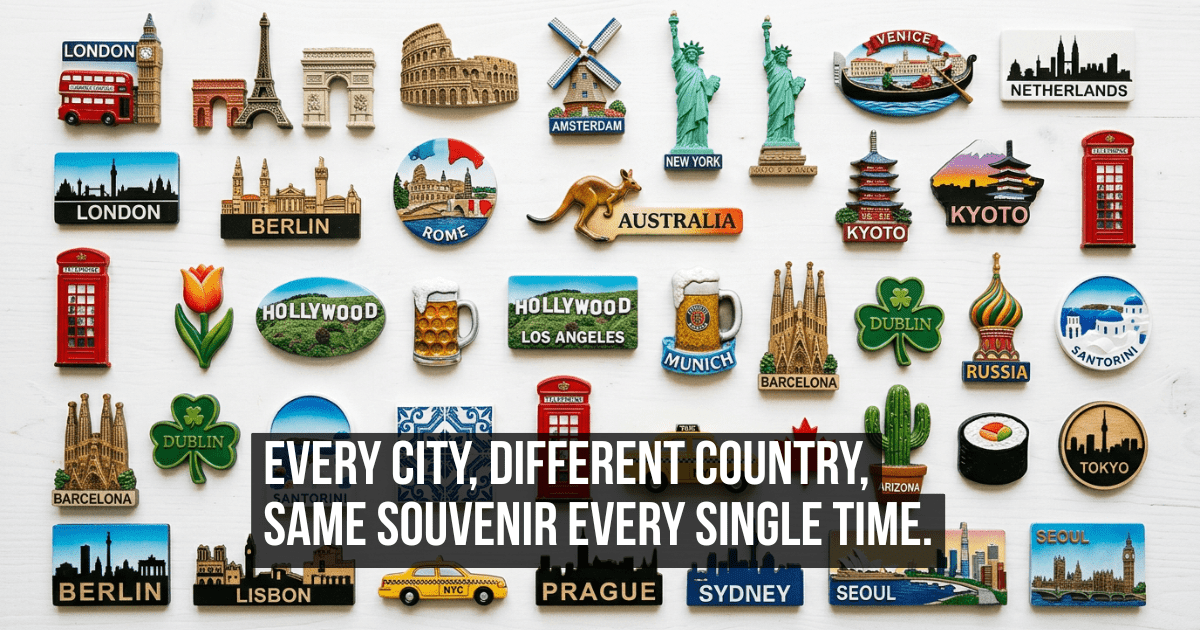
The magnet is on the fridge. The small ceramic dish is on the kitchen shelf. The woven bracelet is in a drawer, somewhere. Each one came from a different city, a different trip, and each one looked, at the time of purchase, like a specific and considered choice. If you lay them out together, a pattern would be visible: they are all roughly the same kind of thing, bought from roughly the same kind of shop, in roughly the same moment of the itinerary.
You didn’t plan this. Nobody does.
The Souvenir as Category
Travel purchasing behavior has been studied by consumer researchers as a specific sub-category of acquisition, distinct from ordinary shopping in ways that are psychologically interesting. The souvenir occupies a unique position: it is a physical object bought to represent an experience, whose value is almost entirely symbolic rather than functional. The magnet doesn’t do anything. The ceramic dish holds things you already had a bowl for. The souvenir’s purpose is to make the place persist in the home after the traveler returns.
What researchers have found is that people’s souvenir-buying behavior is far more consistent across trips than they typically realize. The type of object, wearable, decorative, edible, functional-but-small, tends to repeat. The price bracket tends to repeat. The occasion within the trip when the purchase happens tends to repeat: usually the last day, or the airport, or the market rather than the museum shop. The individual choice feels deliberate. The pattern it belongs to was never consciously designed.
What the Object Is Carrying
The consistency of souvenir type across trips suggests that the purchase is less about the specific place and more about the ritual of place-marking. The magnet isn’t really about the city it depicts. It’s about the act of acquiring proof that you were there, a material token of the trip that will sit in the home as a visible record of the experience.
Anthropologists who study material culture and memory describe souvenirs as portable shrines, objects that concentrate the emotional significance of an experience into a physical form that can be carried back and reinstalled in everyday life. The shrine doesn’t need to be beautiful or unique. It needs to be present, legible, and capable of triggering the memory it was bought to preserve. The magnet from every trip, clustered on the fridge, is not a failure of originality. It’s an archive.
The Shop You Always Go Into
The souvenir-buying pattern also has a spatial consistency that mirrors the object consistency. Most travelers have a type of shop they reliably enter in any unfamiliar city: the ceramics place, the food market, the stall selling locally made textiles. The shop is not chosen deliberately. It is recognized. Something about its character, its scale, its visual register, matches an internal template for where the right purchase will be found.
This shop recognition is a form of taste operating automatically in an unfamiliar environment. You cannot find a shop you want in a city you don’t know. But you can recognize it immediately when you walk past it, because it resembles the shops in previous cities where the right object turned up. The souvenir habit is not just about the object. It’s about a practiced eye for the kind of place where the right object lives.
The One That’s Different
Most souvenir collections contain one anomaly: the object that broke the pattern. A piece of clothing actually worn, a book actually read, a piece of food actually finished. This was usually bought on a trip that was different in some way, longer, more immersive, more disruptive to ordinary self-concept. The anomalous souvenir is a signal that something about the place reached far enough inside to change the purchase logic.
The rest are magnets. The magnets are fine. They’ve been doing their job on the fridge for years, holding up exactly what they were bought to hold: the evidence that you left, and came back, and brought a small piece of it with you.
Something went wrong. Please refresh the page and/or try again.
Help us improve your journey
We use cookies to personalize your experience and understand how you use our site. By clicking 'Yes, I'm in!', you help us show you content you'll actually love. If you prefer to keep things simple, you can stick to the essentials. You can change your mind anytime!
Necessary
Always active
The technical storage or access is strictly necessary for the legitimate purpose of enabling the use of a specific service explicitly requested by the subscriber or user, or for the sole purpose of carrying out the transmission of a communication over an electronic communications network.
Preferences
The technical storage or access is necessary for the legitimate purpose of storing preferences that are not requested by the subscriber or user.
Analytics
The technical storage or access that is used exclusively for statistical purposes.The technical storage or access that is used exclusively for anonymous statistical purposes. Without a subpoena, voluntary compliance on the part of your Internet Service Provider, or additional records from a third party, information stored or retrieved for this purpose alone cannot usually be used to identify you.
Advertising
The technical storage or access is required to create user profiles to send advertising, or to track the user on a website or across several websites for similar marketing purposes.




Leave a Reply