Why Cheap Instant Coffee Has Earned Far More Respect Than the Specialty Coffee Industry Wants to Give It
In a specialty coffee shop in Melbourne, a barista pulls a single-origin Ethiopian Yirgacheffe through a hand-calibrated grinder, doses it to 18.5 grams, tamps with precisely 15 kilograms of pressure, and extracts a shot in 27 seconds. The cup costs six dollars. Two streets away, a construction worker tears open a sachet of Nescafé, pours boiling water from a thermos, stirs with a pen, and drinks it standing up in under a minute. His coffee costs approximately twelve cents. The specialty coffee world treats the second cup as barely worth mentioning. It should probably reconsider.
A Hundred Billion Cups a Year
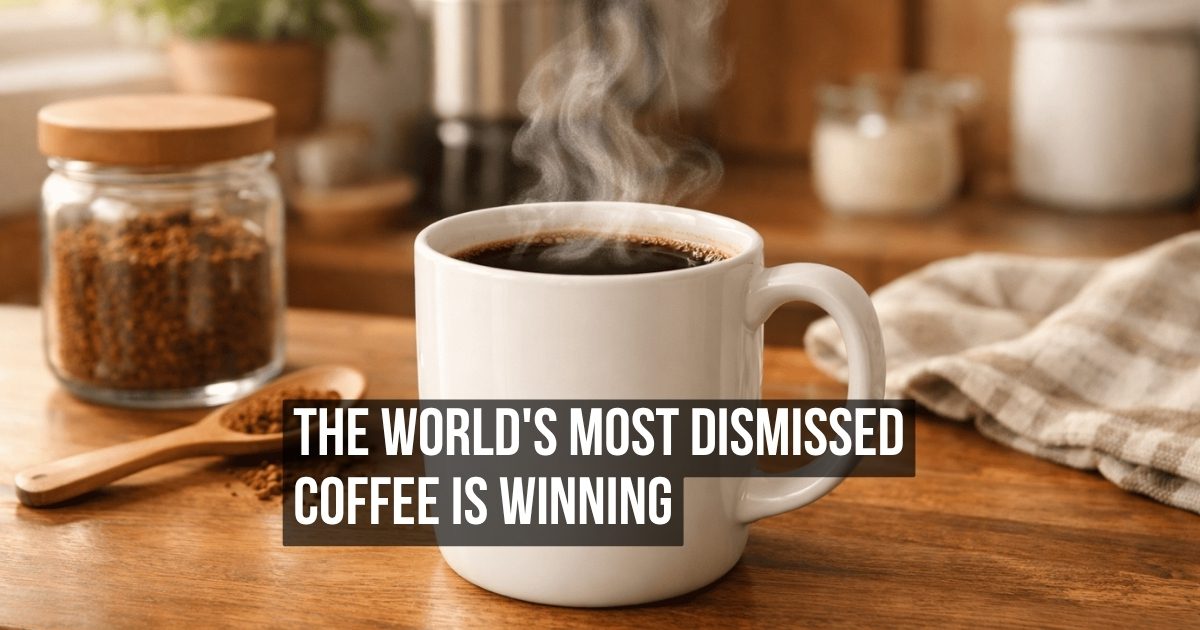
Instant coffee accounts for approximately 34 percent of all coffee consumed globally, and in several major markets — the UK, Japan, South Korea, India, Russia, and large parts of Southeast Asia and Eastern Europe — it represents the majority of coffee consumed. More than a hundred billion cups of instant coffee are drunk annually. This is not a niche product clinging to market share. It is the dominant form of coffee consumption for most of the world, and the specialty industry’s dismissal of it reflects a cultural blind spot, not a quality assessment.
The dismissal is consistent and reflexive. Specialty coffee culture treats instant as the opposite of real coffee — a processed, industrialised, flavour-compromised product that exists only because people don’t know better. “Once you’ve tasted proper coffee, you’ll never go back” is the industry’s founding mythology. The data contradicts it. Markets where specialty coffee is most accessible — Australia, the US, the UK — maintain large and stable instant coffee segments. People who have tasted “proper” coffee continue to drink instant, deliberately, by the billion.
What Instant Coffee Actually Is
Instant coffee is brewed coffee that has been dehydrated. The two main production methods — spray drying and freeze drying — differ in cost and quality, but both start with coffee brewed from real beans at industrial scale. Freeze-dried instant, the premium format, preserves volatile aroma compounds more effectively than spray drying, producing a cup that, while distinct from freshly brewed coffee, is chemically a closer relative than the specialty world typically acknowledges.
The original invention is attributed to Satori Kato, a Japanese-American chemist, around 1901, though Nestlé’s development of Nescafé in 1938 transformed it into a mass-market product. During World War Two, instant coffee became a military staple — easy to transport, fast to prepare, and requiring no brewing equipment. Its association with practicality over pleasure was established early and has persisted culturally, even as the product itself has improved considerably.
The Democratic Argument
A bag of specialty beans costs between 8 and 25 pounds for 250 grams — enough for approximately 15 cups. A jar of decent instant coffee costs 4 to 6 pounds for 100 grams — enough for approximately 50 cups. The price per cup difference is roughly fivefold to tenfold. For households where coffee is consumed multiple times daily by multiple people, the economic argument for instant is not a matter of ignorance. It is a matter of arithmetic.
Specialty coffee also requires equipment. An entry-level espresso machine costs 300 to 500 pounds. A grinder — essential, because pre-ground coffee degrades rapidly — adds another 100 to 300. Filter methods are cheaper but still require a kettle, a scale, a timer, and a brewing device. Instant coffee requires a kettle and a spoon. The barrier to entry is essentially zero, which means instant coffee is accessible to anyone with boiling water, regardless of income, equipment, counter space, or technical knowledge.
The Time Equation
Preparing specialty coffee properly takes between four and eight minutes, depending on method. Grinding beans, heating water to the correct temperature, measuring doses, timing extraction — these steps are pleasurable for enthusiasts and burdensome for everyone else. Instant coffee takes under a minute, including boiling the kettle. For a parent getting three children out the door, a shift worker starting at 5 a.m., or anyone who wants caffeine without ceremony, instant is not a compromise. It is a rational allocation of time.
The specialty industry’s response — that the ritual is part of the experience, that the process enhances the pleasure — is genuine but class-specific. Ritual is a luxury available to people with time, equipment, and the freedom to treat coffee preparation as leisure. For a significant portion of the global coffee-drinking population, coffee is functional. It is caffeine delivery. The ritual is drinking it, not preparing it.
The Quality Renaissance
The instant coffee of today is not the instant coffee of 2005. Several producers — including Sudden Coffee, Waka, Swift Cup, and Cusa — now offer single-origin, specialty-grade instant coffees produced from high-quality beans and using advanced freeze-drying techniques that preserve significantly more flavour complexity than traditional spray-dried products. Blind taste tests reported by coffee industry media have found that experienced tasters sometimes struggle to distinguish premium freeze-dried instant from brewed filter coffee.
Major manufacturers have also improved. Nescafé Gold, Kenco Millicano, and Starbucks VIA represent a mid-market tier that delivers a meaningfully better cup than the budget granules of previous decades. The category is not static. It is evolving, driven partly by competitive pressure from specialty coffee and partly by consumer expectations that have risen across all segments of the market.
The Snobbery Tax
Dismissing instant coffee is not a flavour judgment. It is a status performance. The person who says “I could never drink instant” is not reporting a taste threshold. They are signalling membership in a cultural group that associates coffee preparation with identity, discernment, and a particular kind of consumer sophistication. The signal is effective precisely because instant coffee is coded as ordinary, unambitious, and unsophisticated — the coffee of people who don’t “care” about coffee.
But caring about coffee and caring about coffee culture are not the same thing. The grandmother in Osaka who drinks instant with hot milk every morning cares about her coffee deeply. The truck driver in Kent who keeps a jar of Kenco in the cab cares about his coffee enough to ensure he always has it. They are not failing to appreciate “real” coffee. They have made a considered assessment that the product they use meets their needs — for taste, cost, time, and convenience — and the specialty industry’s insistence that they’re wrong says more about the industry than about the coffee.
Something went wrong. Please refresh the page and/or try again.
Help us improve your journey
We use cookies to personalize your experience and understand how you use our site. By clicking 'Yes, I'm in!', you help us show you content you'll actually love. If you prefer to keep things simple, you can stick to the essentials. You can change your mind anytime!
Necessary
Always active
The technical storage or access is strictly necessary for the legitimate purpose of enabling the use of a specific service explicitly requested by the subscriber or user, or for the sole purpose of carrying out the transmission of a communication over an electronic communications network.
Preferences
The technical storage or access is necessary for the legitimate purpose of storing preferences that are not requested by the subscriber or user.
Analytics
The technical storage or access that is used exclusively for statistical purposes.The technical storage or access that is used exclusively for anonymous statistical purposes. Without a subpoena, voluntary compliance on the part of your Internet Service Provider, or additional records from a third party, information stored or retrieved for this purpose alone cannot usually be used to identify you.
Advertising
The technical storage or access is required to create user profiles to send advertising, or to track the user on a website or across several websites for similar marketing purposes.




Leave a Reply