FOMO and Burnout Are Not Opposite Problems — They Run on Exactly the Same Engine
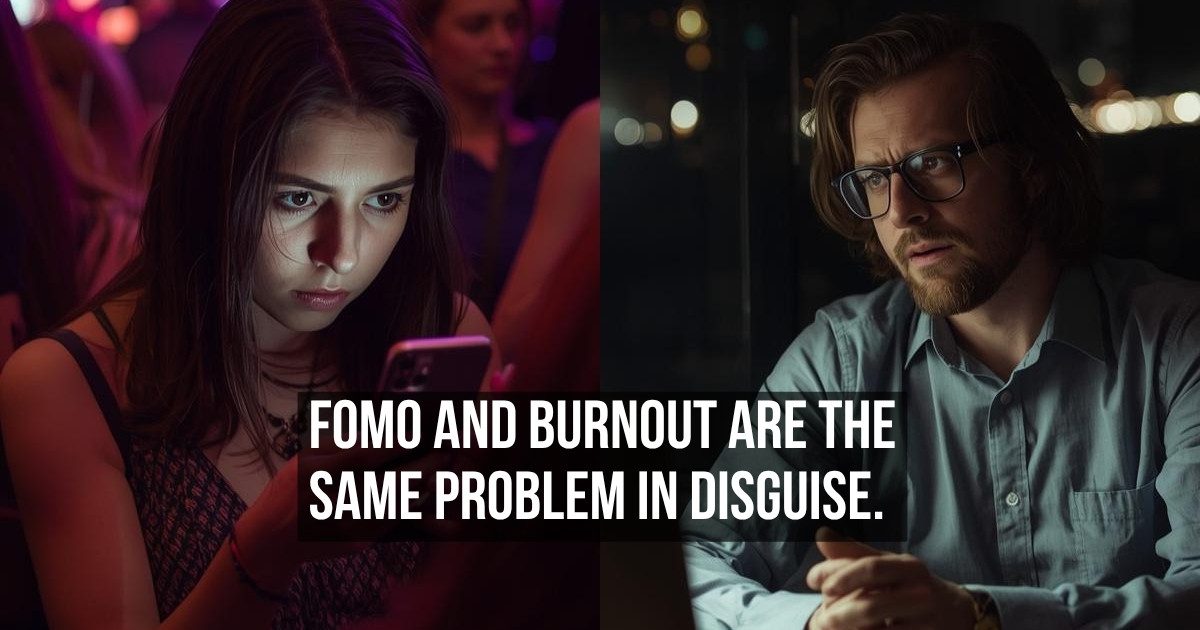
Fear of missing out and exhaustion from doing too much look like opposite problems. They are the same problem operating in different directions. Both share structural features with the doom scrolling reflex — the same avoidance-as-stimulation pattern described in why doom scrolling might be rational.
The Avoidance at the Center of Both
FOMO is typically described as a hunger for more: more experiences, more social connection, more stimulation, more of what others appear to be having. Burnout is described as the consequence of too much: too many demands, too much responsibility, too many obligations draining a finite reserve. The cultural narratives pull in opposite directions; FOMO as deprivation, burnout as excess.
The common root is avoidance of the present moment. FOMO is driven not by genuine desire for more experiences but by dissatisfaction with the current one — the party you are at is slightly less compelling than the one you imagine might be happening somewhere else. Burnout is often driven by an inability to disengage from obligation and be present in rest without it feeling like falling behind. Both conditions are characterized by a fundamental failure to fully inhabit the moment currently available. The same failure to find genuine value in non-productive time underlies what has happened when hobbies died when we made them productive.
Research on self-determination theory by Edward Deci and Richard Ryan identifies contingent self-worth as a risk factor for both: the tendency to locate value in external achievement, social comparison, and others’ approval rather than intrinsic engagement. The FOMO sufferer and the burnout patient are both operating from a position where the current moment is insufficient relative to a standard located elsewhere — in others’ apparent lives, in performance metrics, in imagined alternatives.
The Same Prescription
The therapeutic recommendation for FOMO and burnout converges remarkably when examined closely. For FOMO, Acceptance and Commitment Therapy recommends defusion from comparative thinking and engagement with present experience. For burnout, recovery research recommends detachment from performance metrics and the capacity for present-moment enjoyment. Both require learning to value what is actually in front of you rather than the experience or outcome being measured against an external standard.
The social media environment that maximizes FOMO is the same environment that drives the comparison-based overextension producing burnout. The constant visibility of others’ curated highlight reels, their achievements, their experiences, their apparent vitality, simultaneously makes you fear missing out and makes your current output feel insufficient. The platforms monetize both anxieties. The user experiences them as opposite problems that require opposite solutions. The structural overlap with the loneliness epidemic is direct — the same platforms that increase comparison also increase isolation.
Psychologist Barry Schwartz identified a related convergence in his concept of the maximizer — the person who seeks the best possible option in any situation rather than one that is adequate. Maximizers show higher rates of depression, regret, and dissatisfaction than satisficers despite consistently achieving objectively better outcomes. The pursuit of the optimal is its own sustained form of exhaustion.
The attention economy profits from both simultaneously, which is one reason neither condition is improving despite growing cultural awareness of each. Social platforms are designed to maximise the feeling that something important is happening elsewhere — the mechanism that drives FOMO — while also providing a stream of achievement visibility that drives the comparison-based overextension characteristic of burnout. The same feed generates both anxieties in sequence, often within a single scrolling session. The user experiences them as separate problems requiring different solutions. The platform experiences them as two revenue streams from the same engagement.
The individual exit from this dynamic is less about willpower and more about explicit restructuring of the information environment. Chronically FOMO-prone individuals benefit from reducing the visibility of others’ highlight reels; chronically burned-out individuals benefit from removing the achievement comparison signals that make current output feel insufficient. Both changes address the same underlying mechanism. The social media feed that feeds both anxieties is not neutral content. It is a curated environment designed to sustain both, indefinitely, because both drive engagement.
FOMO and burnout are not opposing states to be balanced against each other. They are the same misalignment presenting in two different time signatures. The solution to both is not doing more, or doing less, but being more fully present in whatever is actually being done.
Something went wrong. Please refresh the page and/or try again.
Help us improve your journey
We use cookies to personalize your experience and understand how you use our site. By clicking 'Yes, I'm in!', you help us show you content you'll actually love. If you prefer to keep things simple, you can stick to the essentials. You can change your mind anytime!
Necessary
Always active
The technical storage or access is strictly necessary for the legitimate purpose of enabling the use of a specific service explicitly requested by the subscriber or user, or for the sole purpose of carrying out the transmission of a communication over an electronic communications network.
Preferences
The technical storage or access is necessary for the legitimate purpose of storing preferences that are not requested by the subscriber or user.
Analytics
The technical storage or access that is used exclusively for statistical purposes.The technical storage or access that is used exclusively for anonymous statistical purposes. Without a subpoena, voluntary compliance on the part of your Internet Service Provider, or additional records from a third party, information stored or retrieved for this purpose alone cannot usually be used to identify you.
Advertising
The technical storage or access is required to create user profiles to send advertising, or to track the user on a website or across several websites for similar marketing purposes.




Leave a Reply