Dating Apps Were Not Designed to Help You Find Love — They Were Built to Keep You Searching
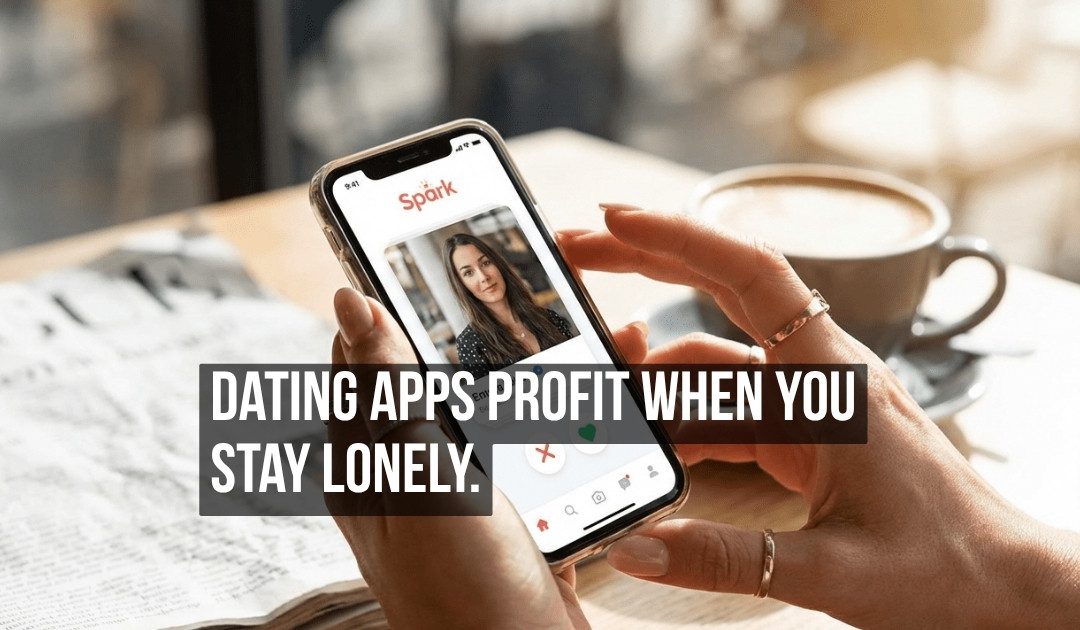
The most successful dating app in the world is one whose users never leave. The business model has a fundamental problem: users leaving is called finding a relationship. The tension at the center of the industry is not a design flaw. It is the design. The same engagement architecture that keeps users in dating apps is the same mechanism documented in why doom scrolling might be rational — variable reward loops designed to sustain seeking behavior.
Gamification as a Business Model
Dating apps share their core behavioral architecture with casino slot machines: variable ratio reinforcement. The swipe produces a match or it does not; the match leads to a conversation or it does not; the conversation leads to a meeting or it does not. Each unpredictable reward activates the dopaminergic anticipation circuit — the same circuit that makes gambling compulsive. The design is not incidental. It is the product.
Match Group, parent company of Tinder, Hinge, OkCupid, and several other major platforms, generates revenue primarily through subscriptions and in-app purchases that promise improved visibility and expanded matching access. In 2022, Match Group reported revenue of approximately $3.2 billion. The company’s financial health depends entirely on users remaining on the platform — dissatisfied enough with outcomes to pay for upgrades, but not so satisfied that they find relationships and leave.
Former Tinder employees speaking to technology journalists have described algorithmic systems designed to show highly attractive profiles early in a user’s experience to create engagement, then gradually modulate match quality to increase frustration and premium upgrade conversion. Match Group has denied systematic use of such mechanisms, but the basic incentive structure — which rewards continued use and penalizes successful exit — creates persistent pressure toward design choices that extend rather than resolve the search.
The Paradox of Choice in Romantic Markets
Dating apps present the largest romantic marketplace most users will ever encounter. Tinder alone reports over 75 million active users globally. At this scale, the paradox of choice becomes acutely operative: the availability of an enormous pool of potential partners does not increase satisfaction. It increases the perceived opportunity cost of any given match and reduces commitment to exploring it seriously. The structural outcome is a sustained state of searching that mirrors the loneliness epidemic — more apparent connection, less actual belonging.
Research published in Psychological Science found that online daters shown larger choice sets were less satisfied with their selections than those with smaller sets — despite having objectively more options. The mechanism is regret anticipation: the awareness that better options may exist prevents full investment in current ones. The swipe interface is structurally optimized for producing this state.
The result is a user population that feels simultaneously busy with romantic activity and no closer to its stated goal. Time spent on platforms increases. Relationship formation rates, corrected for demographic trends, have not improved proportionally with app adoption. The engagement metrics and the romantic outcomes have diverged.
The shift from community-based to market-based partner selection represents a structural change extending beyond individual experience. Pre-digital partner finding was embedded in social networks — the colleague introduced by a mutual friend, the person met through a shared activity. These pathways embedded the relationship in a social context from its beginning, providing external accountability and a community invested in the relationship’s success. Dating apps produce connections without context: two individuals in a marketplace, with no shared social infrastructure to support what follows the first message. The resulting isolation has the same structural profile as what drives FOMO and burnout — comparison without belonging.
The implications for long-term relationship quality are beginning to appear in the research literature. A 2023 study in the Journal of Social and Personal Relationships found that couples who met through mutual social networks reported higher relationship satisfaction at five years than those who met through dating apps, even after controlling for demographic and personality variables. The mechanism proposed was contextual embedding: relationships that begin within a shared social world have structural support that platform-sourced connections must build from nothing.
Dating apps are genuinely useful tools for meeting people who would not otherwise intersect. They are also commercial products with financial incentives that are partially and systematically misaligned with their users’ romantic goals. Treating them as neutral technology — rather than as an engineered environment optimizing for engagement over outcomes — is a navigational error that the industry is very happy for users to keep making.
Something went wrong. Please refresh the page and/or try again.
Help us improve your journey
We use cookies to personalize your experience and understand how you use our site. By clicking 'Yes, I'm in!', you help us show you content you'll actually love. If you prefer to keep things simple, you can stick to the essentials. You can change your mind anytime!
Necessary
Always active
The technical storage or access is strictly necessary for the legitimate purpose of enabling the use of a specific service explicitly requested by the subscriber or user, or for the sole purpose of carrying out the transmission of a communication over an electronic communications network.
Preferences
The technical storage or access is necessary for the legitimate purpose of storing preferences that are not requested by the subscriber or user.
Analytics
The technical storage or access that is used exclusively for statistical purposes.The technical storage or access that is used exclusively for anonymous statistical purposes. Without a subpoena, voluntary compliance on the part of your Internet Service Provider, or additional records from a third party, information stored or retrieved for this purpose alone cannot usually be used to identify you.
Advertising
The technical storage or access is required to create user profiles to send advertising, or to track the user on a website or across several websites for similar marketing purposes.




Leave a Reply