Going to Bed Before Ten Is Not Boring It Is Quietly Defiant
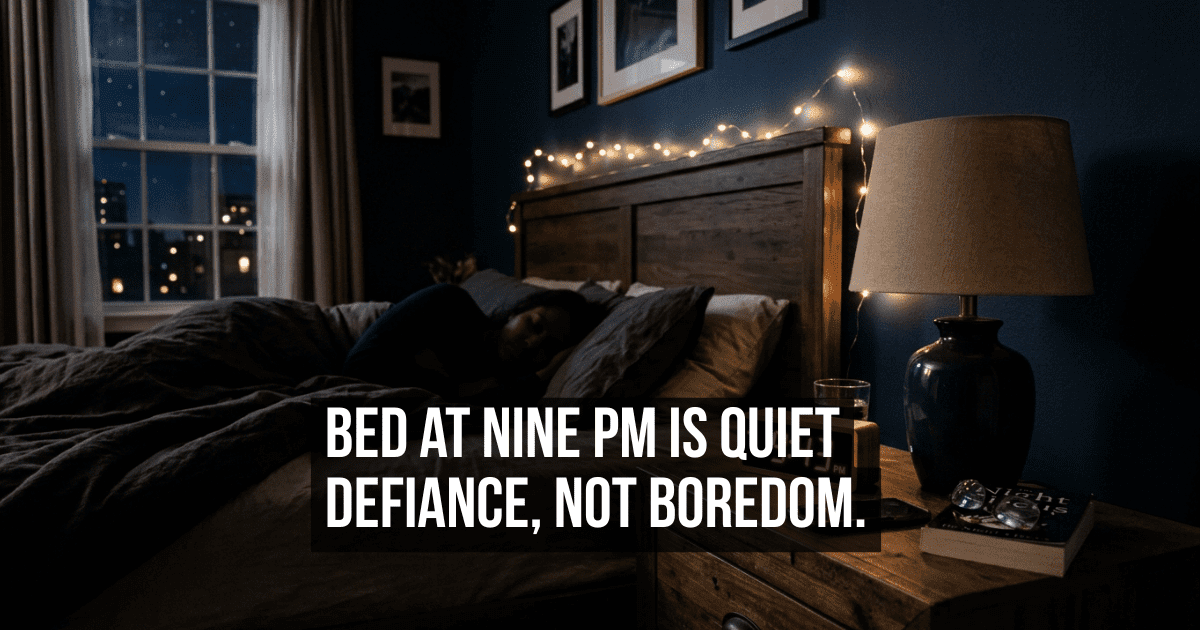
The alarm is set for six. The book is on the nightstand, the light is off, and it’s nine forty-three. You are awake for another fifteen minutes, approximately, and then you’re not. The evening is gone early, by most social standards, and you don’t particularly care.
Various people have implied this says something about you. It does. Just not what they think.
The Late Night as Status Signal
Late-night culture is embedded deeply enough in social life that going to bed early reads, in many contexts, as a mild failure of vitality. The person who’s in bed by ten is implicitly someone who has nothing more interesting to do, or who lacks the stamina for how things are properly done.
This is a recent cultural construction. For most of human history, sleep aligned more closely with darkness, and the hours between nine and midnight were not the primary location of social or creative life. The industrial and electric revolution changed this. The culture of lateness is, in significant part, a product of artificial light and the industries that benefit from attention after dark.
What Sleep Science Actually Shows
The evidence on sleep duration and quality is among the most consistent in health research. Adults who regularly get seven to nine hours of sleep show better cognitive performance, lower rates of cardiovascular disease, and more stable emotional regulation than those who don’t. Matthew Walker, sleep scientist at UC Berkeley, describes chronic sleep restriction as one of the most pervasive and underacknowledged public health crises in developed countries.
An early bedtime, for someone who rises early, is not an indulgence. It’s a prerequisite. The person who goes to bed at nine-thirty to be awake at five-thirty is not retreating from life. They’re protecting the conditions under which they can participate in it.
The Chronotype Question
Not everyone who goes to bed at ten is making a freely chosen lifestyle decision. Circadian rhythms, which regulate the timing of sleep and wakefulness, vary significantly between individuals. Research led by Till Roenneberg at Ludwig Maximilian University of Munich has found that chronotypes distribute across a wide spectrum, with morning types genuinely experiencing peak alertness earlier and fatigue earlier in the evening.
The socially dominant late-night schedule accommodates evening chronotypes better than morning ones. Morning types spend much of their professional lives managing a mismatch between their biology and their environment’s expectations. The early bedtime is, for this group, not a preference but a physiological requirement. Framing it as boring is, from this angle, a category error.
The Defiance Nobody Credits
There’s something genuinely counter-cultural about choosing sleep over the evening’s ambient demands. The phone wants you. The streaming platform has four more episodes. The group chat is active. The news requires monitoring. Saying no to all of that at nine forty-three is not passivity. It’s a choice about what you’re willing to let have you.
The early bedtime is not the absence of a life. For the people who keep it deliberately, it’s one of the more honest decisions they make about what their life is actually for.
Something went wrong. Please refresh the page and/or try again.
Help us improve your journey
We use cookies to personalize your experience and understand how you use our site. By clicking 'Yes, I'm in!', you help us show you content you'll actually love. If you prefer to keep things simple, you can stick to the essentials. You can change your mind anytime!
Necessary
Always active
The technical storage or access is strictly necessary for the legitimate purpose of enabling the use of a specific service explicitly requested by the subscriber or user, or for the sole purpose of carrying out the transmission of a communication over an electronic communications network.
Preferences
The technical storage or access is necessary for the legitimate purpose of storing preferences that are not requested by the subscriber or user.
Analytics
The technical storage or access that is used exclusively for statistical purposes.The technical storage or access that is used exclusively for anonymous statistical purposes. Without a subpoena, voluntary compliance on the part of your Internet Service Provider, or additional records from a third party, information stored or retrieved for this purpose alone cannot usually be used to identify you.
Advertising
The technical storage or access is required to create user profiles to send advertising, or to track the user on a website or across several websites for similar marketing purposes.




Leave a Reply