Why Almost Everyone Wears Black and Nobody Will Honestly Admit the Real Reason They Do
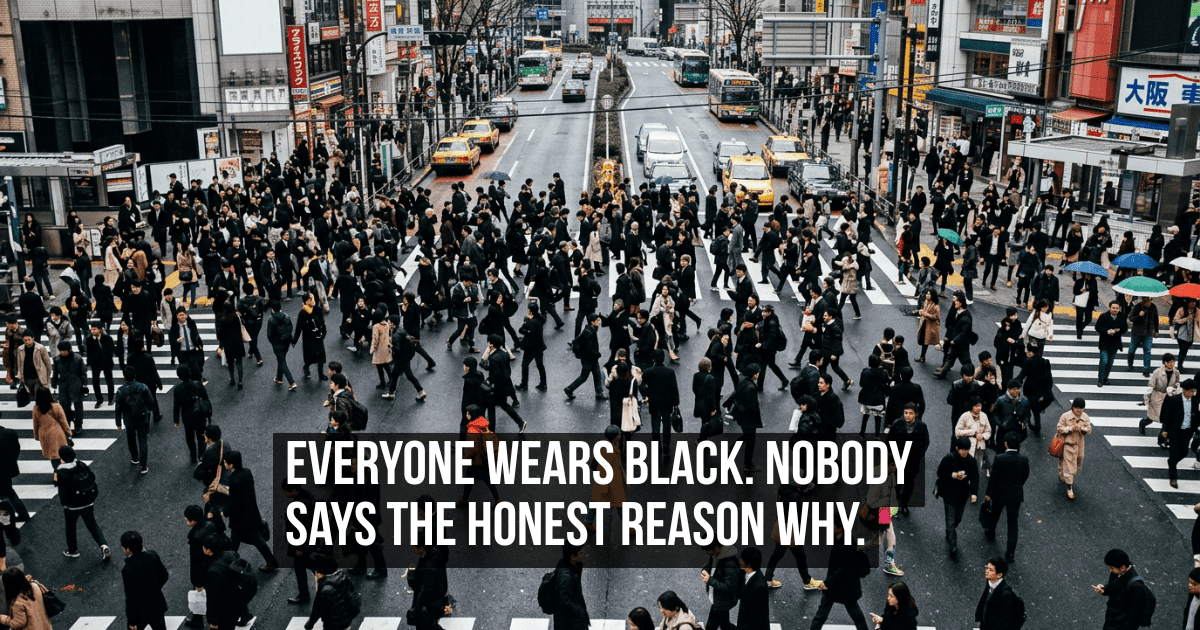
Everybody wears black. Not exclusively, not always, not universally — but in cities, in professional contexts, at dinner tables and gallery openings and airport terminals from Seoul to Stockholm, black clothing has achieved a dominance that is without precedent in the history of fashion. The colour that was once the marker of mourning, then of rebellion, then of intellectual seriousness, is now simply what most people reach for when they want to look presentable without thinking about it.
Ask most people who wear black regularly why they wear it, and the answers are consistent in their vagueness: it’s easy, it goes with everything, it’s slimming, it’s classic. These are all true, but they are also the post-hoc rationalisations of a behaviour that has far more interesting structural drivers — and that most people, pressed, would acknowledge contains a social dimension they prefer not to name directly.
The Economics of the Non-Decision
Steve Jobs wore a black turtleneck every day for the last two decades of his life. He discussed the reasoning explicitly: eliminating the daily clothing decision freed cognitive resources for decisions that actually mattered. Barack Obama reduced his wardrobe to a rotating set of grey and blue suits for the same stated reason. The concept — decision fatigue applied to personal presentation — entered mainstream discourse and provided intellectual legitimacy to what had, for many people, already become habitual.
Black solves the coordination problem. A black jacket works with black trousers. Both work with any shade of black. The darker end of the colour spectrum compresses into a narrow band that requires minimal matching skill and produces consistent visual coherence regardless of what specific garments are combined. For people who either lack interest in or confidence about colour coordination, black eliminates the possibility of error.
The Social Permission Structure
Black clothing carries cultural associations that make it safe to wear in almost any context that urban professional life requires. It reads as appropriate in professional settings without being aggressively formal. It reads as appropriate in social settings without being aggressively casual. It signals effort — in the sense of having dressed deliberately — without asserting strong individual taste that might be judged or found inappropriate. Black is the colour with the lowest social risk across the widest range of contexts.
This is, in sociological terms, an extraordinarily valuable property. Clothing is a continuous social signal. Every garment and colour choice is a communication made to everyone who sees it. Communicating in black says something legible and broadly acceptable to almost everyone. Communicating in ochre, in coral, in patterned prints, in saturated colour, is a more specific statement that narrows the population to whom it reads well.
Black as Cultural Capital
In artistic, intellectual, and creative professional circles, black carries a specific additional charge. It is the colour historically associated with European artistic bohemianism — the Paris art world, the New York downtown scene, the continental intellectual — and its adoption by these communities has given it cultural associations that extend well beyond its optical properties. Wearing black signals, in certain contexts, not merely neutrality but a kind of studied refusal of the consumer colour cycle: a position outside trend, which is itself a position.
The irony is that this anti-fashion gesture has been so thoroughly absorbed by fashion that it is now the most fashion-forward choice available. The fashion industry publishes all-black editorials season after season. Luxury brands build entire aesthetic identities around black. The colour that once signalled an exit from the commercial system has been fully incorporated into it. The refusal has become a product.
What Nobody Wants to Say
The explanation that goes unstated in most conversations about black clothing is the simplest one. Black is slimming. The optical property of dark colours — reducing the visibility of body contours and creating a visual minimisation of silhouette — is real and well-documented in both physics and perception research. In a culture with deeply entrenched body image pressures applied continuously across media, advertising, and social platforms, the choice of a colour that systematically makes the body look smaller or less visible is not incidental.
The practical rationalisations — easy, matches, classic — are all accurate. They are also partial. The third reason, the one that a survey conducted with perfect honesty might surface more consistently, is the one that most people acknowledge privately and prefer not to say at dinner.
Something went wrong. Please refresh the page and/or try again.
Help us improve your journey
We use cookies to personalize your experience and understand how you use our site. By clicking 'Yes, I'm in!', you help us show you content you'll actually love. If you prefer to keep things simple, you can stick to the essentials. You can change your mind anytime!
Necessary
Always active
The technical storage or access is strictly necessary for the legitimate purpose of enabling the use of a specific service explicitly requested by the subscriber or user, or for the sole purpose of carrying out the transmission of a communication over an electronic communications network.
Preferences
The technical storage or access is necessary for the legitimate purpose of storing preferences that are not requested by the subscriber or user.
Analytics
The technical storage or access that is used exclusively for statistical purposes.The technical storage or access that is used exclusively for anonymous statistical purposes. Without a subpoena, voluntary compliance on the part of your Internet Service Provider, or additional records from a third party, information stored or retrieved for this purpose alone cannot usually be used to identify you.
Advertising
The technical storage or access is required to create user profiles to send advertising, or to track the user on a website or across several websites for similar marketing purposes.




Leave a Reply