Wearing the Same Three Outfits Every Week Is More Sophisticated Than It Appears
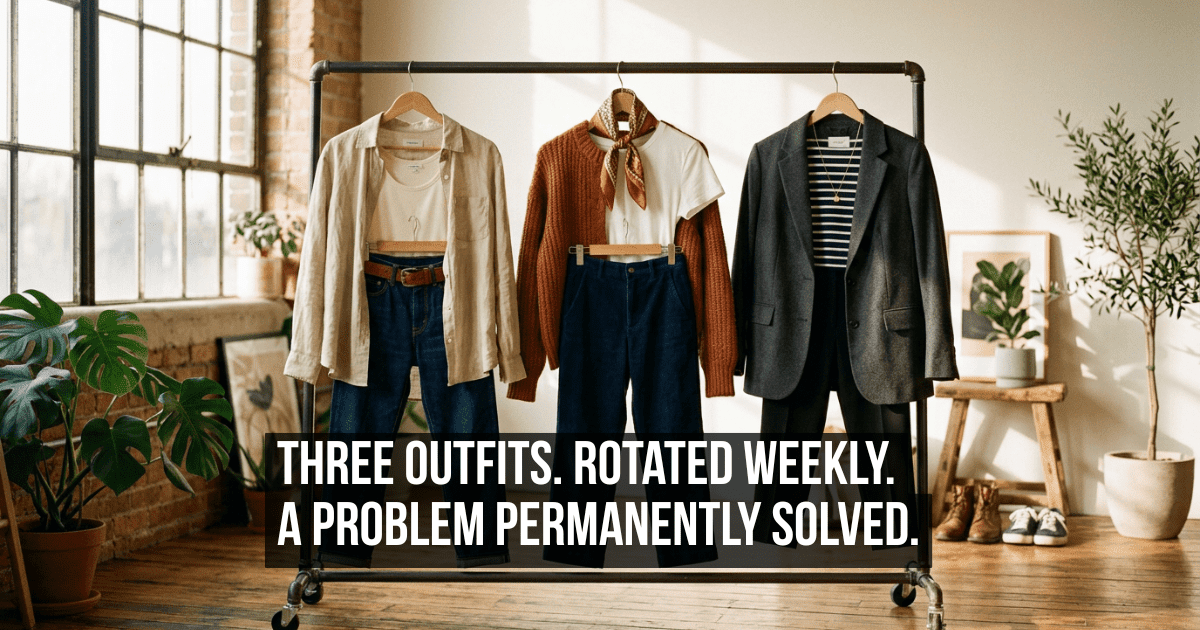
Monday, the dark trousers and the reliable top. Wednesday, the same. Friday, the one that’s slightly more casual. The wardrobe is larger than three items, but this rotation handles most of the week, most of the year, and you’re no longer particularly apologetic about it.
The fashion industry has opinions on this. They’re worth examining.
The Uniform’s History
The deliberate wardrobe reduction has been practiced by people whose relationship with appearance you’d be unlikely to describe as unsophisticated. Albert Einstein reportedly owned several versions of the same outfit. Matisse wore the same studio clothes for years. The tech-industry uniform associated with Jobs and Zuckerberg entered popular culture not as a symbol of indifference to appearance but as a statement about where attention was being allocated instead.
The uniform signals something. The question is whether the signal is the one it’s usually assumed to be.
What Getting Dressed Actually Costs
Clothing decisions are made under conditions that make them poor candidates for daily creative effort. Early morning, limited time, variable mood, simultaneous management of other logistics. The daily outfit decision is an investment of cognitive resources in a task whose returns are, for most people on most days, marginal.
Research on decision fatigue suggests that decision quality declines as the volume of earlier decisions increases. Getting dressed is, by most schedules, one of the first decisions of the day. Making it effortful sets a cost before the more meaningful decisions have even begun. The three-outfit rotation eliminates this entirely.
The Environmental Case Nobody Makes
There is a dimension of the rotation that gets almost no attention in fashion culture: it is significantly better for the environment than the alternative. The fashion industry produces an estimated 10 percent of global carbon emissions. The average consumer today buys 60 percent more clothing than fifteen years ago and keeps each garment half as long.
The person who wears the same three outfits every week is not making a sustainability statement. But they are consuming considerably less than the industry requires. Without any grand philosophy, the rotation produces an outcome that many conscious sustainability efforts fail to achieve.
The Sophistication Nobody Attributes to It
Fashion culture frames variety as sophistication and repetition as poverty of imagination. The opposite case is defensible: knowing what works for you, committing to it, and eliminating the daily performance of variety requires a clarity about your own preferences that takes longer to develop than a trend-dependent wardrobe does.
The person who wears the same three things has usually already worked out what they look good in, what they are comfortable in, and what impression they want to make. The variety-maximizer is often still figuring that out.
The three outfits are not a limitation. They are the result of a process that most wardrobes are still in the middle of.
Something went wrong. Please refresh the page and/or try again.
Help us improve your journey
We use cookies to personalize your experience and understand how you use our site. By clicking 'Yes, I'm in!', you help us show you content you'll actually love. If you prefer to keep things simple, you can stick to the essentials. You can change your mind anytime!
Necessary
Always active
The technical storage or access is strictly necessary for the legitimate purpose of enabling the use of a specific service explicitly requested by the subscriber or user, or for the sole purpose of carrying out the transmission of a communication over an electronic communications network.
Preferences
The technical storage or access is necessary for the legitimate purpose of storing preferences that are not requested by the subscriber or user.
Analytics
The technical storage or access that is used exclusively for statistical purposes.The technical storage or access that is used exclusively for anonymous statistical purposes. Without a subpoena, voluntary compliance on the part of your Internet Service Provider, or additional records from a third party, information stored or retrieved for this purpose alone cannot usually be used to identify you.
Advertising
The technical storage or access is required to create user profiles to send advertising, or to track the user on a website or across several websites for similar marketing purposes.




Leave a Reply