How Fast Food Became the Most Consumed and the Most Socially Shameful Meal in the World
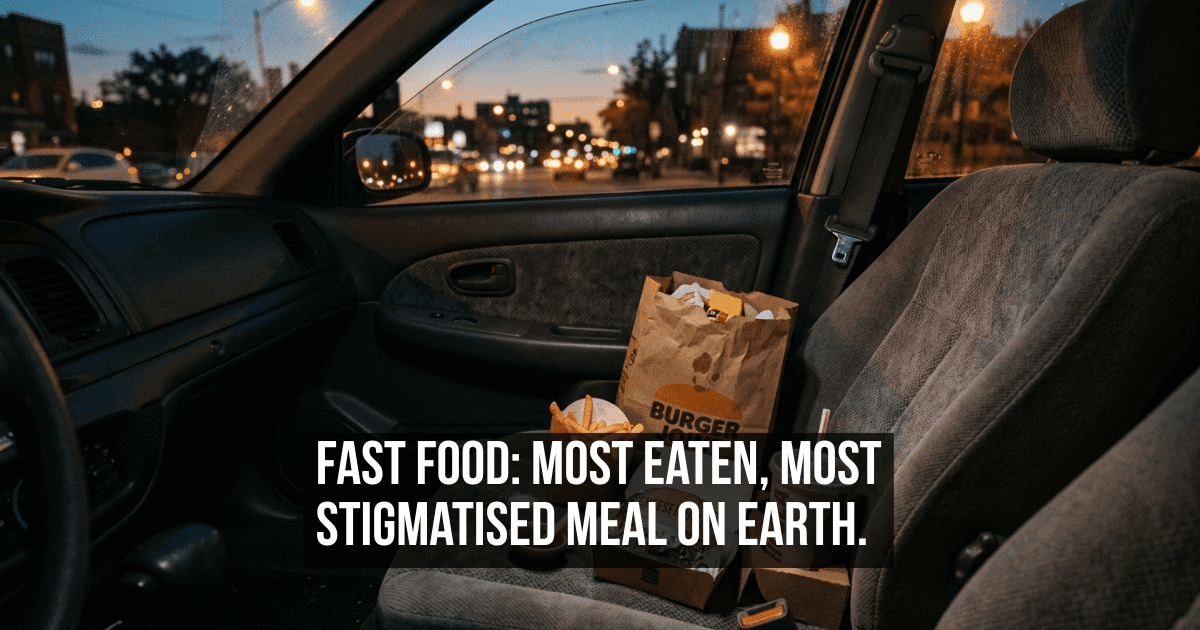
Fast food is the most consumed category of food in the developed world and among the most publicly stigmatised. In the United States, an estimated 36 percent of the population eats fast food on any given day. In the UK, the figure is similar. McDonald’s serves approximately 69 million customers daily in over 100 countries. These numbers describe a food system that a substantial portion of humanity uses regularly as a primary source of calories.
They also describe a food system that its users often discuss with something approaching embarrassment, that is systematically excluded from serious food culture, and that generates continuous media coverage of its health risks alongside continuous commercial success that shows no sign of abating. No other category of consumption is this simultaneously dominant and shameful. Understanding how fast food achieved and maintains this paradoxical status reveals something about how food culture actually works.
What Fast Food Actually Is
The industrial food system that fast food represents solved a genuine and persistent problem: how to provide hot, consistent, calorie-dense food quickly and cheaply to large numbers of people with limited time and income. The solution involved standardising ingredients, centralising production, engineering flavour through fat and salt ratios optimised for palatability, and building distribution infrastructure that made the product available almost everywhere.
The result is not healthy food. The caloric density, the processed ingredient lists, the sodium and saturated fat levels, the portion sizes: none of this is nutritionally optimal. But the accusation that fast food is nutritionally poor does not answer the question of why an enormous percentage of humans choose it over alternatives, including in markets where alternatives are available. The answer involves price, time, consistency, and something that nutrition science tends to underweight: the psychology of reward.
The Engineering of Palatability
The flavour engineers employed by major fast food companies have produced, through decades of research into fat, salt, and sugar ratios, products that engage the brain’s reward system with unusual directness. The specific combination of fat content, salt levels, and refined carbohydrates in a standard fast food meal activates dopaminergic reward pathways in ways that nutritionally balanced meals typically don’t. This is not accidental. The optimisation of palatability is the product’s primary engineering objective.
The consistency of the experience is a related factor. A Big Mac in Tokyo tastes the same as a Big Mac in Chicago. In a global food environment of enormous variation and uncertainty — where a meal from a new restaurant might be excellent or might be unpleasant — the guarantee of a known sensory experience has genuine value. The food that always tastes exactly the same is providing a form of reliability that more interesting food cannot offer.
The Class Architecture of Food Shame
The stigma attached to fast food consumption is not evenly distributed. Middle and upper-middle class consumers who eat fast food tend to frame it as an occasional indulgence, a guilty pleasure, a transgression from their usual standards. Working-class consumers for whom fast food represents a regular, practical meal solution face a stigma they didn’t choose and a set of alternatives that are not as accessible as food culture commentary implies.
The discourse around fast food — the advice to cook at home, to choose whole foods, to prioritise nutrition — assumes a set of material conditions that are not universal: time to cook, kitchen equipment, food budgets that allow for fresh ingredient shopping, proximity to grocery stores that carry affordable fresh produce, and the energy at the end of a working day to engage in domestic food production. For families without these conditions, fast food is not a failure of knowledge or willpower. It is the available option.
The Persistence of Shame
The food shame attached to fast food serves a function for the food culture that enforces it. The person who eats exclusively at restaurants with notable provenance and who constructs their diet from farmers’ market produce signals cultural capital through those choices. The stigmatisation of fast food is part of this signal: it defines the boundary of acceptable consumption by which the culturally sophisticated distinguish themselves.
That the most consumed food category in the world remains simultaneously the most stigmatised is a reasonably precise description of how cultural hierarchies work: the dominant practice is not the legitimate one. The legitimate practice is the one that requires resources — money, time, knowledge, proximity — that are unequally distributed. The shame is not about nutrition. It is about class, signalled through the medium of food choice, in a context where most of the relevant choices are made by conditions rather than preferences.



Leave a Reply