How the Five-Star Rating System Quietly Destroyed the Concept of Honest Consumer Opinion
The five-star rating system is everywhere. Amazon products, Uber rides, Airbnb stays, restaurant experiences, hospital visits, university professors, freelance workers, and in some jurisdictions, municipal government services: all have been subjected to the same five-dot scale, on the implicit assumption that any human experience can be meaningfully reduced to a number between one and five.
The system has a specific and poorly understood problem: it doesn’t measure quality. It measures the intersection of quality, social expectation, and the asymmetric psychology of rating, which produces distributions that make the scale almost entirely useless as an information tool — and has, in doing so, not replaced consumer opinion but quietly eliminated it.
The Distribution That Shouldn’t Exist
If the five-star scale measured quality honestly, ratings should distribute across the full range. A normal distribution would place most ratings around three stars, with fewer products and services at the extremes. What actually happens, across virtually every platform that uses star ratings, is a distribution so skewed toward the top that it renders the middle of the scale meaningless. On Amazon, the median rating across most product categories sits above 4.2 stars. Airbnb has the same problem: a 4.5 rating on the platform corresponds roughly to a middling-to-poor experience by any objective standard. Anything below 4.0 is functionally a death sentence for a listing, regardless of actual quality.
The distribution is not reflecting product quality. It is reflecting the social psychology of rating: the discomfort of giving a low score to a person, the optimism bias that inflates evaluations of recent purchases, and the selection effect in which people who had genuinely bad experiences often don’t bother rating at all.
The Uber Effect
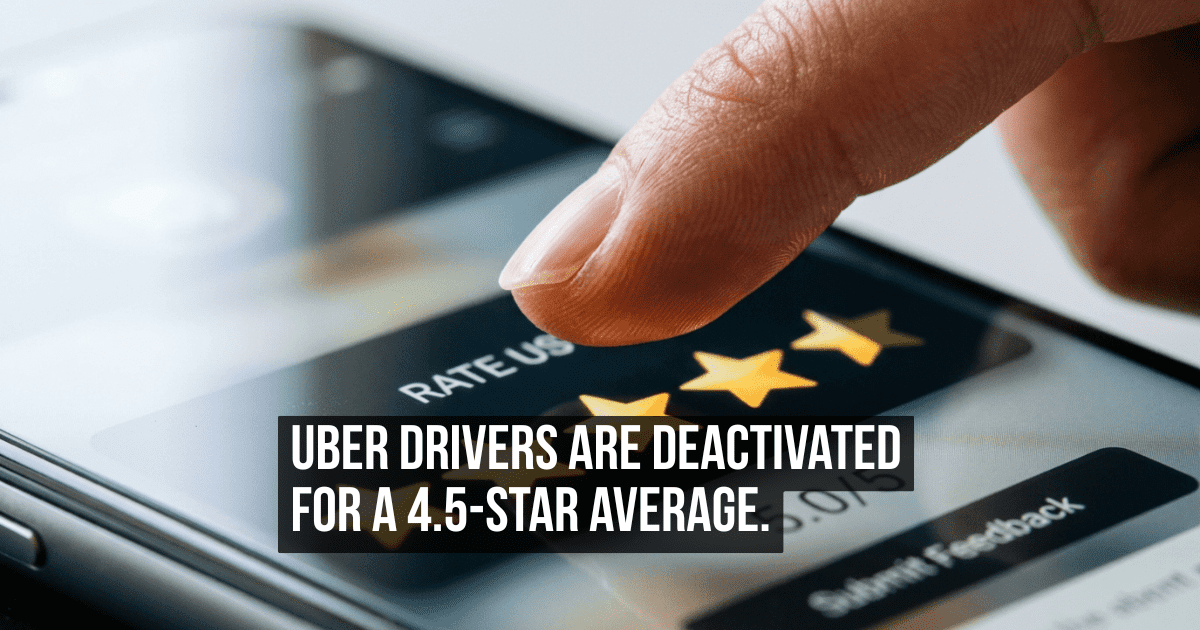
The gig economy platforms made the distortion explicit by tying ratings directly to worker livelihood. An Uber driver with a rating below 4.6 may be deactivated from the platform. The threshold sounds generous; the practical effect is that anything below 5 stars constitutes a mild penalty and anything below 4.7 constitutes an existential threat. Passengers who understand this — and many do — give 5 stars as a default, reserving lower ratings for egregious failures. The rating no longer measures quality on a five-point scale. It measures compliance with platform requirements on a binary scale of 5 and not-5, with the lower grades reserved for genuine misconduct.
The system that was supposed to create accountability for service quality instead created a social obligation to give 5 stars to every adequate interaction, because the alternative is harming someone whose income depends on a mathematical average they cannot control.
The Review That Replaced the Rating
Because the star number has become largely meaningless, the actual information content has migrated into the text review — the written account, the specific detail, the observation that cannot be captured in a numeric summary. The person who reads a hundred-word review of a hotel room gets considerably more useful information than the person who reads its 4.3 average, because the review encodes specificity that the number cannot: the noise level, the quality of the breakfast, the actual size of the bathroom, the responsiveness of reception.
The text review is, in turn, subject to its own distortions: fake reviews, review bombing, the self-selection of reviewers. But its informational value over the numeric average is so large that most experienced platform users have learned to ignore the star rating and read the text, particularly the negative reviews, which are where the honest information tends to concentrate.
What Was Lost
The pre-digital version of consumer opinion — word of mouth, specialist publications, trusted critical sources — was unevenly distributed and often inaccessible. The promise of aggregated ratings was that scaling up opinions would produce wisdom. What scaling up actually produced was a social compliance mechanism that looks like a quality signal and functions as one, but reflects the psychology of giving scores rather than the experience of receiving services. The number is not lying, exactly. But it is measuring something other than what it appears to measure, with enough confidence to have replaced the more imperfect but more honest communication system it displaced.
Something went wrong. Please refresh the page and/or try again.
Help us improve your journey
We use cookies to personalize your experience and understand how you use our site. By clicking 'Yes, I'm in!', you help us show you content you'll actually love. If you prefer to keep things simple, you can stick to the essentials. You can change your mind anytime!
Necessary
Always active
The technical storage or access is strictly necessary for the legitimate purpose of enabling the use of a specific service explicitly requested by the subscriber or user, or for the sole purpose of carrying out the transmission of a communication over an electronic communications network.
Preferences
The technical storage or access is necessary for the legitimate purpose of storing preferences that are not requested by the subscriber or user.
Analytics
The technical storage or access that is used exclusively for statistical purposes.The technical storage or access that is used exclusively for anonymous statistical purposes. Without a subpoena, voluntary compliance on the part of your Internet Service Provider, or additional records from a third party, information stored or retrieved for this purpose alone cannot usually be used to identify you.
Advertising
The technical storage or access is required to create user profiles to send advertising, or to track the user on a website or across several websites for similar marketing purposes.




Leave a Reply