The Reason You Keep Clothes That Have Not Fit in Three Years
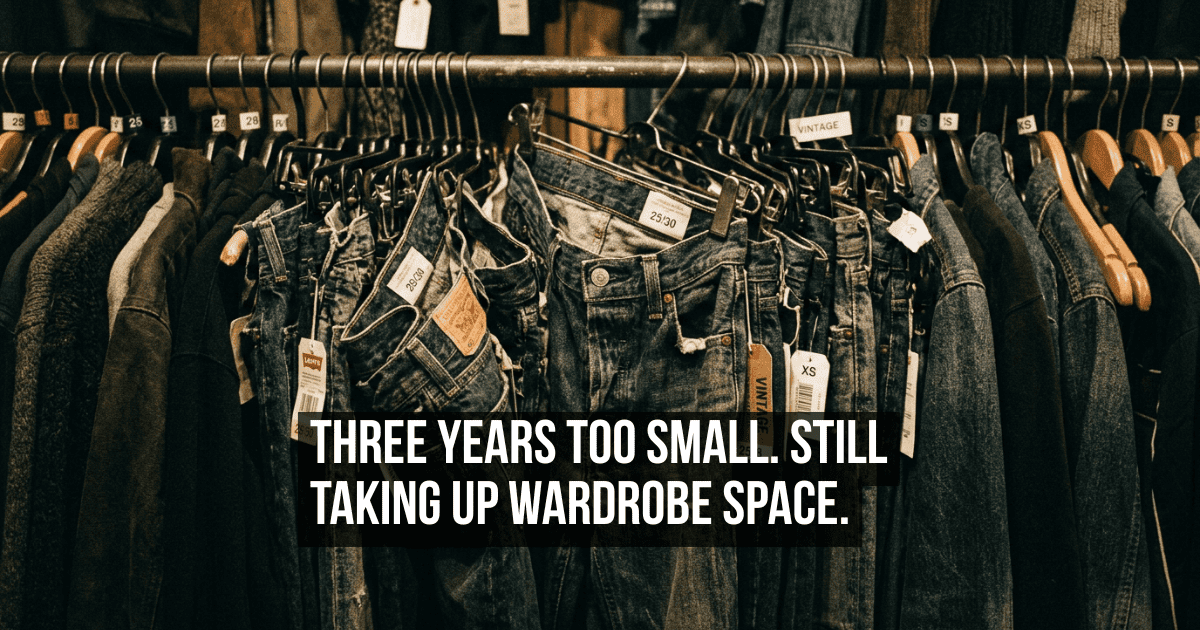
The jeans are on the third shelf. They haven’t fit in the way you’d want them to for going on three years now — not dramatically, not embarrassingly, just enough that you don’t wear them. You have thought about this on multiple occasions while looking for other things. You have never moved them to the donation bag.
This is not about the jeans.
The Weight of a Former Self
Most wardrobes contain a section of aspirational clothing — items kept not because they’re worn but because discarding them would require a specific kind of admission. To give away the jeans that used to fit is to acknowledge, formally, that the body you have is the body you currently inhabit — not a temporary condition, not a body mid-project, but the actual current state of affairs.
Keeping them is not denial exactly. It’s more like holding an option open. As long as the jeans are on the shelf, the question remains technically unresolved. The minute they’re gone, something is settled that you haven’t decided to settle yet.
Psychologists who study self-concept and material possessions describe this as “possible self maintenance” — the tendency to use objects as markers of selves we might become, or selves we used to be, both of which feel meaningfully continuous with who we are now. The jeans belong to a possible self — one that remains available for return, in theory, as long as the evidence of its existence is still in the room.
What the Keeping Costs
The clothes that don’t fit occupy physical space, but the more significant cost is psychological. Research on cluttered environments and self-perception — including a widely cited study from UCLA’s Center on Everyday Lives of Families — found that visual evidence of aspirational incompletion in the home environment correlates with elevated cortisol levels, particularly in women. Seeing what you haven’t achieved, daily, in a private space, has a measurable effect on baseline stress.
The aspiration represented by the jeans isn’t motivating. For most people it’s a mild, consistent drain — a small reminder, encountered at 7 a.m. while looking for something else, that you haven’t done the thing you intended.
The Try-On That Happens Occasionally
Most people who keep clothes that don’t fit try them on periodically. Not to wear them — the occasion never seems quite right — but to check. To take the measurement. To see if the gap has closed or widened since last time.
The jeans going on easily feels like a small triumph. The jeans not going on feels like confirmation of something you’d prefer not to confirm. The try-on isn’t about the clothes. It’s a checkpoint — a way of assessing where you are relative to a version of yourself that you placed a value on at some point and haven’t formally let go of.
The frequency tends to correlate with how the rest of life is going. More often during periods of stock-taking. Rarely when things feel settled. The jeans sit in the wardrobe as an unofficial measuring device, available whenever the question re-presents itself.
The Decision You’re Not Making
Keeping ill-fitting clothes isn’t a failure of discipline or a lack of self-awareness. It’s a deferred decision about identity — specifically about which self you’re willing to commit to, and which one you’re still leaving room for.
The choice to give them away is not a choice about the jeans. It’s a choice to fully inhabit the body and the life you currently have, rather than the ones you projected you’d be living by now.
That’s a harder choice than it sounds. The jeans can wait.
Something went wrong. Please refresh the page and/or try again.
Help us improve your journey
We use cookies to personalize your experience and understand how you use our site. By clicking 'Yes, I'm in!', you help us show you content you'll actually love. If you prefer to keep things simple, you can stick to the essentials. You can change your mind anytime!
Necessary
Always active
The technical storage or access is strictly necessary for the legitimate purpose of enabling the use of a specific service explicitly requested by the subscriber or user, or for the sole purpose of carrying out the transmission of a communication over an electronic communications network.
Preferences
The technical storage or access is necessary for the legitimate purpose of storing preferences that are not requested by the subscriber or user.
Analytics
The technical storage or access that is used exclusively for statistical purposes.The technical storage or access that is used exclusively for anonymous statistical purposes. Without a subpoena, voluntary compliance on the part of your Internet Service Provider, or additional records from a third party, information stored or retrieved for this purpose alone cannot usually be used to identify you.
Advertising
The technical storage or access is required to create user profiles to send advertising, or to track the user on a website or across several websites for similar marketing purposes.




Leave a Reply