Why Casual Friday Became the Most Anxiety-Inducing Workday Despite Supposedly Removing All Dress Pressure
Casual Friday arrived in American offices in the early 1990s, imported loosely from Hawaiian Aloha Friday traditions and promoted, with considerable commercial interest, by the American clothing industry, which recognized an opportunity to sell a second work wardrobe to people who had previously needed only one. The premise was simple: one day per week, employees would be released from formal dress requirements. The result, in most workplaces, was not the relaxed sartorial liberation the premise implied.
Casual Friday became, within a decade, one of the most reliably anxiety-inducing dress occasions in professional life. The day explicitly designed to remove dress pressure created more of it. The reason illuminates something fundamental about what dress codes actually do.
The Paradox of Undefined Space
Formal dress codes are, in a specific sense, liberating. They eliminate a decision. If the rule is suits on weekdays, the decision is made: a suit. The cognitive load of dressing for work is low, the risk of error is minimal, and the social information conveyed is predictable. Everyone within the dress code looks broadly similar, which is partially the point — formal dress is a great leveler of individual difference, creating visual coherence within a professional hierarchy.
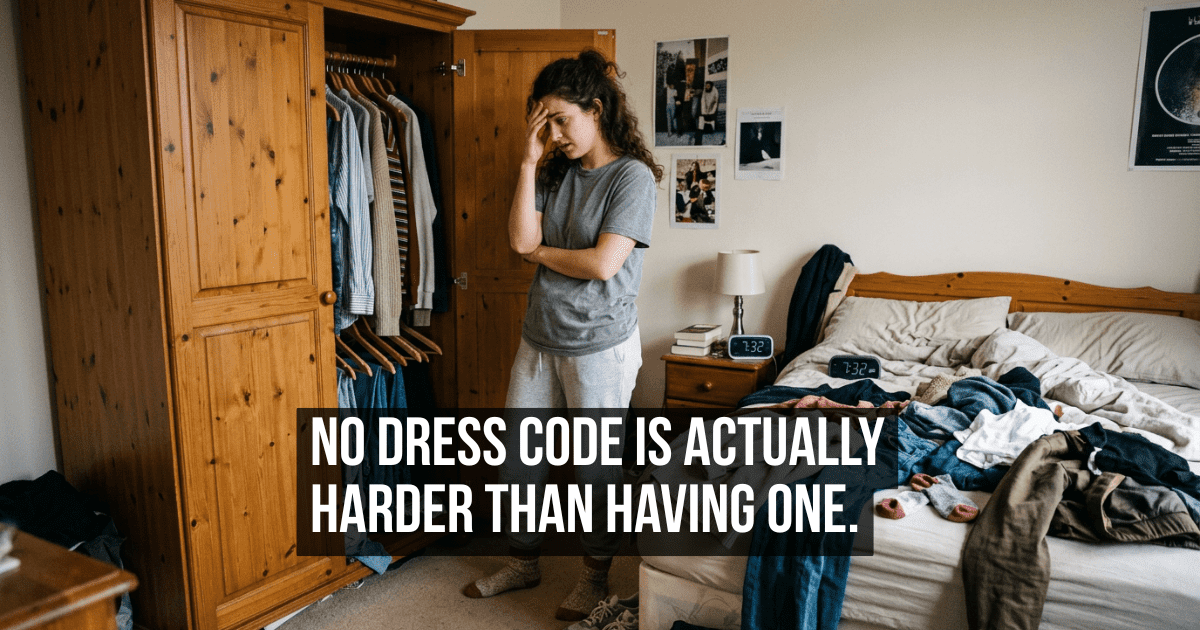
Casual Friday removed the rule without providing a replacement. The instruction was essentially: dress less formally, but not informally. The precise location of the boundary — how much less formally, what specific garments crossed the line in which direction — was left undefined, and the undefined space was where the anxiety lived. Is a polo shirt casual or smart-casual? Are dark jeans acceptable? What about clean trainers? White trainers? Does it depend on the meeting schedule?
The Status Game That Dress Codes Normally Suppress
Formal dress codes suppress one dimension of status signaling — the signaling through clothing brand, fit, and taste — by standardizing the visual environment. Casual dress reactivates it. On Casual Friday, the person wearing a well-fitted Italian linen shirt is visibly distinguishable from the person wearing a faded polo. The quality, the cut, the brand awareness encoded in the choice: all of these are legible to colleagues in ways that are deliberately muted by formal dress.
For people with strong taste in casual clothing, this creates an opportunity. For people who are uncertain about casual professional dress, or who lack the disposable income to maintain a second high-quality wardrobe, it creates exposure. The playing field that formal dress had leveled is un-leveled. The day meant to be relaxed becomes the day where social class and cultural capital are most visibly on display.
The Creep That Followed
Business casual — the attempt to codify a middle register between formal and casual — emerged largely as a response to the ambiguity that Casual Friday created. If casual was undefined, business casual was slightly less undefined: it ruled out ties and suits on one end, and jeans and sneakers on the other, leaving a range of khakis, collared shirts, blazers, and tailored trousers that represented a permanent compromise.
Business casual then spread from Friday to the full working week in many industries, as the cultural moment that produced formal office dress receded. The result is that the ambiguous middle register — the one that produces the most individual anxiety — became the default in most white-collar environments. The specific discomfort that one day per week had generated became a five-day condition.
What Dress Codes Are Actually For
The persistence of dress code anxiety in environments that have officially abandoned formal requirements reveals what dress codes were doing when they existed. They were not primarily about aesthetics. They were a coordination mechanism: a shared signal that said, among other things, that the individual had subordinated their personal expression to the collective project of appearing professional. The uniformity was the message.
Without a shared code, every clothing choice becomes an individual statement in a context where individual statements are being collectively read and assessed. The absence of a rule does not produce freedom from judgment. It produces continuous, ambient, low-stakes judgment with no clear standard to be judged against. Casual Friday didn’t eliminate the dress game. It made the rules opaque and kept the stakes exactly the same.
Something went wrong. Please refresh the page and/or try again.
Help us improve your journey
We use cookies to personalize your experience and understand how you use our site. By clicking 'Yes, I'm in!', you help us show you content you'll actually love. If you prefer to keep things simple, you can stick to the essentials. You can change your mind anytime!
Necessary
Always active
The technical storage or access is strictly necessary for the legitimate purpose of enabling the use of a specific service explicitly requested by the subscriber or user, or for the sole purpose of carrying out the transmission of a communication over an electronic communications network.
Preferences
The technical storage or access is necessary for the legitimate purpose of storing preferences that are not requested by the subscriber or user.
Analytics
The technical storage or access that is used exclusively for statistical purposes.The technical storage or access that is used exclusively for anonymous statistical purposes. Without a subpoena, voluntary compliance on the part of your Internet Service Provider, or additional records from a third party, information stored or retrieved for this purpose alone cannot usually be used to identify you.
Advertising
The technical storage or access is required to create user profiles to send advertising, or to track the user on a website or across several websites for similar marketing purposes.




Leave a Reply