Why Napping Is Not Laziness but the Biological Optimization Your Brain Actually Needs
The culture that treats the midday nap as weakness has been consistently wrong. The culture that eliminated it has been consistently more tired for it. The same cultural logic that pathologized napping also pathologized sleep more broadly — as examined in why your body never forgets stolen sleep.
What Science Has Known for Decades
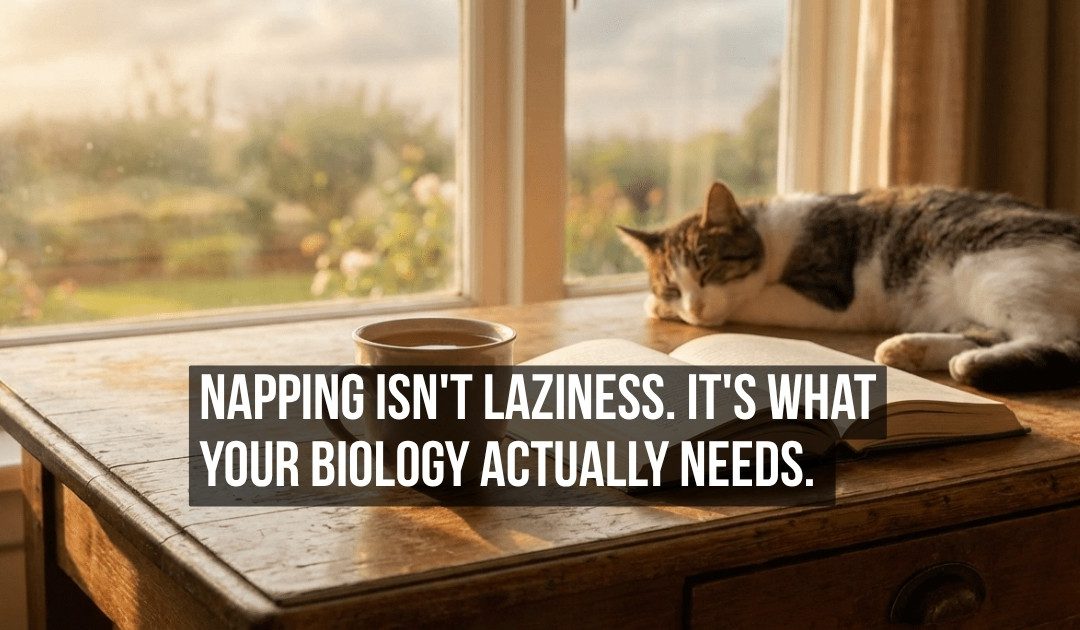
The early afternoon dip in alertness — typically occurring between 1pm and 3pm — is not caused by a heavy lunch, insufficient coffee, or inadequate motivation. It is a genetically programmed feature of human circadian biology. Nearly all humans experience a secondary sleep propensity window in the early afternoon, driven by the same biological mechanisms governing nighttime sleep. Many cultures never pathologized it. Many still do not.
NASA research on sleep and operational performance found that a 26-minute nap improved pilot performance by 34 percent and alertness by 100 percent. The optimal nap duration, established across multiple independent studies, is 10 to 20 minutes — long enough to enter light sleep without reaching slow-wave deep sleep, which causes sleep inertia upon waking. A 90-minute nap, by completing a full sleep cycle, avoids inertia through a different mechanism.
The countries with strong napping cultures — Japan, Spain, China, and several Mediterranean and Latin American nations — are not evidence of productivity deficits. Japan, with its formal institution of inemuri, the practice of napping in public and in the office, consistently ranks among the world’s most productive economies. The evidence does not support the cultural story that napping and productivity are opposed. The ideological roots of that story are the same ones documented in how productivity culture pathologized sleep.
What We Gave Up and Why
The industrial work schedule — eight to ten consecutive hours measured by physical presence and clock-in accountability — was designed around factory work, not around human neurobiology. The knowledge economy still largely operates on this inherited schedule, designed for a different kind of labor. The worker who would benefit most from a 20-minute afternoon reset sits in an open-plan office where lying down is, at best, eccentric.
Companies that have experimented with nap-friendly policies — Ben and Jerry’s, Google, Nike, and Huffington Post have all invested in dedicated rest spaces — report improvements in afternoon productivity, reduced error rates, and higher employee wellbeing. These are not anecdotal outcomes. They reflect the application of biology that does not disappear simply because the schedule ignores it.
The stigma around napping is not evidence-based. It is cultural, inherited from a work ethic that conflates consciousness with productivity and treats rest as a reward earned rather than a biological requirement. The research does not support this conflation. Rest is not a prize for sufficient effort. It is a precondition for sustained function. The economic and cultural mechanisms that commodified hobbies follow the same logic — analyzed in how hobbies died when we made them productive.
The workplace architecture problem is structural and largely unaddressed. An employee who closes an office door for a 20-minute rest break is, in most professional cultures, risking social consequences far more serious than the performance cost of skipping the rest. The stigma is self-reinforcing: because napping at work is rare and socially visible, it marks the individual as eccentric regardless of the cognitive evidence supporting the behaviour. The companies that have invested in dedicated rest infrastructure — sleep pods at Nike headquarters, rest rooms at Google — are not indulging their employees. They are rationally deploying knowledge about human performance that most organisations continue to ignore.
The science of napping has one further implication worth noting: it does not suggest unlimited napping. The 20-minute window is specific because it is the duration that delivers cognitive benefits without triggering the slow-wave sleep that causes grogginess on waking. A 90-minute nap that completes a full sleep cycle also avoids this problem but requires infrastructure most workplaces cannot provide. The precise, evidence-informed intervention is not a blanket endorsement of afternoon sleep. It is a very specific tool with a very specific optimal application.
The person who naps at 2pm for 20 minutes is not surrendering to weakness. They are using a biological tool that costs nothing, requires no technology, and produces measurably better cognitive performance in the hours that follow. The person who refuses, on cultural principle, to do the same is not being more productive. They are simply more tired while doing work of lower quality.
Something went wrong. Please refresh the page and/or try again.
Help us improve your journey
We use cookies to personalize your experience and understand how you use our site. By clicking 'Yes, I'm in!', you help us show you content you'll actually love. If you prefer to keep things simple, you can stick to the essentials. You can change your mind anytime!
Necessary
Always active
The technical storage or access is strictly necessary for the legitimate purpose of enabling the use of a specific service explicitly requested by the subscriber or user, or for the sole purpose of carrying out the transmission of a communication over an electronic communications network.
Preferences
The technical storage or access is necessary for the legitimate purpose of storing preferences that are not requested by the subscriber or user.
Analytics
The technical storage or access that is used exclusively for statistical purposes.The technical storage or access that is used exclusively for anonymous statistical purposes. Without a subpoena, voluntary compliance on the part of your Internet Service Provider, or additional records from a third party, information stored or retrieved for this purpose alone cannot usually be used to identify you.
Advertising
The technical storage or access is required to create user profiles to send advertising, or to track the user on a website or across several websites for similar marketing purposes.




Leave a Reply