Morning Routines Are Making You Worse by Optimizing the Wrong Hours of Your Biological Clock
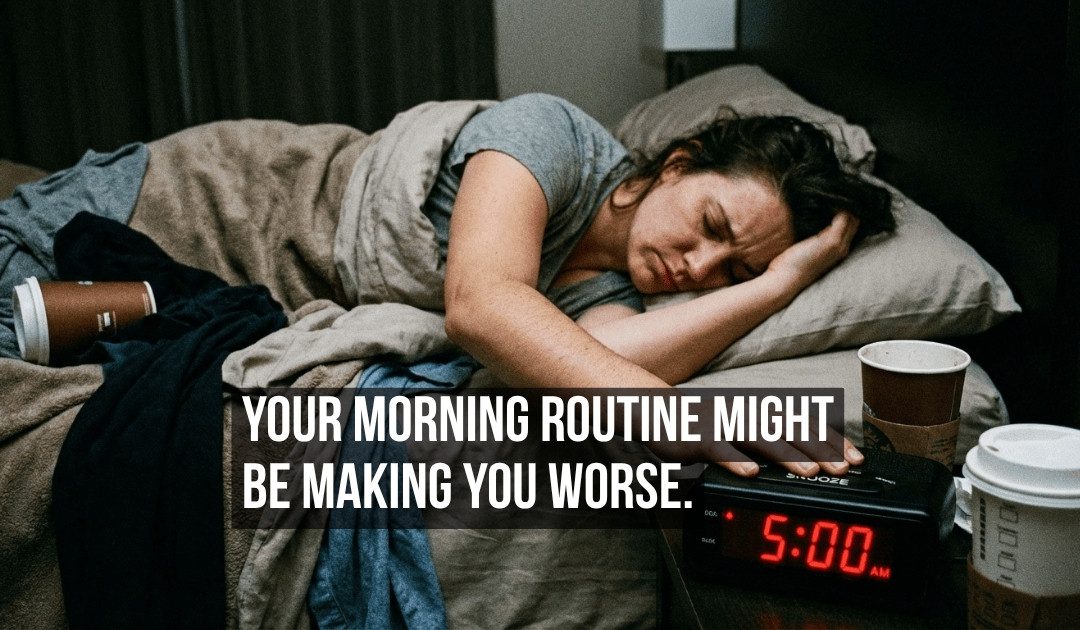
The most reliably unhappy people in every modern office are not the ones who sleep in. They are the ones whose 5am alarm has failed them again. The same industrial logic that turned sleep into a productivity variable — documented in how productivity culture pathologized sleep — produced the morning routine as its consumer-facing expression.
The Biology They Ignore
Morning routine culture — the podcasts, the productivity influencers, the bestselling books organized around pre-dawn habits — has constructed a compelling story: how you start your day determines the quality of everything that follows. Cold showers, journaling, meditation, exercise, and a protein-rich breakfast before 7am will supposedly install discipline, focus, and competitive advantage. The evidence for this specific sequence is thin to non-existent.
The most significant oversight is chronotype — the biological predisposition governing when a given person’s brain reaches peak alertness. Research published in Chronobiology International estimates that roughly 25 percent of the population are genuine evening types, meaning their cognitive peak arrives in late afternoon or early evening. Forcing these individuals into a 5am productivity framework does not align them with peak performance. It systematically misaligns them from it.
Circadian biology is not a mindset. The cortisol awakening response, which drives morning alertness, peaks later in evening chronotypes. Imposing an early schedule on a biological evening person produces not discipline but a sustained performance deficit — the same cognitive impairment profile as mild chronic sleep deprivation, maintained indefinitely by the insistence that the schedule is correct and the body is wrong. The physiological cost of sustained sleep debt is detailed in why your body never forgets stolen sleep.
When the Ritual Becomes the Problem
There is a subtler failure mode: the morning routine that becomes an anxiety object. When the cold shower is skipped, the journal is forgotten, or the alarm goes unheard, the carefully constructed framework collapses into self-reproach. The routine designed to create stability becomes a daily test that cannot always be passed. Psychologists recognize this as contingent self-worth — tying one’s sense of competence to the completion of external behaviors rather than intrinsic values.
A large-scale study of productivity habits conducted by the Behavioural Insights Team found no meaningful correlation between early rising and professional output quality. High performers were distributed across all chronotypes and schedule patterns. What correlated with sustained performance was consistency of schedule, not earliness of it. The 5am riser who wakes at the same time every day outperforms the 5am aspirer who fails three mornings per week.
The genuinely useful kernel inside morning routine culture is intentionality — starting the day with some deliberate structure rather than reaching immediately for a phone and entering reactive mode. A short walk, an uninterrupted coffee, ten minutes of reading: these produce real benefits. The problem is the prescriptive, competitive framing that transforms personal habit into performance sport, where sleeping in is a moral failure rather than a biological accommodation. The evidence that intentional rest is a performance tool and not its opposite is also documented in why napping is not laziness.
The productivity industry has significant financial reasons to encourage prescriptive morning routines. Books, apps, courses, and coaching programs built around specific pre-dawn sequences generate revenue that generic advice about consistency does not. The 5am alarm is a product. Chronobiology is not. The former has an extensive marketing infrastructure; the latter has academic journals. When those two compete for cultural authority, the outcome is rarely determined by evidence.
The genuinely useful question for anyone considering a morning routine overhaul is not whether the routine is ambitious enough. It is whether it is biologically timed correctly for the person practising it. A routine built around a person’s natural peak is a genuine performance tool. A routine built around someone else’s schedule is a daily tax on cognitive capacity that compounds invisibly across months.
Sleep in if your biology says to. Do the journaling at noon. Walk after dinner. The body functions best when its rhythms are respected, not overridden. The real productivity insight is not what time you wake up. It is whether the structure you have built serves your actual biology or someone else’s brand.
Something went wrong. Please refresh the page and/or try again.
Help us improve your journey
We use cookies to personalize your experience and understand how you use our site. By clicking 'Yes, I'm in!', you help us show you content you'll actually love. If you prefer to keep things simple, you can stick to the essentials. You can change your mind anytime!
Necessary
Always active
The technical storage or access is strictly necessary for the legitimate purpose of enabling the use of a specific service explicitly requested by the subscriber or user, or for the sole purpose of carrying out the transmission of a communication over an electronic communications network.
Preferences
The technical storage or access is necessary for the legitimate purpose of storing preferences that are not requested by the subscriber or user.
Analytics
The technical storage or access that is used exclusively for statistical purposes.The technical storage or access that is used exclusively for anonymous statistical purposes. Without a subpoena, voluntary compliance on the part of your Internet Service Provider, or additional records from a third party, information stored or retrieved for this purpose alone cannot usually be used to identify you.
Advertising
The technical storage or access is required to create user profiles to send advertising, or to track the user on a website or across several websites for similar marketing purposes.




Leave a Reply