Overthinking and Inaction Are the Same Loop and Your Brain Cannot Tell Them Apart
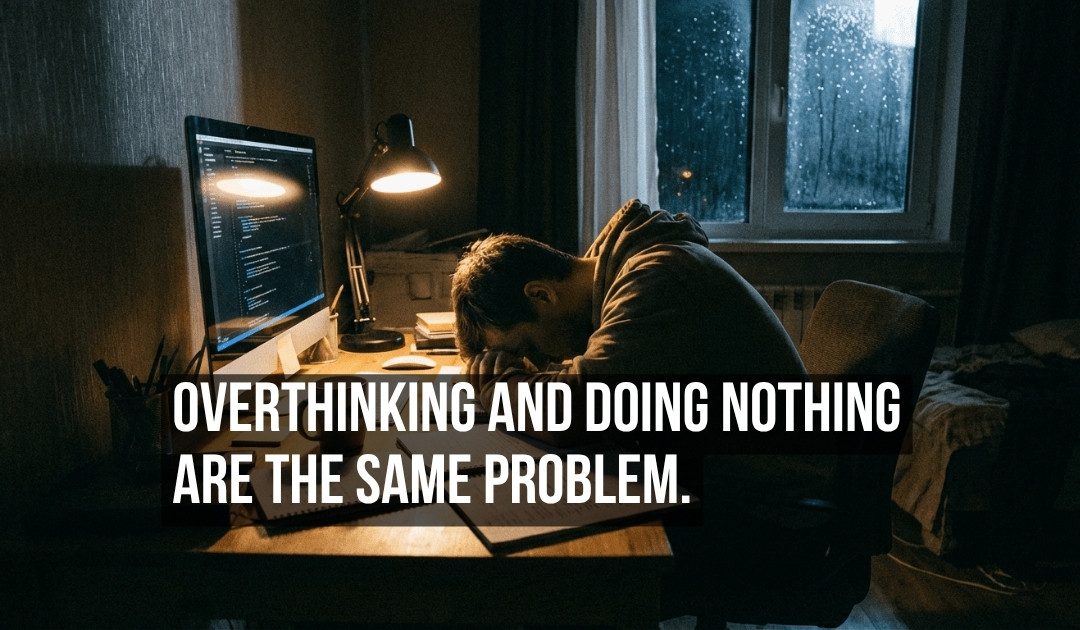
The person who overthinks is generally accused of thinking too much. The actual problem is almost always thinking in circles while successfully avoiding a decision. The connection between this loop and future-oriented paralysis is central to why future anxiety is procrastination — the mechanism is the same threat-avoidance cycle.
What Overthinking Is Doing
Overthinking — formally studied as rumination in cognitive psychology — is not deep analysis. It is repeated non-progressive analysis. The same considerations cycle without generating new information or resolving toward a conclusion. What distinguishes overthinking from genuine deliberation is not the quantity of thought but its structure: deliberation moves through a problem, accumulates information, and terminates in a decision. Rumination circles a problem without approaching it.
The neurological substrate is revealing. Functional imaging research shows that rumination is associated with elevated activity in the default mode network — the brain system processing self-referential thought, autobiographical memory, and social evaluation. Overthinking is the brain conducting threat-assessment about itself and its social standing rather than engaging the deliberative system needed to actually decide anything.
Researcher Susan Nolen-Hoeksema at Yale, who spent her career studying rumination, found it to be a significant predictor of depression, anxiety, and reduced problem-solving effectiveness. The people who describe themselves as overthinkers are rarely people who think too carefully. They are people whose cognitive processing has been captured by the emotional threat-assessment system and cannot access the deliberative functions needed to move forward. This overlap with productivity and procrastination being neurologically identical is not coincidental — both are states where high mental activity produces no output.
The Inaction Connection
Inaction is typically characterized as the absence of thinking — the passive failure to engage. In practice, chronic inaction and chronic overthinking are almost always the same phenomenon observed from different angles. The person who cannot decide is usually the person who cannot stop thinking about the decision. The mental activity is continuous. The forward movement is zero.
Behavioral activation research, developed initially in the context of depression treatment, found that disrupting rumination through directed action — any action, not necessarily the optimal one — consistently reduced overthinking more effectively than further analysis. The brain’s rumination circuit is interrupted not by better thinking but by behavior. The imperfect decision made produces better outcomes than the perfect decision indefinitely deferred.
There is a particular class of overthinking that disguises itself as responsible diligence: the research spiral. More information is gathered, more perspectives are sought, more scenarios are modeled — not because they are necessary for an adequate decision, but because information-gathering feels like progress while preserving the option to defer the actual decision indefinitely. It has all the cognitive texture of productivity with none of its output. The anxiety that drives this deferral is structurally the same as what is described in the obsession with order as control anxiety — the need to eliminate uncertainty before acting.
The paradox of trying to stop overthinking is worth examining. Deliberate attempts to suppress a thought — the classic experiment being told not to think of a white bear — reliably produce the opposite result. Instructing an active rumination circuit to cease activates the monitoring function that checks whether the instruction is being followed, which requires representing the very thought it was supposed to avoid. The person who resolves to stop overthinking a decision frequently finds it more present than before. The circuit is not interrupted by intention. It is interrupted by engagement with something else entirely — a physical task, a conversation, a sufficiently absorbing alternative.
Overthinking is not the failure of a good mind to reach a good conclusion. It is the capture of a capable mind by its own threat-detection circuitry. The thought that keeps returning is not asking for more analysis. It is asking, in the only language available to it, for a decision — any decision — that will finally allow the loop to close.
Something went wrong. Please refresh the page and/or try again.
Help us improve your journey
We use cookies to personalize your experience and understand how you use our site. By clicking 'Yes, I'm in!', you help us show you content you'll actually love. If you prefer to keep things simple, you can stick to the essentials. You can change your mind anytime!
Necessary
Always active
The technical storage or access is strictly necessary for the legitimate purpose of enabling the use of a specific service explicitly requested by the subscriber or user, or for the sole purpose of carrying out the transmission of a communication over an electronic communications network.
Preferences
The technical storage or access is necessary for the legitimate purpose of storing preferences that are not requested by the subscriber or user.
Analytics
The technical storage or access that is used exclusively for statistical purposes.The technical storage or access that is used exclusively for anonymous statistical purposes. Without a subpoena, voluntary compliance on the part of your Internet Service Provider, or additional records from a third party, information stored or retrieved for this purpose alone cannot usually be used to identify you.
Advertising
The technical storage or access is required to create user profiles to send advertising, or to track the user on a website or across several websites for similar marketing purposes.




Leave a Reply