Why Karaoke Remains the Most Honest and Revealing Social Ritual in Any Culture That Has Adopted It
Karaoke has a problem. It requires singing in front of people. Singing in front of people requires being heard — not in the controlled, rehearsed way of a performer who has chosen that exposure and prepared for it, but in the unfiltered, unrehearsed, immediately audible way of someone who has been handed a microphone in a social setting and now has a room’s attention whether they wanted it or not.
And yet more than 100,000 dedicated karaoke venues operate globally. The market generates an estimated $10 billion annually. The practice has spread from Japan across Asia, the Americas, Europe, and the Middle East, absorbed into wildly different cultural contexts and adapted to them without losing its essential character. Whatever karaoke is doing, it is doing it effectively enough that people return to it voluntarily, repeatedly, despite the vulnerability it requires.
The Japanese Invention of Safe Performance
Karaoke was developed in Japan in the early 1970s, most commonly attributed to musician Daisuke Inoue, who created the first karaoke machine in 1971 as a backing track service for bars in Kobe. The format migrated to private karaoke boxes — small rooms rented by the hour, insulated from public view — in the 1980s, which became the dominant format in East Asia and changed the social dynamics of the practice significantly. The box format confined performance to a known, trusted group, removing the stranger audience and transforming karaoke from a public exposure to a private one.
The Western karaoke format — typically performed in bars, in front of strangers — preserved the public dimension that the Japanese box eliminated. Two different social architectures, two different relationships to vulnerability, operating under the same name.
What Karaoke Reveals That Nothing Else Does
The person at a karaoke microphone is performing in a context where the normal defences of social presentation are unavailable. You cannot claim skill you don’t have — the singing voice does not lie, and pitch is objectively verifiable. You cannot perform effort without performing exposure — the commitment to the song is legible from outside. And unlike most social performances, the audience knows you are being evaluated because the evaluation is the point.
What karaoke reveals, consequently, is something about how a person relates to exposure: their appetite for self-mockery, their relationship to failure in public, their capacity to commit to something despite knowing they might be bad at it, and the gap between their private understanding of themselves and the self they present in social contexts. The person who attacks a song with evident joy despite an imperfect voice is communicating something genuine about their character. So is the person who refuses to participate, the person who only sings within their precise range, and the person who performs the ironic detachment of choosing a deliberately bad song to protect against sincere failure.
The Ritual Function
Anthropologists who have examined karaoke as a cultural phenomenon note its structural similarities to ritual: a bounded, temporally defined event with specific roles (singer, audience), symbolic objects (microphone, screen, songbook), and a social function of communal participation that transcends the quality of the individual performance. The karaoke singer is not primarily trying to impress; they are primarily participating in a shared form that the group has collectively elected to take seriously for the duration of the evening.
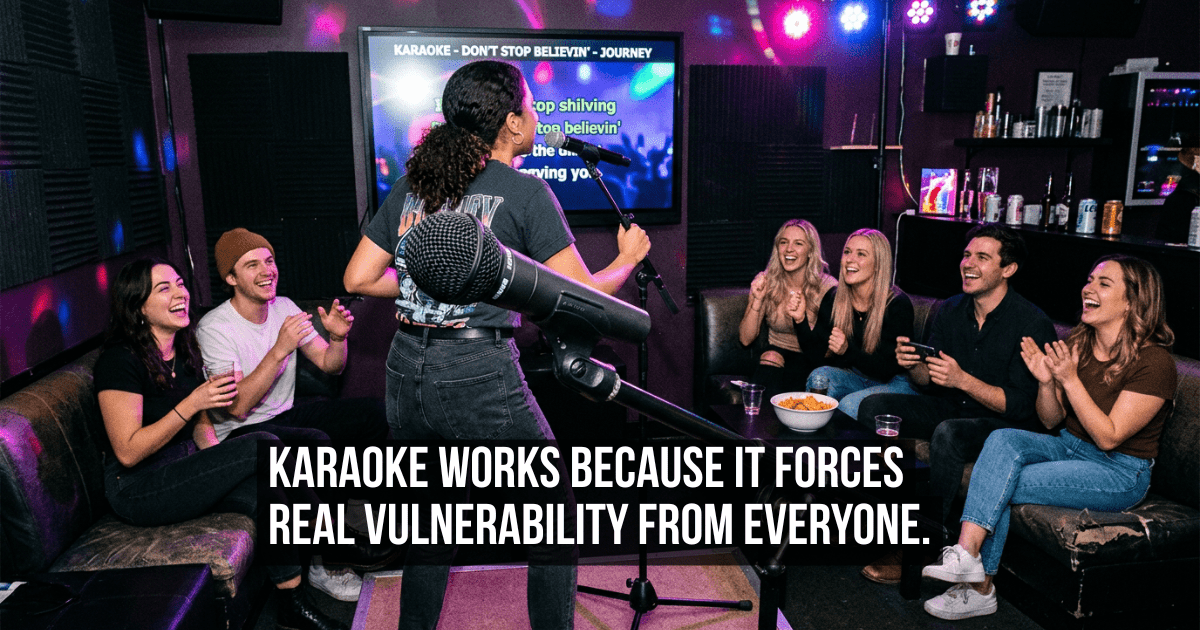
The worst karaoke performances are often the most celebrated, because the gap between the song’s ambition and the singer’s capacity creates a shared experience of generous witnessing: the room is on your side because the room knows it will be in your position, or was in your position, or both. The karaoke bar is one of the few contexts in contemporary urban social life where failure is structurally expected and structurally forgiven.
The Honesty of the Microphone
What separates karaoke from most other social rituals is the impossibility of faking it. You can fake enthusiasm at a dinner party, fake competence in a meeting, fake happiness in a photograph. You cannot fake a singing voice in real time in front of witnesses. The microphone is, in this specific sense, the most honest instrument most people will hold in a social setting. What comes through it is what is actually there.
Cultures where karaoke is deeply embedded — Japan, South Korea, the Philippines — have developed specific social norms for receiving it: enthusiasm for the attempt, generosity toward the result, applause calibrated to effort rather than quality. The social technology that makes karaoke work is not the machine. It is the collective agreement to evaluate it on different terms than the ones that govern most public performance. That agreement is, in its own way, considerably more sophisticated than anything the song required.



Leave a Reply