You Let the Shower Run Empty Before Getting In and Tell Yourself It Is About the Temperature
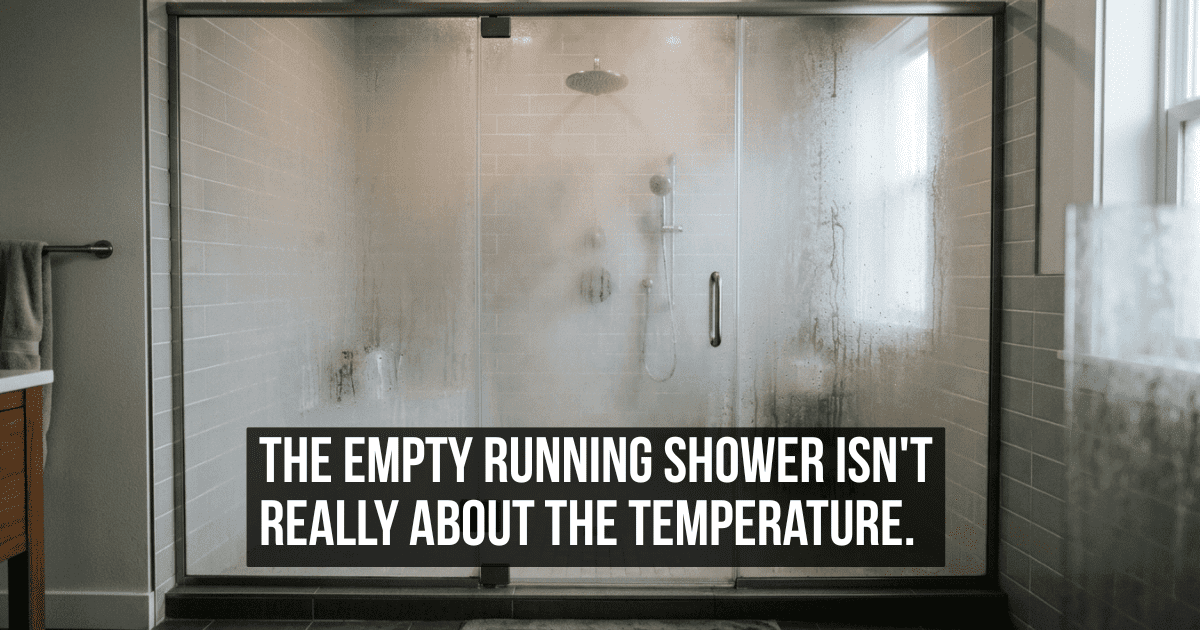
The tap goes on. You step back. The water runs into the empty shower tray — nobody in it, nothing being washed — for ninety seconds, two minutes, sometimes longer. Then you get in. You’ve been doing this for as long as you can remember, and the explanation you give yourself, if you give one at all, is that you’re waiting for it to reach the right temperature.
The temperature arrives in about twenty seconds. You wait considerably longer than that.
The Gap Between the Reason and the Behavior
The warm-up wait is one of those behaviors that has an official explanation and an actual one, and the gap between them is worth examining. For a combi boiler in a well-maintained home, hot water reaches most shower heads within half a minute. The additional ninety seconds of empty running isn’t achieving anything thermally. It’s achieving something else.
What it’s achieving is transition. The shower, once running, creates a contained sensory environment: a specific sound, a specific warmth radiating from the water, a specific quality of steam beginning to form. The act of starting it before entering is, functionally, the act of preparing the space — the way you might turn on a lamp before sitting in a room, or set the table before eating. The ritual creates the context before you enter it.
Environmental psychologists who study how people inhabit domestic spaces note that thresholds — the moments of entering a space or beginning an activity — are frequently managed with preparatory rituals that have no practical function but significant psychological ones. The empty shower running is a threshold ritual. You’re not waiting for the water. You’re waiting for yourself to be ready to begin.
What the Water Is Actually Doing
There’s a secondary function worth naming. The sound of running water — consistent, rhythmic, masking — acts as an audio buffer. It covers the sounds of the house, the day, whatever was happening before. By the time you step in, the sonic environment has already shifted. The shower has begun for you before you’ve touched the water.
Research on pre-task environments and cognitive readiness finds that creating a distinct sensory context before beginning a routine — even a mundane one — speeds entry into the associated behavioral state. Athletes who use pre-performance rituals show faster access to optimal arousal states than those who don’t. Your shower warm-up is, in a minor key, the same mechanism.
The Cost Nobody Mentions
The water waste is real. Two minutes of shower-head flow averages between sixteen and twenty litres, depending on pressure. Across a year, the warm-up wait of a single person represents several thousand litres of water heated and drained unused. This is worth knowing, and worth considering.
But the behavior persists because it’s meeting a need that the cold shower, started immediately, doesn’t meet. Not a need for hot water. A need for the morning to begin in a specific way, in a space that’s already ready for you.
Something went wrong. Please refresh the page and/or try again.
Help us improve your journey
We use cookies to personalize your experience and understand how you use our site. By clicking 'Yes, I'm in!', you help us show you content you'll actually love. If you prefer to keep things simple, you can stick to the essentials. You can change your mind anytime!
Necessary
Always active
The technical storage or access is strictly necessary for the legitimate purpose of enabling the use of a specific service explicitly requested by the subscriber or user, or for the sole purpose of carrying out the transmission of a communication over an electronic communications network.
Preferences
The technical storage or access is necessary for the legitimate purpose of storing preferences that are not requested by the subscriber or user.
Analytics
The technical storage or access that is used exclusively for statistical purposes.The technical storage or access that is used exclusively for anonymous statistical purposes. Without a subpoena, voluntary compliance on the part of your Internet Service Provider, or additional records from a third party, information stored or retrieved for this purpose alone cannot usually be used to identify you.
Advertising
The technical storage or access is required to create user profiles to send advertising, or to track the user on a website or across several websites for similar marketing purposes.




Leave a Reply