Your Recycling Bin Is a Corporate Guilt Transfer Designed to Make Waste Your Problem
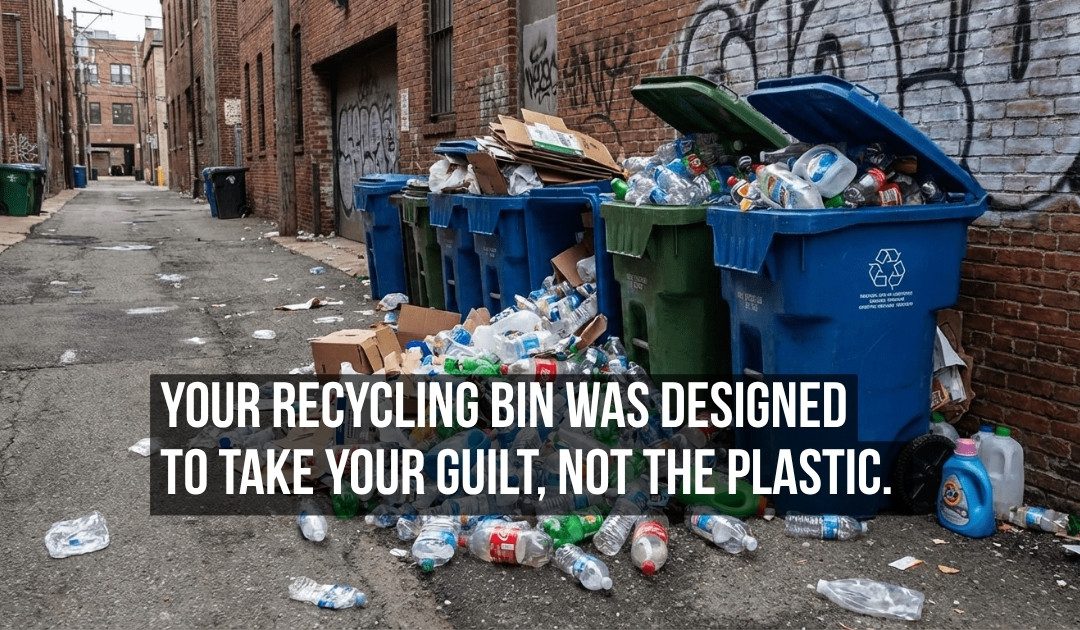
Most of what you carefully separate into the recycling bin is not being recycled. The fiction that it is serves a specific commercial purpose, and the primary beneficiary is not the environment. The same strategic logic that produced this fiction also produced the carbon footprint concept — both are instruments of responsibility transfer documented in how big oil invented the carbon footprint.
The Numbers Behind the Story
A 2017 paper in Science Advances, the first comprehensive global analysis of plastic production and waste, found that of the 9.2 billion tonnes of plastic produced to that point, only 9 percent had been recycled. 12 percent had been incinerated. The remaining 79 percent was in landfills or in the natural environment. These figures predate China’s 2018 National Sword policy, which banned the import of most foreign recyclable materials and effectively collapsed the recycling infrastructure of dozens of countries that had been quietly shipping sorted waste to Chinese processing facilities.
After China’s ban, recycling processors across the United States, United Kingdom, Australia, and much of Europe found themselves with sorted material they had no facility to process and no market to sell into. The pragmatic solution, widely implemented across many municipalities, was to landfill or incinerate the collected material. Residents continued sorting. The sorted material arrived at facilities. The facilities sent it to landfill in cleaner batches.
What distinguishes recyclable from non-recyclable plastic in most systems is not physical properties but market economics: a material is recyclable when there is an economically viable market for the processed output. When the market disappears, recyclability disappears with it. The chasing arrows symbol on packaging does not indicate actual recycling infrastructure. It indicates a theoretical possibility under ideal market conditions that may or may not exist. This is the same dynamic explored in how recycling became a corporate lie — the symbol functions as reassurance rather than evidence.
Who Built This System and Why
The modern consumer recycling framework was substantially shaped by a strategic PR campaign. In the 1970s, plastic industry lobbying groups heavily funded public recycling awareness initiatives as a response to growing momentum for product bans and corporate liability for waste. Research by NPR and Frontline drawing on internal industry documents found that plastics executives privately acknowledged that recycling was economically unviable for most plastics while publicly promoting it as the primary solution to the waste crisis.
The strategic logic was direct: recycling transferred moral responsibility for plastic waste from producers to consumers. If individuals sorted correctly and recycled responsibly, the crisis became their problem to solve. The infrastructure question — whether viable recycling systems actually existed — was secondary to the narrative function of distributing blame.
For materials with genuine, stable recycling markets — aluminum, glass, certain paper grades — consumer recycling is effective and consequential. The aluminum recycling rate in the United States is approximately 50 percent, saving significant energy compared to primary production. The problem is the generalization of recycling as a universal solution when it is, in practice, highly material-specific and highly market-dependent.
The most consequential individual actions on plastic waste are structural choices that receive far less cultural attention than sorting: refusing single-use packaging at the point of purchase, supporting businesses with refill systems, and directing political attention toward producer responsibility legislation that places the cost of waste management on manufacturers rather than municipalities and individuals. These actions are less visible, less immediately satisfying, and less profitable for the companies that have successfully redirected environmental discourse toward consumer sorting behaviour. The feeling of doing something by separating recyclables is real. The certainty that it achieves something is considerably less so. The argument for why individual-scale environmental choices fall short while systemic ones matter is extended in why electric cars won’t save the planet.
The moral psychology dimension is worth examining. Research on what psychologists call moral licensing shows that performing a virtuous act — sorting recycling, buying organic, choosing the reusable bag — creates a felt sense of having done something good that can actually reduce the likelihood of further pro-environmental action. The small virtuous act licenses the larger unconsidered one. The recycling bin that reassures the consumer is, in a documented psychological sense, providing cover for the structural consumption it was meant to address.
The recycling bin is a meaningful object for a narrow range of materials and a performance of environmental responsibility for most plastics. Understanding the distinction, and directing attention toward production and policy questions rather than sorting anxiety, is the more consequential investment.
Something went wrong. Please refresh the page and/or try again.
Help us improve your journey
We use cookies to personalize your experience and understand how you use our site. By clicking 'Yes, I'm in!', you help us show you content you'll actually love. If you prefer to keep things simple, you can stick to the essentials. You can change your mind anytime!
Necessary
Always active
The technical storage or access is strictly necessary for the legitimate purpose of enabling the use of a specific service explicitly requested by the subscriber or user, or for the sole purpose of carrying out the transmission of a communication over an electronic communications network.
Preferences
The technical storage or access is necessary for the legitimate purpose of storing preferences that are not requested by the subscriber or user.
Analytics
The technical storage or access that is used exclusively for statistical purposes.The technical storage or access that is used exclusively for anonymous statistical purposes. Without a subpoena, voluntary compliance on the part of your Internet Service Provider, or additional records from a third party, information stored or retrieved for this purpose alone cannot usually be used to identify you.
Advertising
The technical storage or access is required to create user profiles to send advertising, or to track the user on a website or across several websites for similar marketing purposes.




Leave a Reply