Digital Detox Is Just Scheduled Relapse and Proves Your Relationship With Technology Is Already Broken
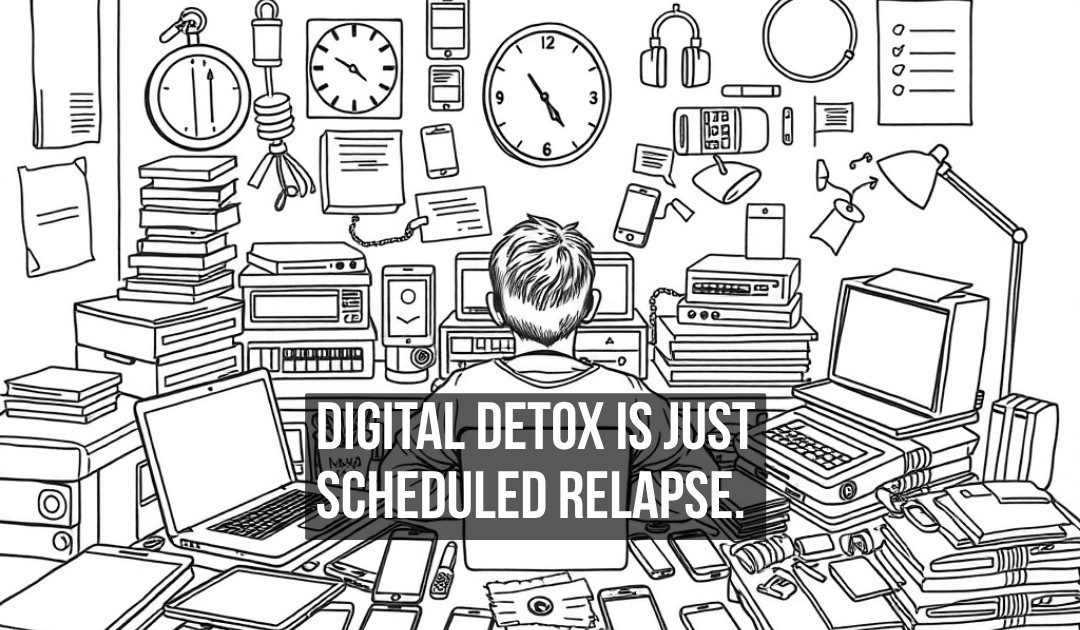
You can’t solve addiction with weekend breaks from the substance you’ll return to Monday.
The digital detox has become aspirational lifestyle practice: periodic breaks from devices, screen-free weekends, phone-free vacations. The ritual provides temporary relief from digital overwhelm, which participants interpret as evidence that detoxing works. What it actually demonstrates is that you’ve built a lifestyle requiring regular breaks to remain tolerable—which suggests the lifestyle itself is the problem.
Detoxing treats symptoms while ignoring causes. You feel better after three days without screens because your normal relationship with screens is unhealthy. The solution isn’t periodic breaks; it’s restructuring the relationship entirely. But restructuring is hard, so we’ve normalized scheduled relapse instead.
The Temporary Relief Trap
Digital detoxes provide genuine short-term benefits. Attention improves. Sleep quality increases. Anxiety decreases. The improvements feel significant, which creates belief that detoxing is working. But the benefits evaporate when normal digital consumption resumes, which it always does.
This creates a cycle: overwhelm, detox, relief, return, overwhelm again. The pattern is suspiciously similar to addiction cycles, where periods of abstinence are followed by relapse to problematic use. Framing this as wellness practice obscures that it’s actually managed addiction.
What’s missing is acknowledgment that needing regular breaks from something suggests that thing is causing harm. If you need to detox from your phone monthly, your phone use is probably destructive. The appropriate response isn’t better scheduling of breaks—it’s examining why your baseline relationship requires periodic intervention.
The Return Problem
The fundamental issue with detoxing is that it’s temporary. You disconnect for a weekend, feel great, then return to the exact same digital environment that created the need for detox. Within days you’re back to problematic patterns, planning the next detox.
This makes detoxing feel productive while avoiding actual change. You’re “doing something” about digital overwhelm, which relieves guilt and creates sense of control. But you’re not changing the underlying behaviors, just cycling through managed breaks from them.
The digital detox industry profits from this cycle. Retreats, courses, coaches—all offering structured disconnection that participants pay for, experience temporarily, then leave. The business model requires that people keep needing detoxes, which means the fundamental relationship with technology never improves.
The Privilege Dimension
Digital detoxing also correlates with economic and social position. Those who can afford to disconnect—people whose jobs allow absence, whose social circles accept unavailability, whose economic security permits ignoring messages for days—are precisely those least dependent on digital connectivity for survival.
For those working precarious jobs, managing irregular schedules, maintaining distant family connections, or building social capital online, disconnection isn’t wellness practice—it’s economic and social risk. Missing messages can mean losing work. Being unavailable can damage relationships. Digital presence is labor, not just consumption.
This creates a dynamic where detoxing becomes class marker. Those who can afford disconnection celebrate it as virtue. Those who can’t afford disconnection are implicitly judged for failing to detox, without acknowledgment that their circumstances make detoxing genuinely costly.
The Structural Avoidance
Digital detoxes also allow avoidance of structural questions about why digital life requires periodic breaks. Instead of asking why workplaces expect constant availability, why social relationships demand continuous digital presence, why information environments are designed to be overwhelming—we ask how individuals can better manage exposure to these conditions.
This individualization serves the systems creating digital overwhelm. Employers don’t need to respect boundaries if employees can just detox on weekends. Platforms don’t need to reduce manipulative design if users can periodically disconnect. The pressure for change shifts to individuals managing symptoms rather than systems causing them.
The personal responsibility framing also prevents collective action. If digital overwhelm is individual problem requiring individual solutions, there’s no reason to demand better platform design, workplace boundaries, or regulatory intervention. Everyone just needs to detox better.
The Integration Alternative
What’s needed isn’t better detoxing but sustainable integration—digital use that doesn’t require periodic breaks to remain healthy. This means fundamentally changing how technology is used, not just temporarily abstaining from it.
Sustainable integration requires structural changes that detoxing avoids. Different notification settings. Reduced platform engagement. Strict work-life boundaries. Platforms designed for health rather than addiction. These changes are harder than weekend detoxes but actually address root problems.
It also requires acknowledging that if your relationship with technology needs regular intervention to remain tolerable, the relationship itself is dysfunctional. The appropriate response isn’t scheduling breaks—it’s rebuilding the relationship from the ground up.
Digital detox culture has normalized addiction cycles by rebranding them as wellness practice. But taking breaks from something harmful isn’t the same as changing your relationship to it. And we won’t fix digital overwhelm by getting better at temporarily escaping it.
Something went wrong. Please refresh the page and/or try again.
Help us improve your journey
We use cookies to personalize your experience and understand how you use our site. By clicking 'Yes, I'm in!', you help us show you content you'll actually love. If you prefer to keep things simple, you can stick to the essentials. You can change your mind anytime!
Necessary
Always active
The technical storage or access is strictly necessary for the legitimate purpose of enabling the use of a specific service explicitly requested by the subscriber or user, or for the sole purpose of carrying out the transmission of a communication over an electronic communications network.
Preferences
The technical storage or access is necessary for the legitimate purpose of storing preferences that are not requested by the subscriber or user.
Analytics
The technical storage or access that is used exclusively for statistical purposes.The technical storage or access that is used exclusively for anonymous statistical purposes. Without a subpoena, voluntary compliance on the part of your Internet Service Provider, or additional records from a third party, information stored or retrieved for this purpose alone cannot usually be used to identify you.
Advertising
The technical storage or access is required to create user profiles to send advertising, or to track the user on a website or across several websites for similar marketing purposes.




Leave a Reply