The Indian restaurant menu you know was designed with you in mind
You are in an Indian restaurant, reading a menu that runs to twelve pages, and you order the same thing you ordered last time. Everybody at the table does the same.
It feels like a window into a national cuisine. It is closer to a mirror. The menu on your table was built over generations by cooks and owners guessing what customers like you would pay for, and it is a cuisine in its own right.
The curry house is not a poor copy of food from India. It is a separate tradition, with its own logic, invented by migrants working out what a new country would eat.
A menu shaped by money
The first Indian restaurant in Britain, the Hindoostane Coffee House, opened in London in 1810, founded by Sake Dean Mahomed, a traveler from Bengal. His customers were largely former colonial officials who missed the flavors of India.
Over the following century and a half, restaurants multiplied, and many were opened by migrants from the Sylhet region of what is now Bangladesh. Running a restaurant was one of the few businesses open to newcomers with limited capital, and it came with a ready market.
Picture the cook. He arrives in a cold port city with a little savings, takes over a failing cafe and has to feed people who have never tasted his food. He cannot afford to lose them, so he adjusts: less heat here, more sauce there, a naan to scoop with, rice for the English plate.
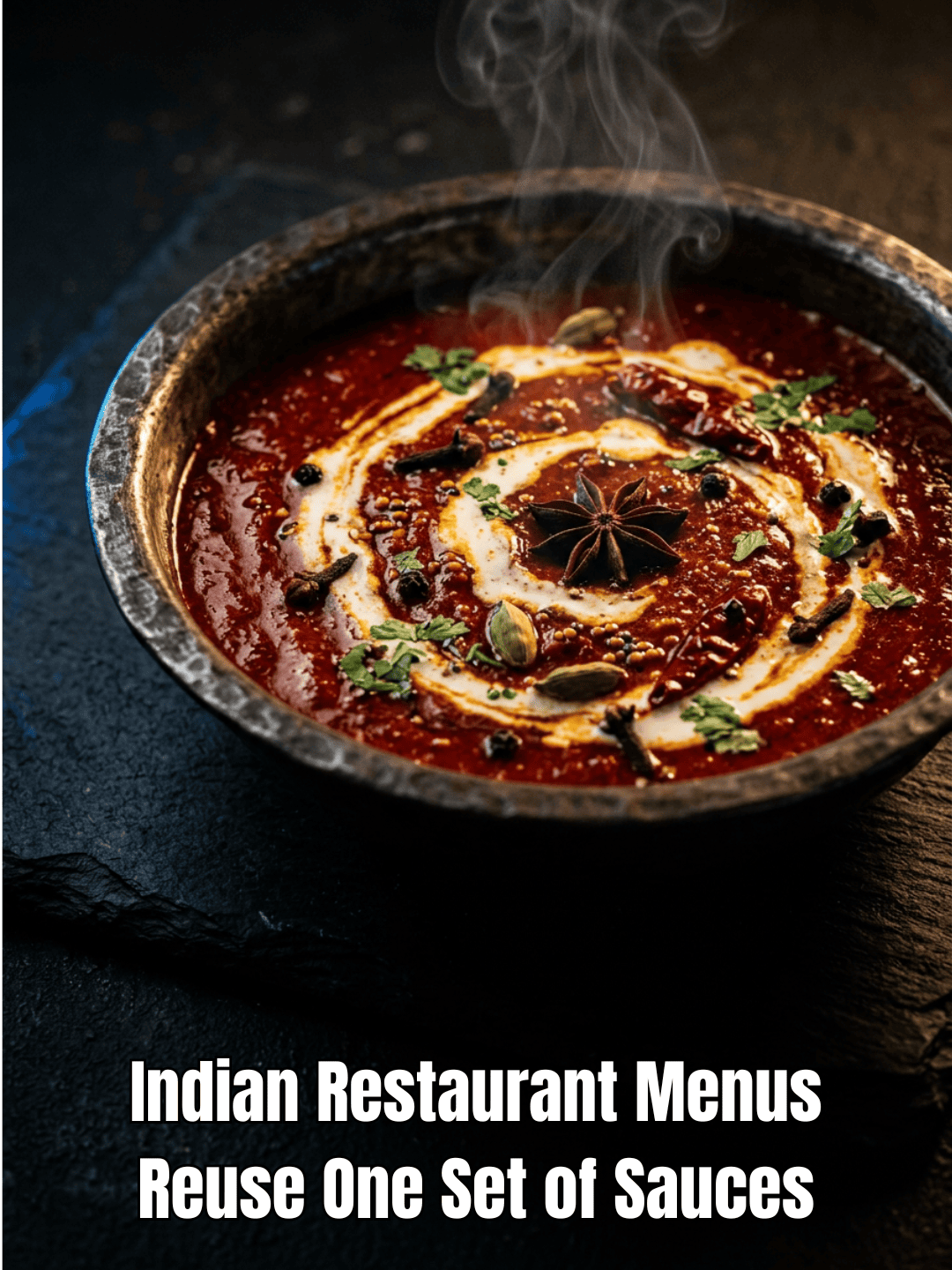
The business model shaped the menu. A twelve-page menu run by a few cooks needs a trick, and the trick is the base gravy: one master sauce of onions, tomato and spices, made in bulk and adapted order by order into dozens of dishes. A korma, a madras and a bhuna can begin in the same pot.
It is efficient, consistent and fast, which is exactly what a busy Friday-night kitchen needs. The variety on the page is partly an illusion of the best kind.
Then there is the pint. The curry house grew up beside the pub, and its busiest hour was closing time. A menu built for people who have been drinking wants strong flavors, big portions and nothing that needs explaining.
A dish with a disputed birth
Chicken tikka masala is the most famous example. Several places claim to have invented it, Glasgow being the loudest, and nobody can prove it. In 2001 the British foreign secretary Robin Cook described it as a true British national dish, on the grounds that it showed how Britain absorbs and adapts outside influences.
A dish that began as a compromise had become a national favorite. This is not unusual. Migrant cooking is routinely rebuilt around local ingredients, local palates and local rent, and the result stops being a copy and becomes something new.
The invention never stopped. Balti, named after the pot it is served in, rose to fame in Birmingham. Menus in other cities carry their own local dishes that would puzzle a cook from Delhi.
Someone at your table asks for “medium spicy”. Nobody has ever agreed what medium means, and everyone nods anyway.
What “Indian” actually covers
India is a country of well over a billion people, and its regional cuisines differ as much as Europe’s do. Kerala cooks with coconut and fish, Punjab with wheat and dairy, Bengal with mustard oil and river fish. A single menu page of “Indian food” folds all of that into one category.
Even the word “curry” is a loose umbrella. It is usually traced to a Tamil word for a sauce or relish, and European traders stretched it to cover almost anything spiced and saucy. A word that began as one thing in one kitchen now labels half a menu.
Everyday meals at home tend to look nothing like the restaurant version: a pot of dal, some vegetables, bread or rice, a pickle. “Curry” as a single category owes more to menus than to kitchens.
The same applies to the people at the next table. Plenty of Indian diners find the menu in front of you unfamiliar, and many families eat at home a style of food that never appears on any restaurant menu at all.
Ask a chef at a curry house what he cooks for himself and the answer is rarely on the menu. That does not make the menu fake. It makes it a conversation between two groups of people who have never fully met.
Try it yourself next time. Ask the waiter what he would order, not what is popular, and watch the pause before he answers. Often the dish he names is the one the kitchen is quietly proudest of.
Many diners now ask for the “real” version. But the real version they are after is itself a recent layer: regional restaurants, from Kerala seafood to Punjabi roadside food, have grown up on top of the older curry house rather than in place of it.
None of this makes the curry house inauthentic. It makes it a different thing, with its own history and its own virtues. The mistake is to judge it as a translation instead of a language.
The dish you call authentic was invented the day somebody asked what you would like to eat.
Something went wrong. Please refresh the page and/or try again.
Help us improve your journey
We use cookies to personalize your experience and understand how you use our site. By clicking 'Yes, I'm in!', you help us show you content you'll actually love. If you prefer to keep things simple, you can stick to the essentials. You can change your mind anytime!
Necessary
Always active
The technical storage or access is strictly necessary for the legitimate purpose of enabling the use of a specific service explicitly requested by the subscriber or user, or for the sole purpose of carrying out the transmission of a communication over an electronic communications network.
Preferences
The technical storage or access is necessary for the legitimate purpose of storing preferences that are not requested by the subscriber or user.
Analytics
The technical storage or access that is used exclusively for statistical purposes.The technical storage or access that is used exclusively for anonymous statistical purposes. Without a subpoena, voluntary compliance on the part of your Internet Service Provider, or additional records from a third party, information stored or retrieved for this purpose alone cannot usually be used to identify you.
Advertising
The technical storage or access is required to create user profiles to send advertising, or to track the user on a website or across several websites for similar marketing purposes.




Leave a Reply