The Strange but Coherent Logic Behind Why Every Teenager in Every City Dresses Identically
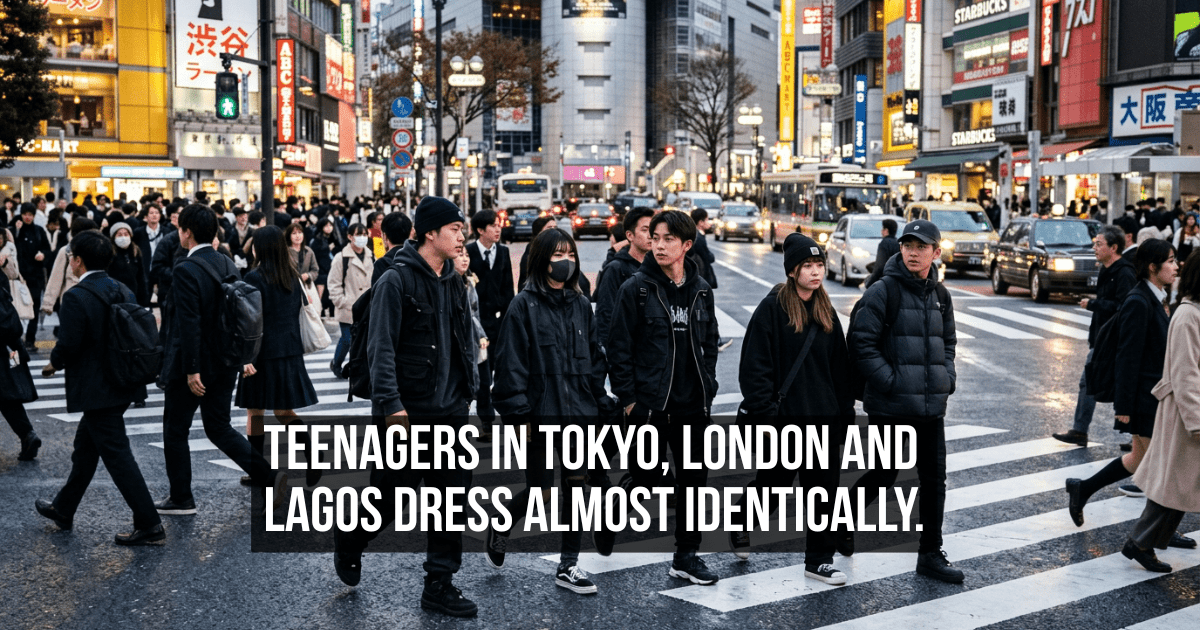
Walk through any major city and observe the teenagers. In Tokyo, in London, in São Paulo, in Lagos: the same wide-leg trousers, the same oversized hoodies, the same chunky sneakers, the same specific palette of muted neutrals interrupted by the occasional deliberate pop of color. The aesthetic details vary slightly by region, but the convergence is striking. Adolescence — the developmental stage supposedly defined by identity formation and differentiation from adults — produces, globally, an almost uniform visual output.
This is not the paradox it appears to be. The homogeneity of teenage fashion is the direct result of how identity formation actually works, not a failure of it.
The Function of Conformity in Adolescence
Developmental psychology is consistent on what adolescence is for: the formation of an identity separate from the family unit, oriented toward a peer group that will eventually replace family as the primary social structure. This process requires belonging. Belonging requires legibility — the ability to signal group membership in terms the group can read and validate.
Clothing is one of the fastest and most legible identity signals available. Wearing what your peers wear communicates group membership before you speak. It reduces the social friction of entry into new peer contexts. It demonstrates that you have access to the cultural information required to dress correctly for your cohort. Teenage fashion conformity is not a failure of individuality; it is the successful execution of a developmental task. The conformity is the strategy.
The Global Flattening
The visual convergence across geographies is a newer phenomenon, driven by the architecture of social media. TikTok, Instagram, and YouTube have created a genuinely global peer group for the first time in adolescent history. A teenager in Seoul and a teenager in Madrid are exposed to the same fashion content, follow the same creators, absorb the same aesthetic signals, and experience pressure to conform to the same visual standards — not because they have the same local peer group, but because they share an online one.
Haul culture — the genre of social media content in which creators unbox and display recent fashion purchases — has also standardized the aesthetic inputs available to teenagers globally. The specific styles that appear in high-engagement haul videos are the styles that spread, because the videos generate the social proof that makes imitation feel safe and desirable.
The Economics of Fast Fashion
The homogeneity is also enforced by supply. The global fast fashion industry operates on a model that produces trend items in enormous volumes at low cost. Shein, Zara, H&M, and their equivalents analyze trend data, produce pieces aligned with the trending aesthetic, and distribute globally at price points accessible to teenagers with limited income. The result is a global inventory of clothing that reflects a narrow set of aesthetic signals, amplified by algorithm, and accessible at scale.
The teenager who wants to deviate from the norm faces both social pressure and supply constraints. The clothes available at accessible price points look largely the same everywhere, because they are largely designed by the same handful of trend-following supply chains responding to the same data.
The Illusion of Individual Choice
Within the conformity, there are micro-differentiations that feel, to participants, like significant individual expression. The specific sneaker model, the exact width of the trouser leg, the brand of the hoodie, the degree of deliberate wear on the denim: these distinctions are legible within the peer group and carry real social meaning in that context. The broader aesthetic template is shared; the variations within it are the personal statement.
Seen from outside the peer group, the distinctions are largely invisible. Seen from within, they are the entire content of individual style. Both observations are accurate, and neither invalidates the other. The teenager dressing “individually” within a shared aesthetic framework is doing the same thing adults do in professional dress codes, wedding guest conventions, and casual Friday norms: expressing individuality within the narrow band that the social context permits and rewards.
The uniform of adolescence is not a failure of imagination. It is imagination deployed in the service of belonging, which is exactly what this stage of life requires.
Something went wrong. Please refresh the page and/or try again.
Help us improve your journey
We use cookies to personalize your experience and understand how you use our site. By clicking 'Yes, I'm in!', you help us show you content you'll actually love. If you prefer to keep things simple, you can stick to the essentials. You can change your mind anytime!
Necessary
Always active
The technical storage or access is strictly necessary for the legitimate purpose of enabling the use of a specific service explicitly requested by the subscriber or user, or for the sole purpose of carrying out the transmission of a communication over an electronic communications network.
Preferences
The technical storage or access is necessary for the legitimate purpose of storing preferences that are not requested by the subscriber or user.
Analytics
The technical storage or access that is used exclusively for statistical purposes.The technical storage or access that is used exclusively for anonymous statistical purposes. Without a subpoena, voluntary compliance on the part of your Internet Service Provider, or additional records from a third party, information stored or retrieved for this purpose alone cannot usually be used to identify you.
Advertising
The technical storage or access is required to create user profiles to send advertising, or to track the user on a website or across several websites for similar marketing purposes.




Leave a Reply