Working Harder to Avoid Being Replaced by AI Is Exactly What Makes You More Replaceable Not Less
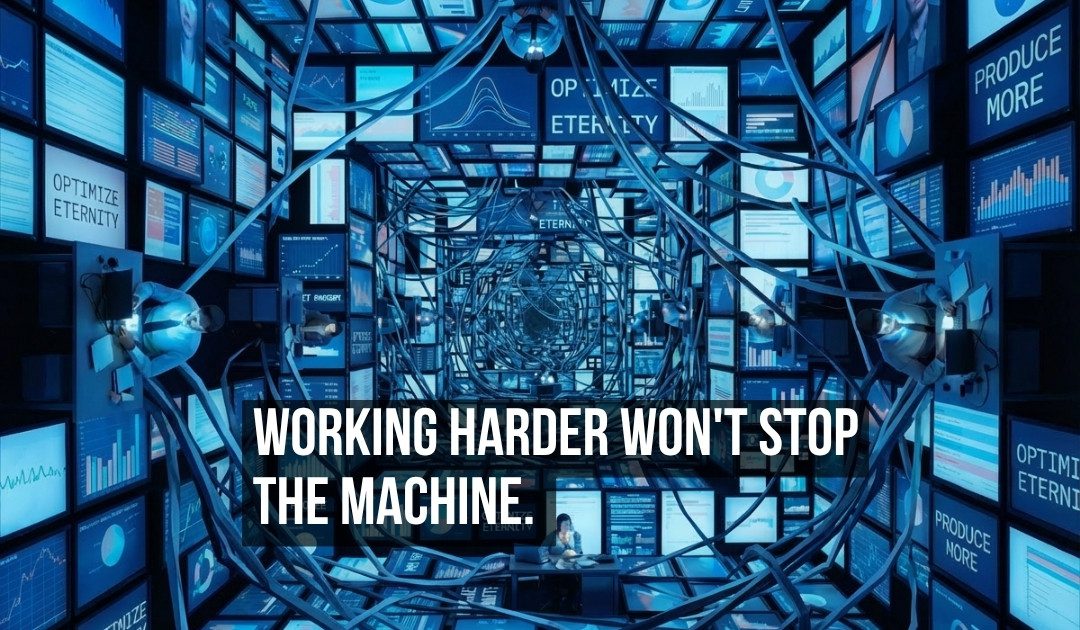
There is something quietly absurd happening in offices, co-working spaces, and home desks across the world. Millions of people terrified of being replaced by artificial intelligence are responding by working longer hours, learning more tools, producing more output, and optimizing their schedules with an almost mechanical precision. The fear of becoming obsolete is turning humans into better machines—which is precisely what makes them easier to replace.
This is the central paradox of the AI anxiety moment: the threat is real, and the reaction to it accelerates exactly what it’s trying to prevent. This mirrors what the creator economy turned creativity into content describes—the market’s demand for volume systematically degrades the human qualities that originally made the work valuable.
Productivity as Self-Defense
When OpenAI released ChatGPT in late 2022, the professional internet immediately divided into two camps: those who saw an opportunity and those who saw an existential threat. By 2025, both camps are doing essentially the same thing. They are racing.
The hustle is now framed as survival. Learn prompt engineering. Master five AI tools before your competitor does. Publish more, respond faster, optimize your workflow until there is no friction left—until you are a frictionless content-producing, task-completing, output-maximizing unit. The irony is structural. The behaviors workers adopt to remain irreplaceable are the behaviors that make human labor most comparable—and most interchangeable—with automated systems.
Goldman Sachs estimated in 2023 that AI could automate tasks currently performed by the equivalent of 300 million full-time workers globally. The response from those workers has not been to slow down and reconsider what work is for. It has been to run harder into the burning building while carrying more. The logical conclusion of this response is examined in AI art exposes how little society values artists—we’ve never actually paid for the human qualities in work, only the output.
The Optimization Trap
There is a specific cognitive loop at work here. Anxiety about job security produces urgency. Urgency produces hyperactivity. Hyperactivity produces burnout. Burnout produces diminished capacity for the kind of creative, relational, and contextual thinking that actually differentiates humans from language models.
Neuroscience has a term for this: cognitive tunneling. Under acute stress, the prefrontal cortex—responsible for long-term planning, abstract reasoning, and creative thought—essentially narrows its function. People under sustained occupational anxiety get better at executing repetitive tasks and worse at the things AI genuinely cannot replicate well: ethical judgment, emotional attunement, conceptual originality, navigating ambiguity.
The result is a workforce that is more productive on paper and less distinctively human in practice. Not because AI has taken over, but because humans have preemptively handed over the most human parts of their work. For the argument that this is not a new pattern, see wrong people are panicking about AI—the professional class has always optimized itself toward what the market wants, with predictable results.
What Gets Lost in the Sprint
Consider what a 12-hour knowledge-work day actually eliminates. Unstructured thinking time. Casual conversations that lead to unexpected ideas. The slow digestion of complex information. Reading something without an immediate application for it. In other words: the inputs from which genuinely novel thinking emerges.
Research from Microsoft’s Work Trend Index in 2023 found that workers were spending 57% of their time on communication and coordination tasks—emails, meetings, messages—and only 43% on actual focused work. Compressing that further in pursuit of productivity doesn’t create more value. It creates more motion.
Meanwhile, the AI systems everyone is racing against are being trained on exactly the kind of deep, original, carefully considered work that unhurried humans produce. The better the machine gets, the more important human depth becomes—and the less time anyone has to cultivate it.
A Loop Nobody Designed
No single actor decided this would happen. Not corporations, not AI labs, not workers themselves. The loop emerged from the collision of genuine technological disruption, economic precarity, and a cultural framework that has long equated busyness with worth.
The question now is not whether AI will change work—it already has. The question is whether the response to that change will be more human or less. Running faster toward the thing that is chasing you is not strategy. Sometimes, the most disruptive move is to stop and think. Which, ironically, is also the thing AI cannot yet do well.
Something went wrong. Please refresh the page and/or try again.
Help us improve your journey
We use cookies to personalize your experience and understand how you use our site. By clicking 'Yes, I'm in!', you help us show you content you'll actually love. If you prefer to keep things simple, you can stick to the essentials. You can change your mind anytime!
Necessary
Always active
The technical storage or access is strictly necessary for the legitimate purpose of enabling the use of a specific service explicitly requested by the subscriber or user, or for the sole purpose of carrying out the transmission of a communication over an electronic communications network.
Preferences
The technical storage or access is necessary for the legitimate purpose of storing preferences that are not requested by the subscriber or user.
Analytics
The technical storage or access that is used exclusively for statistical purposes.The technical storage or access that is used exclusively for anonymous statistical purposes. Without a subpoena, voluntary compliance on the part of your Internet Service Provider, or additional records from a third party, information stored or retrieved for this purpose alone cannot usually be used to identify you.
Advertising
The technical storage or access is required to create user profiles to send advertising, or to track the user on a website or across several websites for similar marketing purposes.




Leave a Reply