How New York City Prices Actually Work and Why the Math Never Adds Up for Anyone
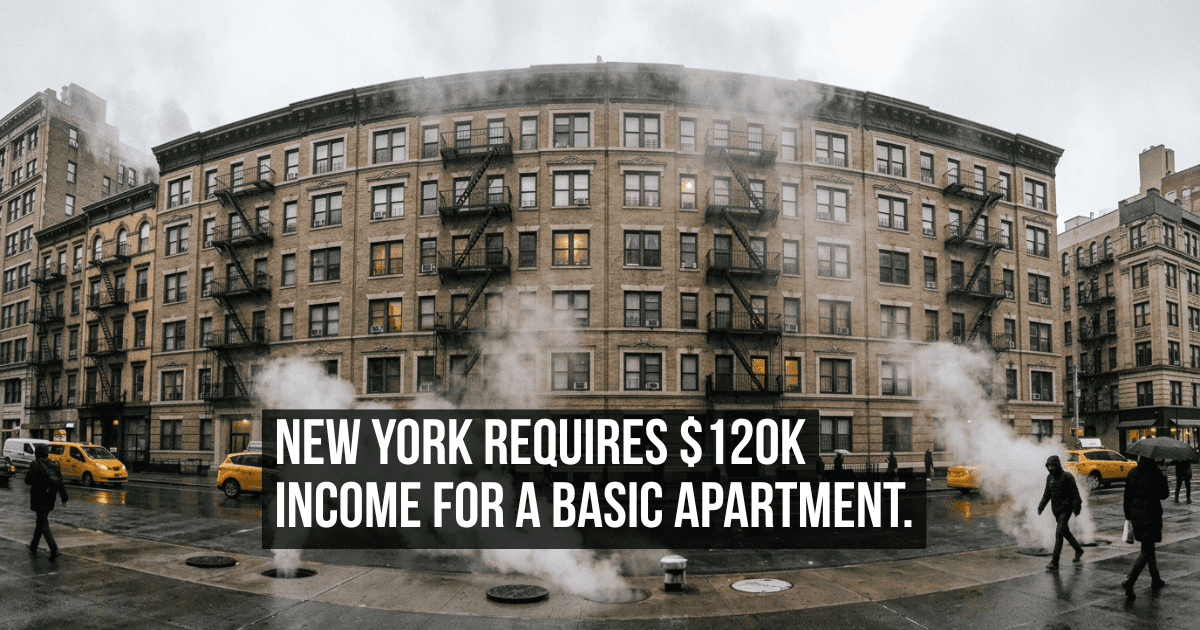
Renting a studio apartment in Manhattan requires, by standard landlord practice, proof of annual income equal to forty times the monthly rent. For an apartment priced at $3,000 a month — below the borough’s median for a studio — that means demonstrating an annual income of $120,000 before the application is considered. A household earning $80,000 per year, which in any other American city would represent a comfortable middle-class income, is immediately disqualified.
The waiting list, in many cases, is still months long.
New York does not behave like a normal price market. Normal markets reach equilibrium: high prices dampen demand until supply and demand align. In New York, prices have risen steadily for decades, demand has not meaningfully fallen, and the number of people who cannot afford to live there continues to grow alongside the number of people who move there anyway. The logic is broken, and it is worth examining why it breaks in that specific direction.
The Visible Cost and the Hidden Layers
The monthly rent figure is only the beginning of the financial architecture. First-time renters in New York typically encounter a broker fee — often equal to one month’s rent, sometimes 15 percent of annual rent — paid not to anyone who helped them find the apartment, but to the landlord’s agent. This fee, which attracted legislative attention and a brief abolition attempt in 2020 before being reinstated, is a transaction cost that exists almost nowhere else in US rental markets.
Beyond that: a security deposit of one or two months, proof of a US bank account with a minimum balance, a US credit history that eliminates most international arrivals, and a guarantor requirement if income cannot be verified in the required format. The formal price of the apartment is only one entry in a much longer financial table.
The Zoning Question Nobody Wants to Answer
The structural driver of New York’s housing cost is supply. Manhattan’s housing stock is constrained by some of the most restrictive zoning rules in any major global city. Large swaths of the city are zoned for low-density development. Height restrictions, landmark preservation requirements, and neighborhood opposition to new construction have together produced a city whose population has grown but whose housing supply has not kept pace since the 1960s.
Economists across the political spectrum have reached the same conclusion: New York’s housing costs are primarily a supply problem, created by policy. Tokyo, which has more permissive zoning and allows dense residential development throughout the city, has kept rents stable for decades despite being one of the most populated urban areas on earth. New York has chosen, through its zoning laws, to have the market it has.
The Parallel City
Inside the same buildings where market-rate apartments sell for $4,000 a month, rent-stabilized units — locked into pricing structures that can stretch back to the 1970s — house tenants paying $800. Two parallel rental economies, governed by entirely different logic, coexist at the same address.
Approximately one million apartments in New York City are rent-stabilized. These units have become, in effect, a form of lottery winnings: once obtained, they are held indefinitely and passed between family members through succession rights. They do not circulate back into the market in any normal sense. The dual structure creates enormous incentives for existing tenants to stay permanently and enormous barriers for new entrants to find affordable housing — a self-reinforcing scarcity mechanism that keeps prices elevated in the market-rate sector.
Why People Come Anyway
The rational response to a market where the math doesn’t work is to leave. Long-term, more New Yorkers are doing exactly that: the city lost population through the early 2020s before partially recovering. But the exodus has not produced an equilibrium adjustment, because people who leave are replaced by people who have decided the price is worth paying — or who have no choice because the jobs they need are there.
New York remains a city where certain industries pay enough to absorb the premium. Finance, law, consulting, media, and the technology sector that has grown substantially in the outer boroughs offer compensation packages calibrated to New York costs. For people in these industries, the math, while uncomfortable, is solvable. For everyone else — the teachers, the nurses, the restaurant workers, the artists — the math requires subsidized housing, multiple roommates, or outer-borough commutes that add hours to each working day.
The city functions because enough people with enough income choose to stay or to arrive, and because a vast subsidy infrastructure holds the rest in place. It does not function because the numbers make sense. They haven’t for a long time.
Something went wrong. Please refresh the page and/or try again.
Help us improve your journey
We use cookies to personalize your experience and understand how you use our site. By clicking 'Yes, I'm in!', you help us show you content you'll actually love. If you prefer to keep things simple, you can stick to the essentials. You can change your mind anytime!
Necessary
Always active
The technical storage or access is strictly necessary for the legitimate purpose of enabling the use of a specific service explicitly requested by the subscriber or user, or for the sole purpose of carrying out the transmission of a communication over an electronic communications network.
Preferences
The technical storage or access is necessary for the legitimate purpose of storing preferences that are not requested by the subscriber or user.
Analytics
The technical storage or access that is used exclusively for statistical purposes.The technical storage or access that is used exclusively for anonymous statistical purposes. Without a subpoena, voluntary compliance on the part of your Internet Service Provider, or additional records from a third party, information stored or retrieved for this purpose alone cannot usually be used to identify you.
Advertising
The technical storage or access is required to create user profiles to send advertising, or to track the user on a website or across several websites for similar marketing purposes.




Leave a Reply