The Longer-Than-Necessary Shower Is the Last Uninterrupted Thinking Space You Have
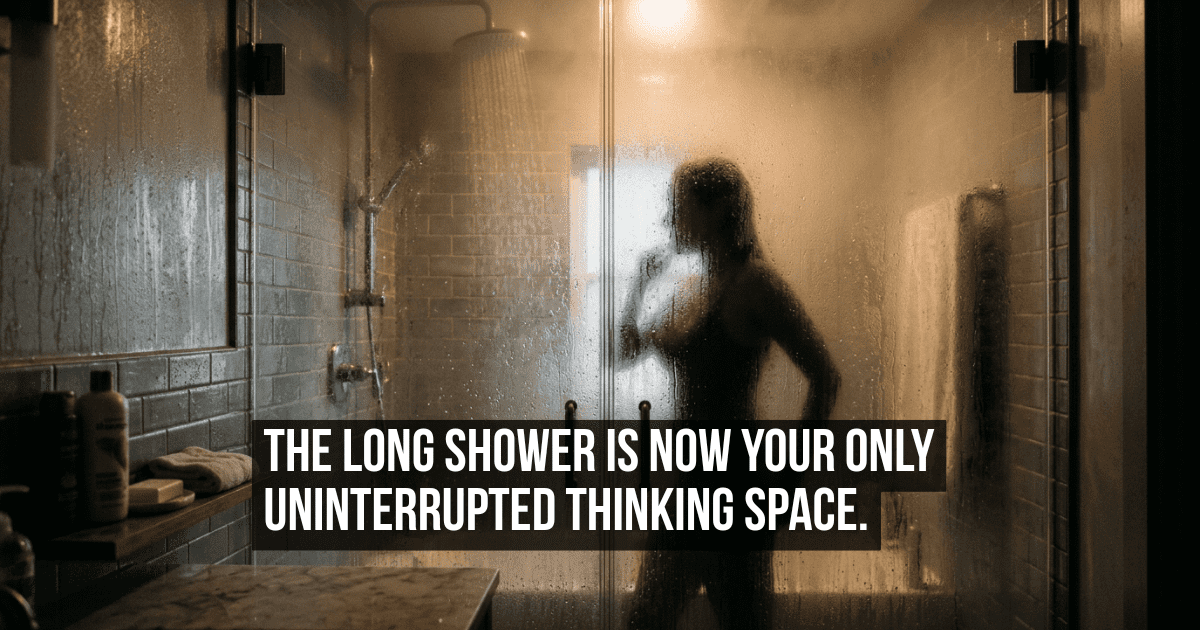
The shower was supposed to take seven minutes. It has been fourteen. The water is still running at the right temperature and you’re not moving toward the tap. You’re thinking — about the conversation from yesterday, about the problem you couldn’t solve at the desk, about a vague plan that might actually work. You stay until the thought is finished, or until the water gets cold, whichever comes first.
This is not inefficiency. It may be the most productive stretch of your day.
The Last Room With No Screen
The shower is one of the few remaining spaces in daily life that resists colonization by the attention economy. Phones don’t belong there. Notifications don’t arrive. The task list exists somewhere else. What remains is a warm, enclosed, low-stimulation environment that the brain has been conditioned to associate with routine — which means it can do something it rarely gets to do: wander freely.
Neuroscientists studying the default mode network — the set of brain regions active when the mind is at rest and not focused on external tasks — have found that this network is associated with some of the most valuable cognitive work the brain performs: consolidating memories, processing emotional experiences, connecting disparate ideas, and generating creative insights. The shower, by removing external demands, creates precisely the conditions the default mode network needs to run.
Why the Ideas Come in the Shower
The “shower thought” is such a reliable phenomenon that it has its own cultural vocabulary, but the mechanism behind it is specific. A 2014 study from the University of California, Santa Barbara found that engaging in an undemanding activity — one that occupied the body without claiming conscious attention — significantly boosted performance on creative problem-solving tasks. The mind, freed from directed effort, made connections it couldn’t make while straining for them.
The shower is warm. The sound is consistent and low. The body is occupied. Cortisol levels drop. Dopamine, which plays a role in facilitating associative thinking, increases slightly in this relaxed state. The insight that emerges isn’t accidental — it’s the result of conditions that modern life otherwise makes almost impossible to produce.
What People Actually Think About
The thoughts that surface in the shower follow a pattern worth examining. They’re rarely the urgent items from the to-do list — those get thought about everywhere. Shower thoughts tend to be the slightly neglected middle tier: things that need a few undistracted minutes but never quite get them at a desk where something more immediately pressing always competes.
The imagined conversation you need to have. The nagging question about whether the plan is actually sound. The creative problem that’s been orbiting for days. These require a particular cognitive temperature: warm enough to engage, unhurried enough to actually follow through. Researchers studying incubation effects in creative thinking consistently find that the rest period needs to be genuinely restful. Scrolling a phone is not rest. The shower, by most available evidence, is.
The Luxury That Isn’t
The long shower has been framed as an environmental indulgence, and the water-use argument is real and worth taking seriously. But the time dimension is worth reconsidering separately. The extra minutes in the shower are not stolen from productivity. For many people they are productivity — the only unstructured, low-stimulation interval in a day that offers no other equivalent.
The thinking that happens there has a quality that desk-thinking rarely matches. The problem you couldn’t solve in forty minutes of deliberate effort resolved itself in three minutes of hot water and nothing else.
You already knew this. You just didn’t have permission to call it work.
Something went wrong. Please refresh the page and/or try again.
Help us improve your journey
We use cookies to personalize your experience and understand how you use our site. By clicking 'Yes, I'm in!', you help us show you content you'll actually love. If you prefer to keep things simple, you can stick to the essentials. You can change your mind anytime!
Necessary
Always active
The technical storage or access is strictly necessary for the legitimate purpose of enabling the use of a specific service explicitly requested by the subscriber or user, or for the sole purpose of carrying out the transmission of a communication over an electronic communications network.
Preferences
The technical storage or access is necessary for the legitimate purpose of storing preferences that are not requested by the subscriber or user.
Analytics
The technical storage or access that is used exclusively for statistical purposes.The technical storage or access that is used exclusively for anonymous statistical purposes. Without a subpoena, voluntary compliance on the part of your Internet Service Provider, or additional records from a third party, information stored or retrieved for this purpose alone cannot usually be used to identify you.
Advertising
The technical storage or access is required to create user profiles to send advertising, or to track the user on a website or across several websites for similar marketing purposes.




Leave a Reply